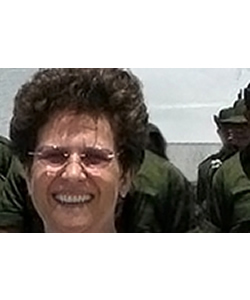
A Discussion with Jill Sternberg, Peace Activist
With: Jill Sternberg Berkley Center Profile
May 22, 2011
Background: As part of the Future of Track-Two Diplomacy Undergraduate Fellows Seminar, in spring 2011 Proshanti Banerjee interviewed Jill Sternberg, peace activist and co-founder of the Peace and Democracy Foundation, about the intersections of U.S. foreign policy, religion, and track-two diplomacy.
Could you explain a bit about your research/involvement with peacebuilding efforts?
I have been involved in peace activism since the 1980s, focused first on militarization of our country, later including nuclear weapons and related policy, and subsequently trying to change policy supporting U.S. military intervention in other countries. I was the first peace studies graduate from the University of Wisconsin-Milwaukee in 1986 and later received a master's degree in international peace studies from the University of Notre Dame (1990).
In the 1980s I worked in a peace center in Milwaukee, Wisconsin affiliated with the National Mobilization for Survival. After an internship with the Women’s International League for Peace and Freedom focused on disarmament in 1991, I went to work for the International Fellowship for Reconciliation’s Nonviolence Education and Training Program (1992-1995).
I spent much of the 1990s focused on nonviolent third-party intervention in conflict areas, including designing and facilitating (for 10 years) a training that brought nonviolent activists together with people engaged in third-party nonviolent intervention. During this time, I also worked on a local dialogue initiative on race relations and diversity issues in Westchester, New York.
Since 1999, my peacebuilding efforts have accompanied the people of Timor-Leste in their independence and nation building process. I have lived in Timor-Leste more than half of the last 10 years. Three of those years I helped to develop a peace center, the Peace and Democracy Foundation, focused on strengthening people’s skills to relate to conflict constructively. I have been supporting a national human rights organization, HAK Association, for the past three years.
What specific role is there for civil society and religious actors when it comes to diplomacy and peacebuilding?
There are endless possibilities for civil society and religious actors in peacebuilding and diplomacy. I think advocacy on foreign policy and halting military support for governments that violate human rights is essentially the responsibility of all citizens who oppose such policies. The East Timor Action Network, together with many constituencies, successfully lobbied U.S. Congress to curb the administration’s support, both Republican and Democrat administrations, for Indonesia’s military occupation of East Timor. We worked in concert with solidarity groups around the world to pressure governments to stop supporting the Suharto regime, when popular opinion held that Timor-Leste would never achieve its independence.
The end of apartheid was brought about by activism within the church and by non-religious activists. Churches were very active in bringing down the Berlin Wall. The examples of lessening people’s oppression and suffering through ordinary people’s action are endless, including the most recent end to the Mubarak regime in Egypt.
However, I think it is important to mention that most, if not all, organized religions have played the role of oppressor or supported people’s oppression, particularly women’s oppression. We all have the potential to oppress others, and the more powerful the institution, the more there is to lose when we stand up to power holders.
Why do you think engaging with civil society can be an effective means of diplomacy as opposed to traditional diplomacy?
In my 10 years in Timor-Leste, I have met with many ambassadors from around the world, not just the U.S. ambassador. Together with Timorese colleagues we have advocated for policies that support the needs of the population, which are not always the same as what the government advocates. We also try to influence the work of the United Nations, both directly here on the ground and via the ambassadors setting policy in New York.
Governments’ interests are different from their populations. Often it is only through popular pressure that they modify their policies, out of fear of tarnishing their image. This is not a role that traditional diplomats typically play without outside pressure.
Traditional diplomacy only works for people who are represented by a government. For unrepresented people, they must rely on other avenues to advance their rights and concerns.
Are there examples you have noticed where religious factors or civil society engagement has hindered or aided U.S. policy?
As a pacifist, I often find myself opposed to U.S. policy that very often applies military resources to problems requiring other solutions. I often work with organizations, both religious and secular, that attempt to change those policies. Specific examples of religious organizations include the Pledge of Resistance and Pastors for Peace.
However, on the negative side, religious organizations often impede U.S. policy aimed at supporting women’s reproductive rights and improving women’s health and lives.