Pedagogical Design and Student Experiences in Identity and Mission Courses at Loyola University Andalusia
By: Stella Vance (C'26)
April 24, 2026
In May and June of 2025, Stella Vance (C'26) spent three weeks researching the intersection of education, identity, and social justice at Loyola University Andalusia. Her fieldwork included semi-structured interviews and participant observation, and it was conducted entirely in Spanish. This research also reflects findings from her participation in the HOPE25 Conference, hosted by Loyola University from June 2 through 4, which brought together over 300 researchers from 32 Jesuit universities around the world.
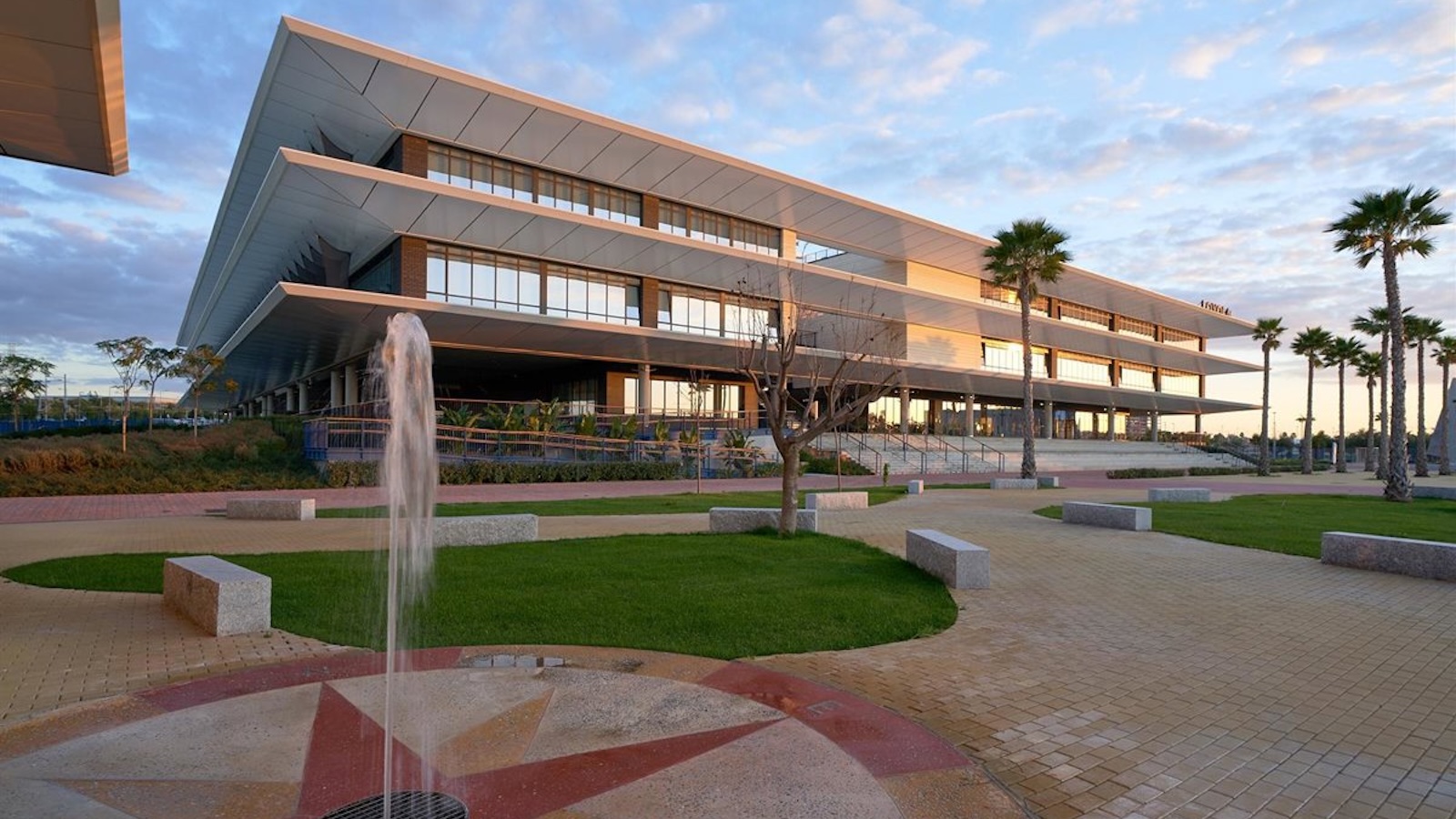
Identity and Mission Courses at Loyola University Andalusia
Loyola University Andalusia was founded in 2011 with the mission to provide education in service to humanity and our planet, training students to engage across differences and lead lives committed to others. Its mission is informed by its Jesuit identity and connection to the Jesuit order, also known as the Society of Jesus. Loyola has campuses in three provinces of Andalusia, Spain’s southernmost autonomous community, including Seville, Córdoba, and Granada. It is a member of multiple Jesuit networks that connect institutions around the world, including the International Association of Jesuit Universities (IAJU) and Kircher Network—an organization of Jesuit higher education institutions in Europe and the Near East. Through the UNIJES network, Loyola collaborates with 10 Jesuit institutions in Spain to develop innovative pedagogy, research solutions to social challenges, and strengthen dialogue surrounding the world’s most pressing issues. UNIJES complements Loyola’s international collaboration and allows the university to extend its impact to 59,782 students across Spain.
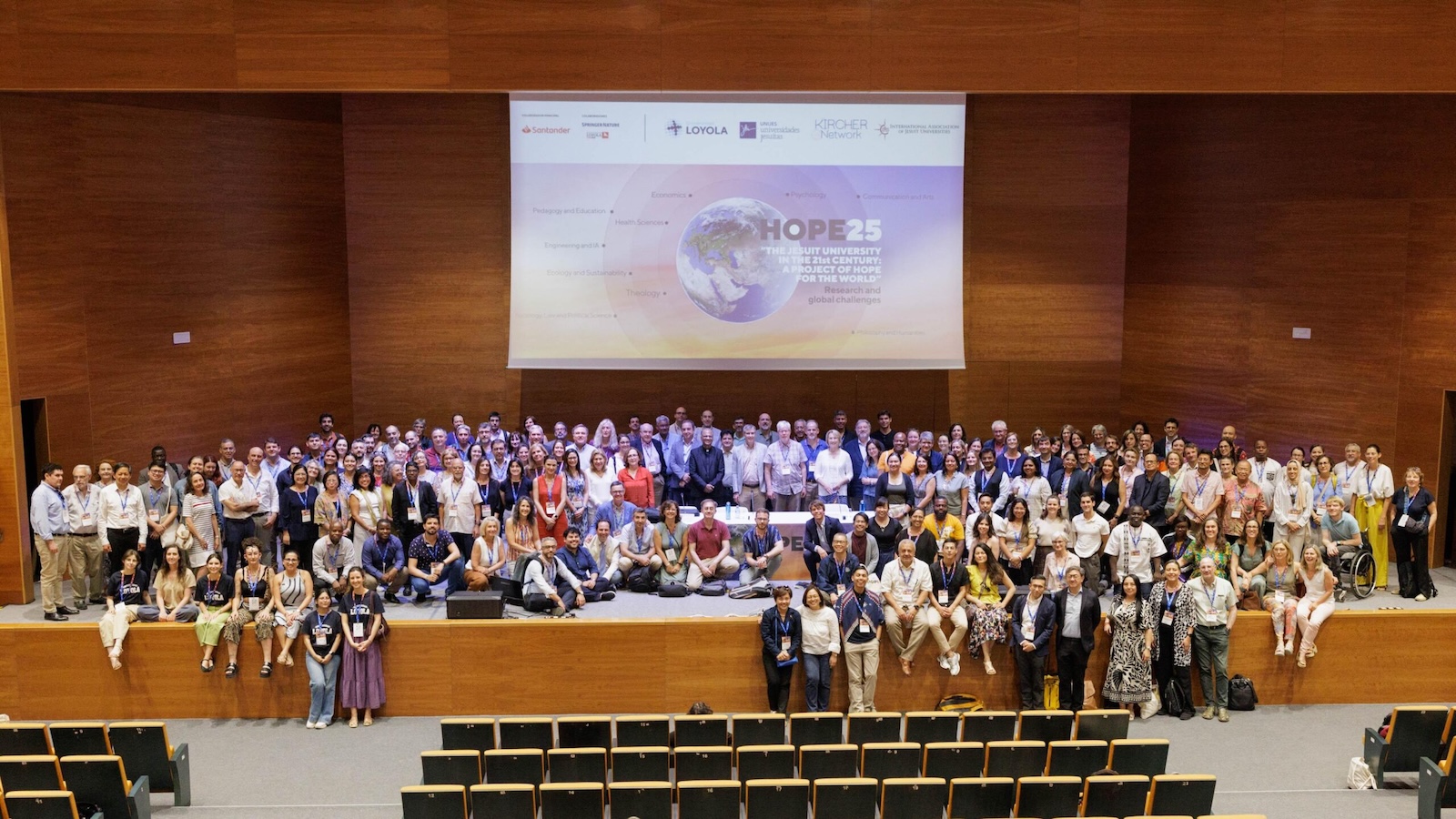
Figure 1: On a wooden stage with a wooden background and auditorium seats in the foreground, a group of around 150 adults stands together. A projected image on a screen behind them reads, “HOPE25” and displays an image of a globe (Source: Kircher Network).
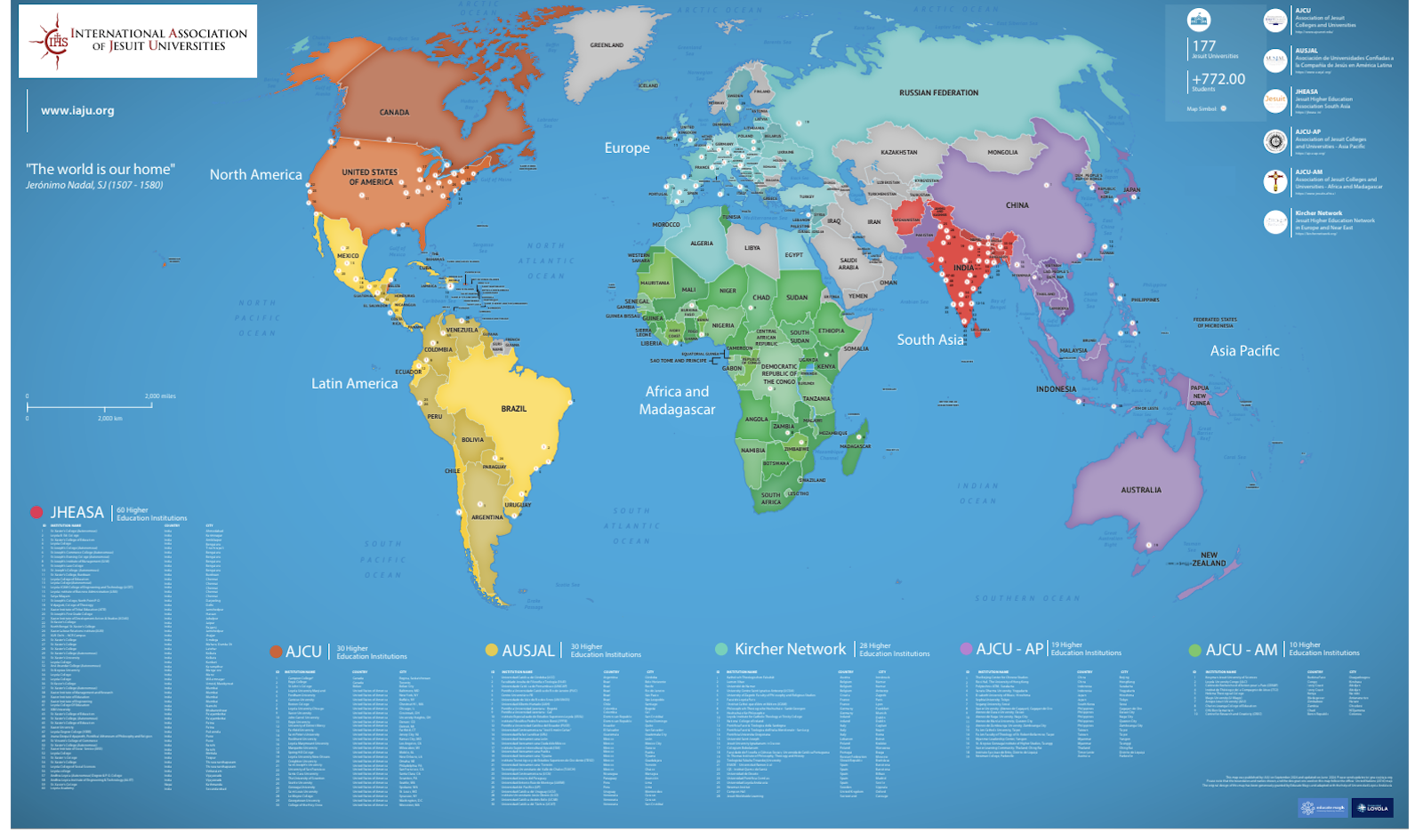
Figure 2: World map showing the global network of Jesuit universities, with regions color-coded by association—North America, Latin America, Europe and Near East, Africa and Madagascar, South Asia, and Asia Pacific—and dots marking the locations of Jesuit higher education institutions across each continent, accompanied by a legend and institutional listings. (Source: IAJU website).
Loyola’s pedagogical approach is informed by its commitment to Jesuit values and mission to create agents of change in the development of a more humane, just, and sustainable society. Part of this approach includes requiring each student to take one class overseen by the university’s Identity and Mission Department. These courses include Leadership and Social Change, Interreligious Dialogue and Spirituality, Catholic Social Thought, and Contextualizing Christianity and the Church, and are designed to support students in their final year at the university in integrating what they’ve learned throughout their education with their understanding of the world and their place in it. Grounded in experiential learning, the courses offer a personalized and introspective experience that gives students tools to reflect on their understanding of some of the world’s most pressing challenges.
Throughout late May and June of 2025, I worked closely with the Identity and Mission Department and its director to explore students’ experiences with the four Identity and Mission courses offered across Loyola’s three campuses. I interviewed professors and administrators about designing and implementing these courses and interviewed students about their perspectives having taken them. I conducted the majority of my research in Seville and also visited and interviewed individuals from the campuses in Córdoba and Granada. Throughout the HOPE25 conference, I interviewed administrators from Jesuit universities around the world about how they align the pedagogy and mission of their institutions. Participating in conference discussions, panels, and keynotes—which centered on the Jesuit commitment to forming hopeful, socially responsible global citizens—provided insights about global approaches to developing impactful educational models.
HOPE25: The Jesuit University in the 21st Century: A Project of Hope for the World. Video 1: The HOPE25 Conference, Loyola campus in Seville, and an explanation of Jesuit universities’ collaboration toward their shared mission (English subtitles available through the "closed caption" button) (Source: Loyola University’s YouTube Channel).
As I translated, coded, and analyzed the data I collected during my time in Spain, it became clear that the Identity and Mission courses at Loyola were unique among the university’s offerings. Professors carefully constructed and approached the classes in a way that facilitated genuine transformation within students, offering undergraduates the opportunity to develop tools to engage across differences and reflect on their personal understanding of complex issues.
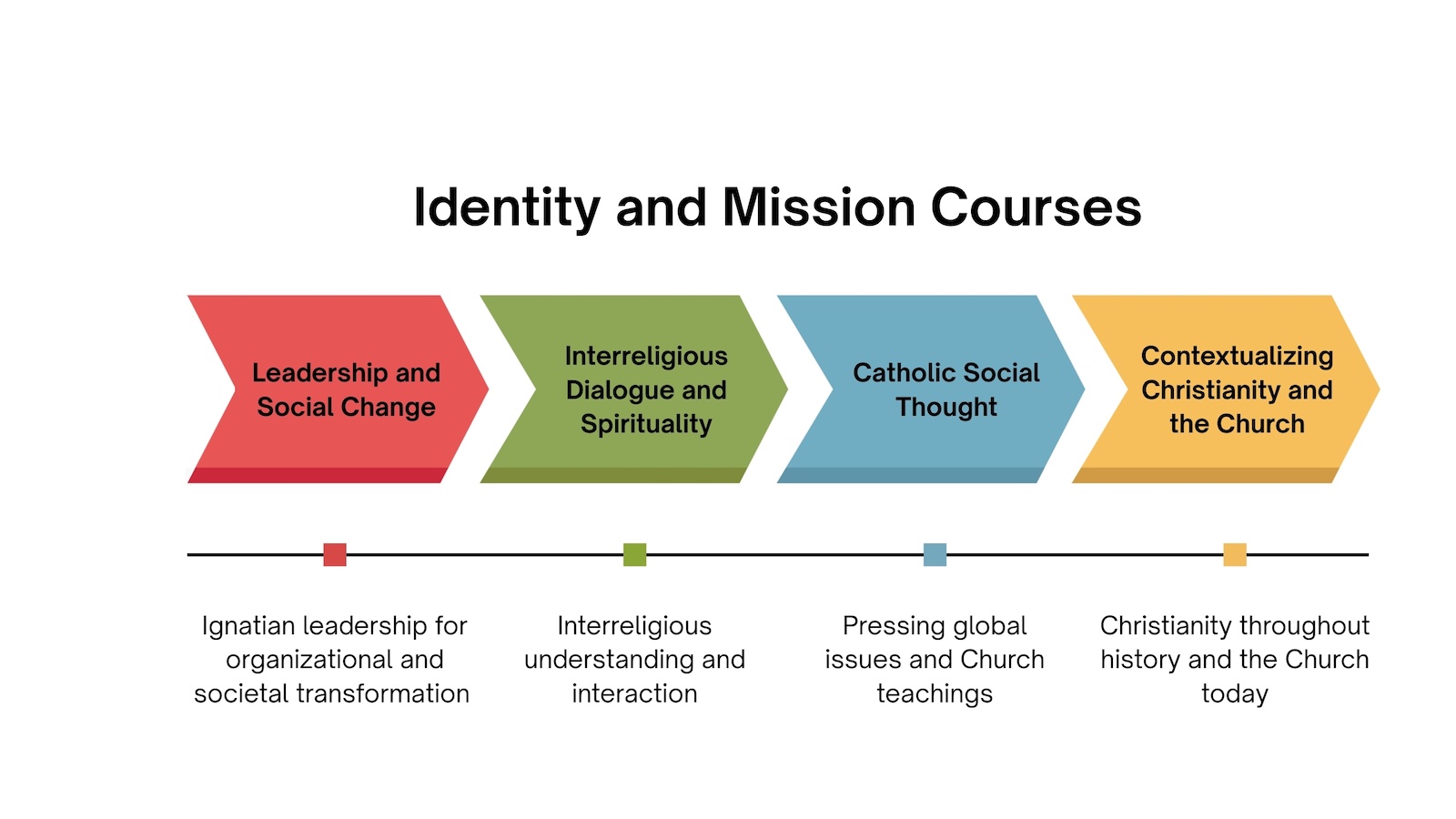
Figure 3: An infographic titled Identity and Mission Courses detailing the primary aims of the four courses in the department. Leadership and Social Change: Ignatian leadership for organizational and societal transformation. Interreligious Dialogue and Spirituality: Interreligious understanding and interaction. Catholic Social Thought: Pressing global issues and Church teachings. Contextualizing Christianity and the Church: Christianity throughout history and the Church today.
Course Design: A Pedagogy of Proximity
The Identity and Mission courses have a unique structure among other courses at Loyola and the Spanish university system more broadly. Both students and professors noted that while other classrooms typically employ a vertical learning model where professors impart information that students must memorize, the Identity and Mission courses have a more horizontal approach. Students engage with professors and their peers more frequently and are expected to contribute their opinions and ideas in class. The courses are defined by proximity—both in professors’ close connection to the material they teach and in their strong emphasis on applied learning.
There are teachers who are fixed, fixed, fixed. In my case, what I want is to generate a space for dialogue in my class. There is no forbidden opinion. The search is shared; it is very important to take the path [of learning] together (Interview with Ángel Viñas Vera, Professor of Catholic Social Thought, May 27, 2025).
I give them [the students] as much of a leading role as possible (Interview with José María Valverde Viqueira, Director of the Identity and Mission Department and Professor of Leadership and Social Change, June 10, 2025).
Experiential learning is central to many of the Identity and Mission courses. Professors require students to directly engage with and apply the class material throughout the semester. In Leadership and Social Change, students collaborate with community organizations to design and complete projects and internships. They learn from guest lecturers in various fields and build practical tools in effective leadership that advances the common good. José Navarro, a fourth-year business student, shared that the class gives you “a glimpse into the tools you need to be a leader tomorrow,” (interview, June 4, 2025).
In Interreligious Dialogue and Spirituality, Professor Jaime Flaquer García, S.J., and Professor Gonzalo Villagrán Medina, S.J., invite Jewish and Muslim faith leaders to share about their experiences and engage in open dialogue with the class. These interactions stand out to students, many of whom have never engaged in interreligious discussions before. “That [experience] was very different and I had never done it in any subject, not at school or anywhere,” (interview with Claudia Fernandez del Aguila, a fourth-year psychology student, June 3, 2025). Carmen Alvarez, a psychology student in her fourth year, explained her perspective on how the Identity and Mission courses integrate applied learning, saying, “[Some subjects] are for you to have the training and knowledge, but the Leadership class, for example, is how to use that knowledge, to give the ‘how’ to the students. It is much more practical—how to apply the content you know about the world and yourself, to give it to other people,” (interview, June 12, 2025).
The courses’ proximal design, emphasizing students’ direct engagement with course material and guest lectures, is complemented by professors’ lived experience as scholar-practitioners. Each professor that I interviewed in the Identity and Mission department studied as a Jesuit, and their classes are informed by their experience studying and applying Jesuit values throughout their lives. For example, Professor Valverde, who teaches Leadership and Social Change, has extensive experience founding and running social justice organizations and NGOs. The Jesuit commitment to develop and apply one’s intellectual life in service to a greater good clearly informs each professor’s instruction style and life’s work, deepening the proximity of the courses to the values they’re designed to teach.
I have been gradually moving from more theoretical frameworks to more experiential frameworks. At the beginning, I liked them to read more, and now, I want them to experience more (Interview with José María Valverde, Director of the Identity and Mission Department and Professor of Leadership and Social Change, June 10, 2025).
If one wants to generate just citizens, they have to make them practice justice. Virtue is practiced, not just reflected on (Interview with Ignacio Sepúlveda, Director of the Humanities Department, June 5, 2025).
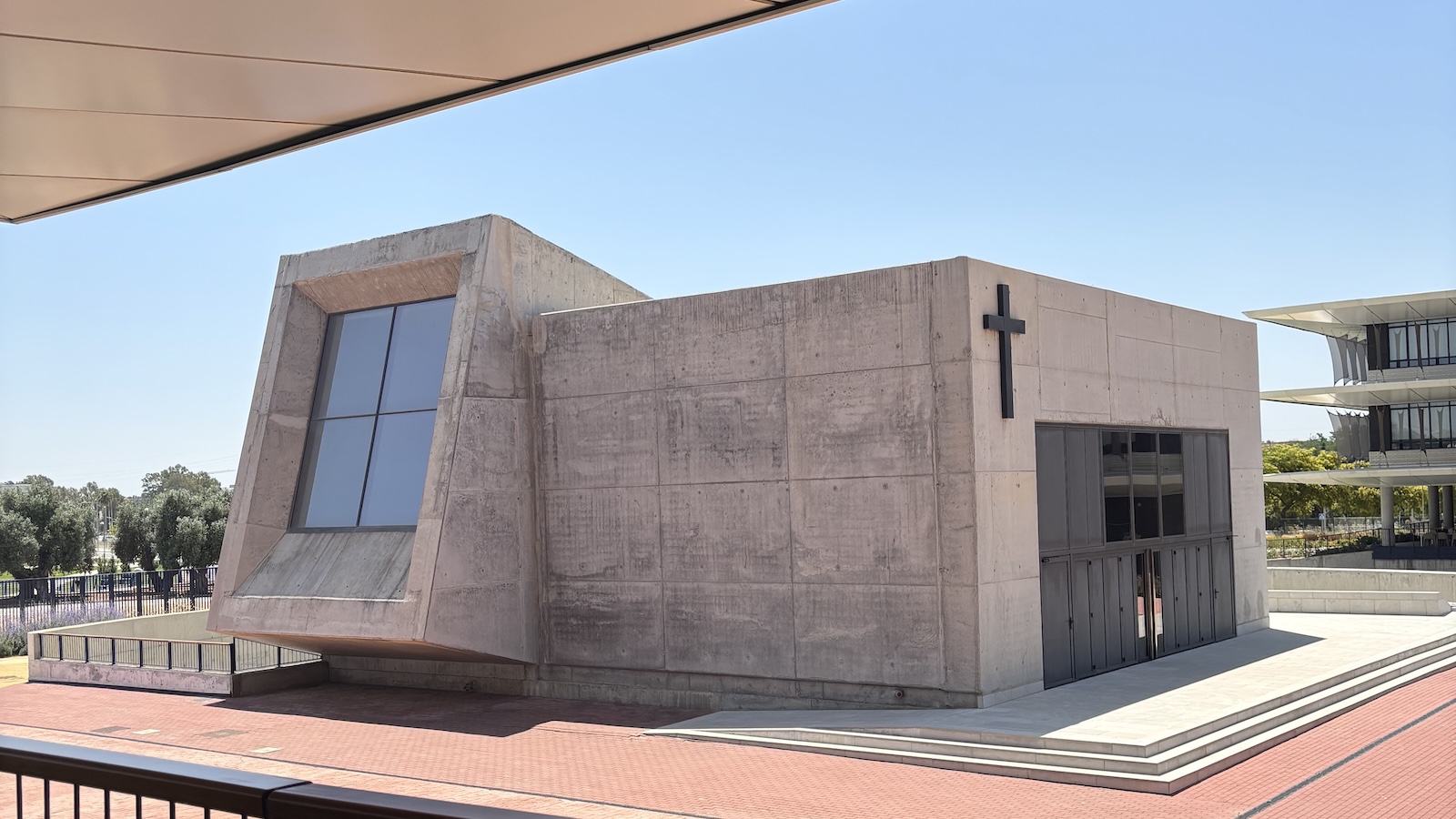
Figure 4: Chapel on the Loyola University campus in Seville: On a red paved courtyard with green foliage in the foreground, there is a grey concrete chapel with a large window and a cross on its right side. The backdrop is of a blue sky, and the photo is taken from under a patio roof, which is protruding at the top of the image (Source: Stella Vance's personal photos).
In contrast to norms in traditional Spanish classrooms, Identity and Mission professors encourage their students to deepen their learning through dialogue and debate in class. This allows students to explore their personal perspectives and interrogate how the course materials apply to their individual lives. Students feel that professors “are not only committed to the theoretical training, but that they also seek that people leave here with knowledge beyond [theoretical or vocational expertise],” (interview with Belén Moreno, an industrial engineering student, May 29, 2025). Professor Viñas says that for his class to be successful, “There must be freedom to speak, to be able to debate,” (interview, May 27, 2025). Claudia Fernández recommended the class Interreligious Dialogue and Spirituality because of its vulnerable and personalized approach. “It is very useful, not only for our career and for our work when we are professionals, but for the vision of each person in general,” (interview, June 3, 2025). The courses’ design is part of how professors orient themselves to welcome students as full people, rather than compartmentalizing them as scholars or future professionals.
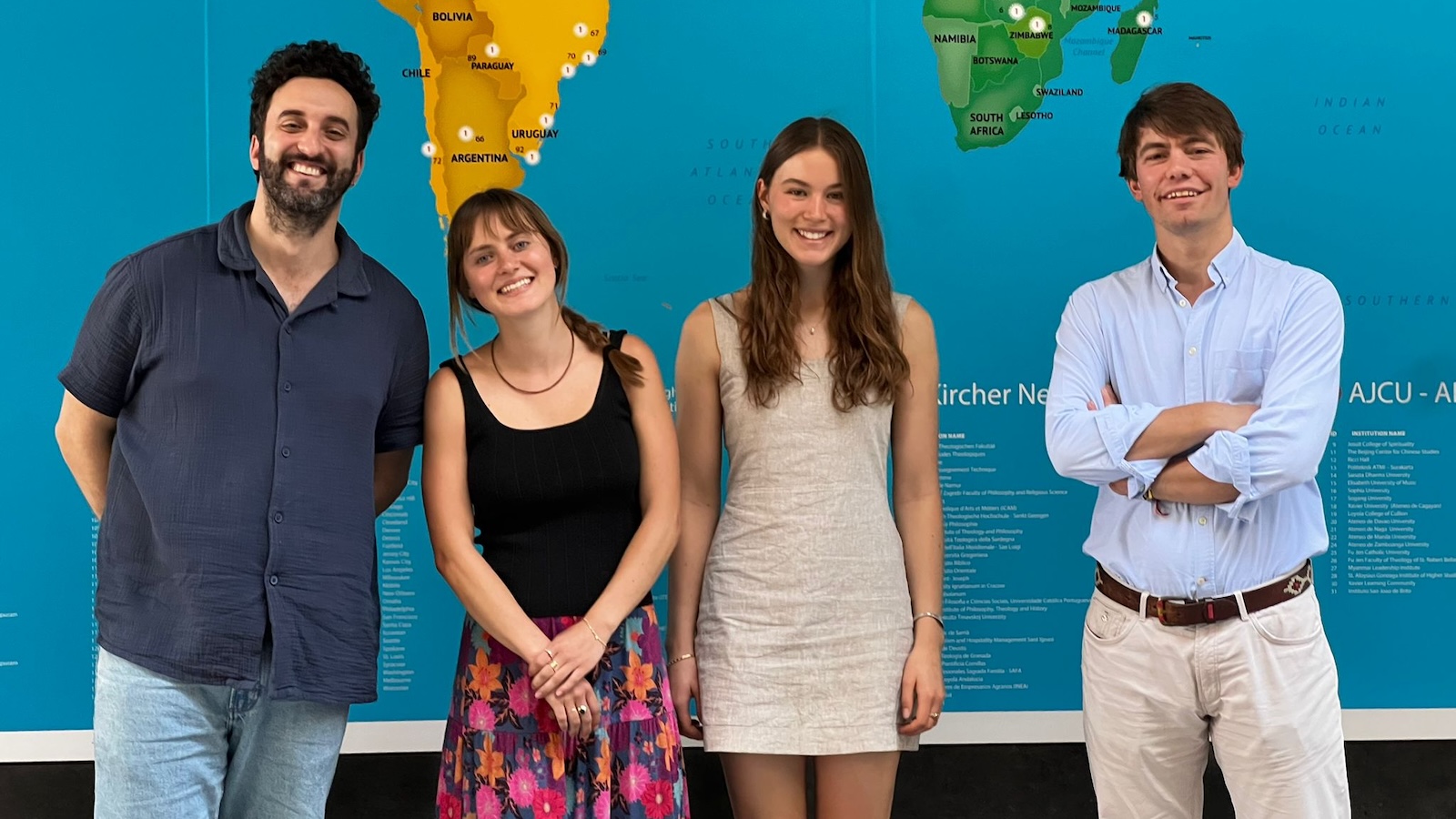
Figure 5: From left to right: Juan Romero, ESJ Fellow Cici Sprouse, ESJ Fellow Stella Vance, Ignacio Garrido Cruz, standing in front of the IAJU Member map at Loyola University campus in Seville (Source: Stella Vance's personal photos).
Professors’ Orientation Toward Students and Their Course Material
Professors of the Identity and Mission courses have a uniquely open, collaborative, and vulnerable orientation toward their students that deepens the impact of their expertise. Students repeatedly expressed that professors approached their classrooms with a notable quality of cercania, the Spanish term for a warm disposition that fosters closeness. Professors understand that their courses are emotionally demanding compared to the classes students are accustomed to, and that asking them to contribute personal reflections, perspectives, and experiences requires a thoughtfully constructed environment.
I notice how close [cercano] they are, and that helps them to transmit [the class] (Interview with José Navarro, June 4, 2025).
Professor Valverde explained how he navigates his classroom, saying, “The only difficult thing is that to have a meaningful process here [with these topics], you have to get into it on a personal level, you have to risk entering areas that you often do not want to enter in class because they touch on more in-depth topics,” (interview, June 10, 2025). When asked about how his course compares to normal Spanish classes, Valverde shared, “Here, it’s extremely strange. The normal thing is that the teacher gives you theoretical material and you do assignments, and then you’re tested on it. That’s what I don’t do [laughs],” (interview, June 10, 2025). He expressed his desire to “take advantage of the space that electives allow,” saying, “I dream that the lectures, the group activities, make you, stir you inside enough to make you ask yourself important questions in your life. That’s my goal. I’ve won [if students say], ‘I dare to ask myself questions that I’ve had, but that I’ve never allowed to emerge,’” (interview, June 10, 2025).
Professors’ efforts to create spaces where students feel comfortable engaging with non-traditional class content don’t go unnoticed. Multiple interviewees highlighted the impact of learning from a professor who simply took the time to learn each of their names, explaining, “This doesn’t happen in other courses,” (interview with Silvestre Fernández, a fourth-year communications student, June 4, 2025). When Professor Flaquer explained how he attempts to “dignify students,” he noted that he responds to student communications quickly (interview, June 5, 2025). Without prompting, a student later mentioned a timely response by one of his professors as an example of the attentiveness and care that set some classes at Loyola apart (interview with Rafael Obrero, a fourth-year communications student, June 10, 2025). Among a busy university system where coursework, exams, and internships can feel overwhelming, students expressed the positive experience of stepping into a classroom where they were individually known, respected, and encouraged to share their ideas.
Professor Viñas described his classroom as an escape from the hustle. “I try to generate a space full of tranquility in class. Here, we come to think, there is no hurry—tranquility. Let's talk about the things that matter to us. My objective is to generate a space of freedom, trust, and tranquility,” (interview, May 27, 2025).
Although Loyola is a Jesuit school, and multiple Identity and Mission courses focus on Catholic teachings, professors are committed to allowing students to connect with course materials and be included in discussions, regardless of their beliefs. Professor Valverde says that Ignatian spirituality is “Presented in a very broad way, in such a way that it not only serves believers, [but] in a way that is valid for anyone,” (interview, June 10, 2025). Professors attempt to assist students in finding their own “personal and spiritual syntheses with the whole world,” rather than imparting a specific ideology to students (interview with José María Valverde, June 10, 2025). To achieve these aims, they prioritize students’ freedom to live in accordance with their values, hoping to serve as sounding boards and provide tools to discover one’s own beliefs. Professor Viñas shared, “I understand the deepest identity of the university, the most profound, as freedom. Therefore, I only understand transmitting identity as leaving the student free so that with information, he can make his personal path. [I try] to help them to be free and choose their path, their personal path,” (interview, May 27, 2025).
Another feature that distinguishes these professors is their perceptible passion and love for the material they teach. One student shared, “I see that they also have, like, something else inside them, which is not only explaining and grading, but going further…something more, it's not just work,” (interview with Belén Moreno, May 29, 2025). José Navarro, who elected to take all four of the optional Identity and Mission courses, explained that these professors “show themselves as they are, they live by example, they really want to help you because they are interested in you learning,” (interview, June 4, 2025). This sentiment was echoed by student after student who explained that professors went above and beyond to connect with them, “not because he has to, or because it is work, he did it because he really wanted to help us,” (interview, June 4, 2025). Professors were consistently available to students outside of class time, via email or in person, and were happy to provide any additional resources that might interest their students or discuss personal concerns over a meal after class.
Professors’ intentionally warm and close orientation requires that professors and students alike step out of their comfort zones to create a space that benefits each person and their commitment to their greater community. Professors not only prompt students to engage vulnerably through required journals and sharing in class, but also lead by example. Multiple professors noted that their approach differed from other courses that are designed to maintain an intentional distance between professors and students. Students are aware of this distinction, and José Navarro remarked, “Keeping a distance, well, it makes you feel safer as a teacher, but maybe, it doesn't make you get involved as much or arouse concerns within a student,” (interview, June 4, 2025). When professors engage in the same way they ask their students to, it creates a space where mutual learning and a more horizontal classroom are possible. Silvestre shared that his professor achieved this aim, saying, “He has this form of making each one feel that they are a part of the teaching” (interview, June 4, 2025).
Because the Identity and Mission courses diverge from the normative structure of courses at Loyola, the spaces professors create and the way they approach their classrooms are of the utmost importance. Their warmth, attentiveness, and closeness allow students to engage deeply with class material and achieve Professor Valverde’s goal that they “confront themselves with other ideas…other testimonies that allow them to put their own life experience in dialogue with others and to generate a new synthesis. A synthesis that is, on the one hand, deeper, that helps to think, to delve deeper into one's own values and to discover some new value,” (interview, June 10, 2025).
Professors are invested in the brief time they spend with the diverse group of students in their Identity and Mission courses, and they design and approach these courses in a manner that allows them to have an outsized impact.
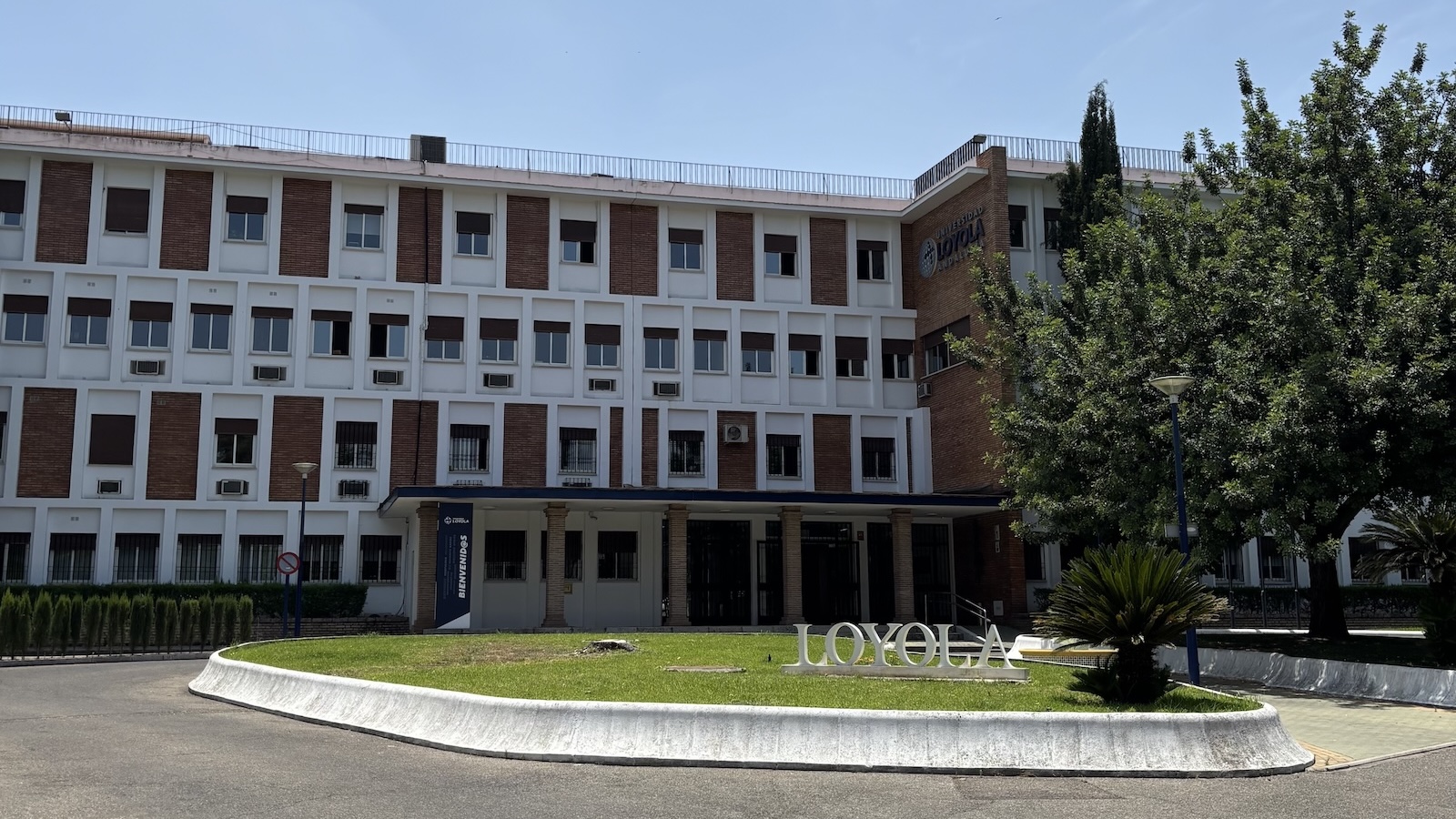
Figure 6: Loyola University Andalusia campus in Córdoba: Front view of a multi-story brick-and-white academic building at Loyola University Córdoba, with a central entrance canopy, rows of rectangular windows, trees and landscaped greenery in front, and a circular lawn displaying large ‘Loyola’ letters under a blue sky (Source: Stella Vance's personal photos).
Student Transformation: Challenging Prejudices and Rethinking the “Other”
Students described a fundamental shift in their analytical process after taking these courses, moving from more binary modes of thinking to an open orientation to new ideas. In most classes outside of the Identity and Mission department, they described being trained to distinguish right from wrong answers and to approach new information as either supporting or undermining their existing reasoning. While this process is useful in making objective judgments that are necessary in many fields, it can also limit one's ability to delve into gray areas that define the social justice and identity concerns present in the Identity and Mission classes.
Belén, an engineering student, explained that taking Interreligious Dialogue and Spirituality challenged the efficiency and speed in determining correct answers that her other classes prioritized. “We seek more than understanding which [belief] to see as right and which as wrong…to learn to listen and learn to accept, and also see the ‘why’ of each [belief],” (interview, May 29, 2025). Before jumping to conclusions about unfamiliar faith traditions, she began to seek an understanding of the foundations of their beliefs. “Before, when I did not understand it, I rejected it and pushed it away. Yes, and now, as I understand it a little more, well, I mean, I'm interested in learning more from their perspective, you know? Like, not so much rejection,” (interview with Belén Moreno, May 29, 2025).
While it was sometimes uncomfortable or foreign at first, practicing a more open orientation when receiving new information allowed students to challenge many of their prejudices and beliefs. In Catholic Social Thought, students grappled with the Church’s teachings regarding pressing social issues. They debated political, ethical, and moral concerns in a classroom designed to dispel binary assumptions of right and wrong and facilitate a deeper understanding of foreign belief systems. José Navarro says that he learned to “try to look beyond an ideological line” and appreciate the “points of truth” in ideologies he doesn’t identify with (interview, June 4, 2025). Similarly to Belén, he says that the most impactful takeaway from the course was “thinking about things rationally before paying attention to an instinct or to a prejudice regarding people who are different. I make an extra effort to see different opinions,” (interview, June 4, 2025).
This process parallels the particularly notable transformation many students experienced in Interreligious Dialogue and Spirituality. Students described the process of coming to understand and confront their prejudices toward other religions as they met Jewish and Muslim people with whom they shared similar values and experiences. In a region with a strikingly Catholic majority where about 4% of people identify as Muslim and around 0.1% as Jewish, this was the first time many students could form ideas about another religion based on information that came from someone who actually practiced it. Claudia Fernández shared that the rabbi whom she spoke with surprised her: “He was a super close person [cercana]; we laughed a lot with him, he explained things naturally. If Gonzalo hadn't brought that person to tell us about his testimony and to talk to us about his religion and such, then I would possibly continue with the preconceived idea I had. He changed my way of thinking a lot,” (interview, June 3, 2025). Rafael was also surprised by these interactions, and shared, “[It now] seems crazy to me [that I don't know someone who is Muslim or Jewish], not only because they are interesting, but also because they are very connected to the day-to-day life and to the reality of young people and students,” (interview, June 10, 2025).
Connecting with community members of different faiths challenged students' ideas about what it meant to be Spanish, and the strong tie between Spanish identity and Catholicism. Rafael shared that he hopes others can see that, “Today, in Spain, there are, obviously, people from all countries, or from all cultures, all religions. I think it is very important that we become aware of that and that we are able to integrate all those people of different origins to respect them. [It is] very important that we understand that there are Muslims, Jews, who are like us, who can even be Spanish like us,” and that hearing a testimony from a “Sevillian who spoke of Seville, and was Jewish” underscored this point (interview, June 10, 2025).
It took away a lot of the prejudices that I had before towards people of another religion, which I think is very important (Interview with Belén Moreno, May 29, 2025).
I had no idea about a lot of things that the men who came told me. It did change me, especially the interreligious dialogue, because of knowing the experience of a person of another belief (Interview with Rafael Obrero, June 10, 2025).
I don’t have to hate it because I'm different (Interview with José Navarro, June 4, 2025).
Every opinion counts, every way of understanding life counts, every way of understanding religion counts (Interview with Silvestre Fernández, June 4, 2025).
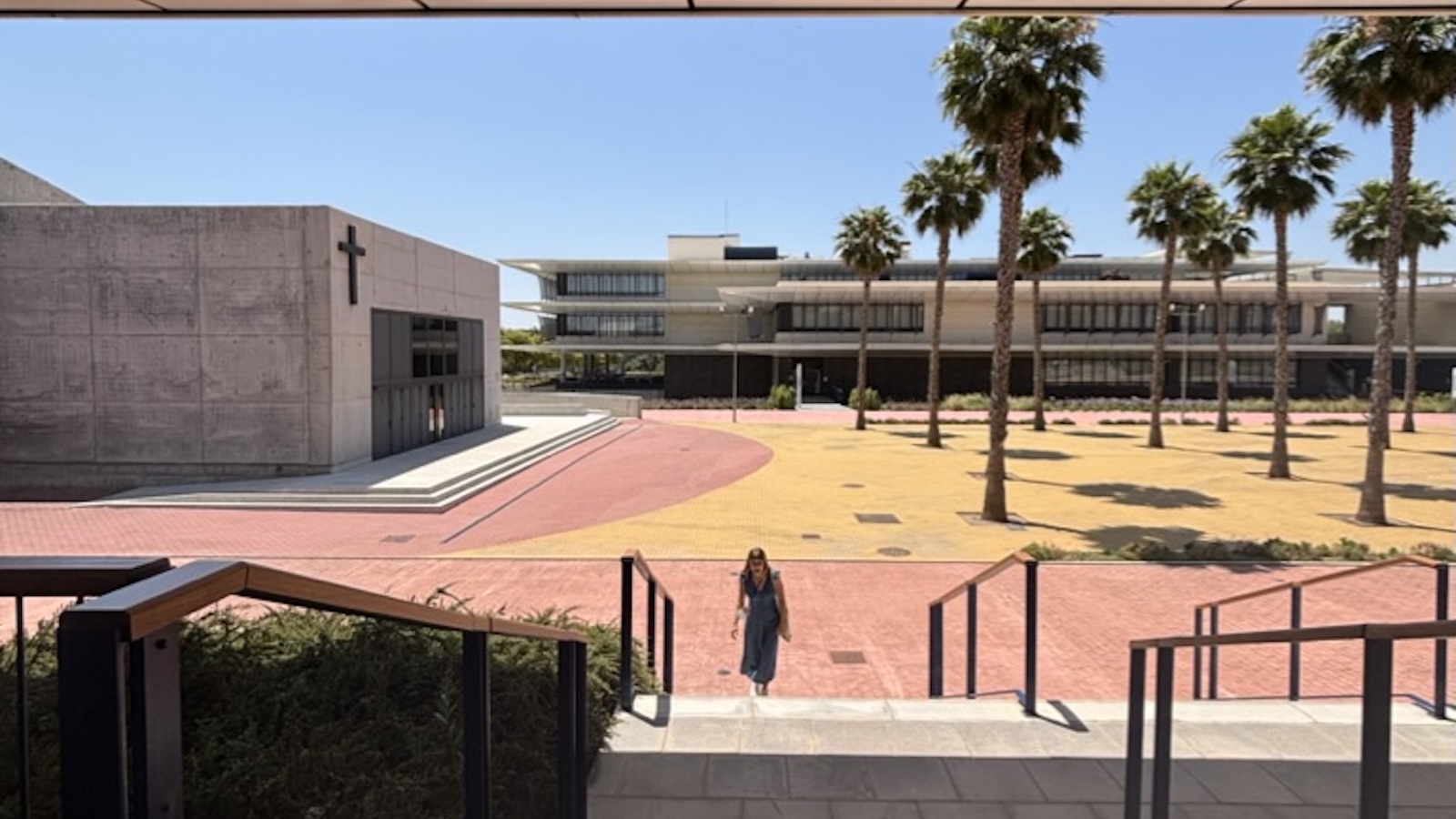
Figure 7: A view into the courtyard on the Loyola University campus in Seville: A young woman walks up a set of stairs in the foreground of the photo. Behind her, there is a yellow and red courtyard with a chapel on the left side, palm trees on the right, and a large glass window in the background (Source: Stella Vance's personal photos).
The strong tie between Spanish and Catholic identity created points of ambivalence for some students, who felt unaligned with various Catholic teachings. Silvestre shared his experience, saying, “Being Spanish, we have a lot of Christian tradition—especially Catholic,” (interview, June 4, 2025). He explained that taking Catholic Social Thought allowed him to reconcile some challenges that came from his distance with the Church as he came to appreciate shared values. “I realize[d] that I am very much in agreement with the values of the Church, although I always wanted to be very far from the Church. I can support those values and think that the Church wants for a better world—the same better world that I trust, I believe. I have learned that, at the end of the day, you don't necessarily have to be a believer or a Catholic to be able to connect with their values,” (interview, June 4, 2025). A transformation in his personal relationship to the Church offered a type of reconciliation and integration with aspects of his Spanish identity.
Beyond altering patterns of thinking and understanding others, students experienced a transformation in their personal sense of identity through taking Identity and Mission courses. Professors required students to critically reflect on their own beliefs and values throughout the courses. Maite explained, “Little by little, you make the message yours,” saying the class “has helped me a lot too, in my identity, [because] it’s a way to organize your life in some way, or what you believe in it,” (interview, June 4, 2025). Marta García, a recent graduate from the psychology department, shared that the class stood out because it equipped her to form and articulate her own beliefs: “Here, I have to think and create myself, my own idea and my arguments, and defend it. And those things, I haven’t seen in another subject,” (interview, June 9, 2025). Although professors shared that they believed they only played a small role, if any, in shaping students’ identities through education, students like Cristina (quoted below) say the Identity and Mission courses are unique, particularly because they facilitate a notable transformation in personal identity.
Have you found something different in that course compared to others you've taken here at Loyola?
I would tell you that it has changed me a lot, it has changed me on a personal level, it has transformed me, undoubtedly. It is going to change the way you understand your life. The way I move has totally changed in the world (Interview with Cristina Luisa, June 11, 2025).
In the end, I've taken [what was learned in the class] with me for my life. It's a class to get to know you better (Interview with Carmen Álvarez, June 12, 2025).
Education as a Tool for Social Justice and Peacebuilding
The Identity and Mission courses offer means for personal and societal transformation, equipping students with tools to engage with people they disagree with. Some students shared a notable change in their perceived distance from religious or political “others,” with whom they found shared values and a common Spanish and human identity. This process constitutes a type of peacebuilding through education, which has impacts far beyond the University of Loyola Andalusia. Professors’ emphasis on celebrating students’ voices and opinions was a critical component in facilitating student transformation, allowing students the freedom to discover and live in alignment with their beliefs while encouraging them to experiment with new ideas and ways of relating to those around them.
The views expressed in this student research are those of the author(s) and not of the Berkley Center or Georgetown University.
Featured Person: Stella Vance Person