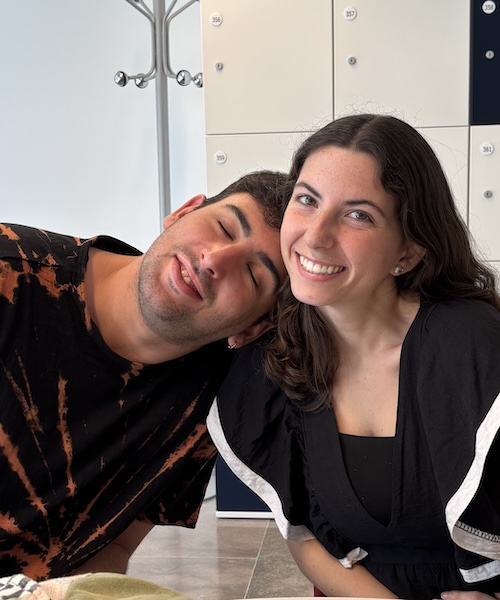
Background: As part of the Education and Social Justice Project, in June 2025, undergraduate student Stella Vance (C'26) interviewed Maite and Silve, students at Loyola University Andalusia in Seville, Spain. In this interview, Maite and Silve discuss Identity and Mission courses at Loyola University Andalusia from the students' perspectives. This interview was conducted in Spanish and translated to English by Stella Vance.
What year are you in the university?
Maite: In the last, the fourth.
Silve: Fourth.
And what do you study here?
Silve: Communication with a focus in journalism.
Maite: And I, communication with a concentration in advertising, or marketing.
Interesting, and do you like it?
Maite: Yes, yes, yes, I like it. I think it is very creative, which gives the possibility of working for many companies in different ways. I'm a little worried about the issue of ethics, because in the end, it's about selling to other people, creating needs, but I also think that you can do a lot of good, so, that's fine.
And you [speaking to Maite], do you like communication?
Maite: Yes, and I like it precisely because of what I have already said about ethics in journalism. You can try to change the world, even if it's a very complicated project, but at least you have a goal and a mission, and you don't have that internal language. If I'm working for a company, they can create many problems, so, I like my major because I am in charge.
And is the communication major big? How many students are there?
Silve: Now, I don't know, but we would be about 70.
Maite: Yes, at Loyola, you can study a double degree. So, there are people who do communication with international relations, with musical production... In other words, there are a lot of people from communications who also do other majors at the same time. Many people.
And I understand that you are students in the Catholic Social Thought class, correct? And you said that it’s with Professor [Ángel] Viñas? How many students are in the course?
Maite: Yes, yes.
Silve: It's complicated, isn't it? It's difficult to understand. Because being in our last year, almost all of us have to do work practices (internships), so, maybe, there are 30 of us in class, but there are 60 people enrolled.
Maite: Matriculating, there are 61. I was also a student of Contextualizing Christianity and the Church, but it was the first semester, and there, we had 67. So, more or less 60 in every class.
But only 30 actually go to class?
Silve: Well, we are doing work practices (internships) at the same time as class, so, some work during class hours and cannot go, but when they finish the contract, they go back to class because we have to do at least two months of internships. And some of them coincide with the class.
But, is it allowed not to attend class because you're doing an internship?
Maite: Yes.
And it’s not connected with the class?
Silve: No, it has nothing to do with it.
Okay, I understand. And have you taken other identity and mission courses here in Loyola?
Maite: Contextualizing Christianity and the Church, and Ethics.
Silve: Yes, right, ethics, ethics.
But is Ethics optional?
Maite: No, it’s required.
Okay, because my understanding is that the Identity and Mission courses are completely optional.
And Contextualizing Christianity and the Church, who taught it?
Maite: Ignacio Andrio.
And for you, that's your only Identity and Mission course here? [to Silve]
Silve: Yes.
Why did each of you decide to take that course?
Silve: A little because of curiosity. I don't consider myself a believer, but at the end of the day, I've learned that, being Spanish, we have a lot of Christian tradition, especially Catholic, and in the end, I was very curious about the social thought of the Church, the values, and, simply, curiosity is why I was interested. And I’ve liked it.
Maite: I am Catholic, so, it was a way to go deeper, because of the faith in seeing what the Church really said. Also, curiosity to understand a little more about culture, traditions, Catholic social thought. I also knew Ignacio, the professor. I had taken a journey with him and he had been my mentor in a retreat, a journey. So, I knew that I was going to like it, the subject. And he told me, he encouraged me.
[Speaking to Silve] And with your interest in social ethics and all of that, do you think that it connects with the themes of the course?
Silve: I don’t know if it really connects, but I have learned that, at the end of the day, Christian values, and in our case, Catholics, can be a general feeling, and you don't necessarily have to be a believer or a Catholic to be able to connect with their values. I understand that as well as with their ethics.
And why did you both choose this class over the other electives, like Leadership and Social Change or Contextualizing Christianity and the Church?
Silve: Well, I've already told you that it was a little out of curiosity, because the alternative I had was marketing and, well, I had more subjects, but the main one I was considering was marketing, and I don't like it. And then I said, "This is something I find interesting." That's what I said for myself.
Maite: Me too, it was a class that some friends had taken in my major. It was familiar because I felt that I could learn more and discover more new things with this class than many with marketing or brand marketing, classes that you can take in other universities and that I can learn on my own, really. So, I had to take advantage of the opportunity to study this at Loyola.
Can you think of any experiences you've had that have made you interested in Catholic Social Thought or in specific topics in the class?
Maite: For example, I had an experience volunteering in a prison with small children. I had my doubts about inquiring a little more into the issue of Church ethics on certain topics, also, in part, because of my faith, I had the need to go deeper, but basically, experiences like these: specific ones that had made me question myself about what I know about ethics and social justice and certain themes. And the need to go deeper to see realities. Well, the issue also of the war, the situation of the world today, things that hurt a lot and also make you not believe, you know? A little more about the way of the world, faith, and its relation with other religions.
Silve: I would say to you that here in Spain, many times the idea of the Church is associated with people from right-wing politics. And this doesn’t make sense in my mind because in the end, many Catholic people do not understand the real values that the Church believes in. So, that is what interested me in thinking about Christian values and, above all, finding an answer to why Christian figures are used politically, when really the policy of the Church is not to interfere in politics.
So, you’re saying that (on the right) they are often very Catholic, but their values are not aligned with Catholics?
Silve: Exactly.
I understand perfectly because in the United States it is very similar, many times. So, you wanted to understand the [Catholic] values in a deeper way because you don't think they match with people who say they have the values?
Silve: Yes, because after all, the documents of the Church, you see that many times they go against the free market, they go against monopolies. And it's like they have a social vision that many people really forget that this is the mission of the Church. So, they think that they can lead a life with values that are not Catholic but at the same time be Catholic. And that's what’s hard for me.
Yes, I understand completely.
Maite: Yes, although, there are parties, we are very mixed. Because, for example, starting from the right: They do defend, for example, life, and go from the left, no. So, it is really very difficult to find a political party that defends 100% the values of the Church. It is very complicated, and here, and in all countries, I think, practically, in the world, so, well, it is an issue.
And have you found anything different in your experiences in this Identity and Mission course compared to the other classes that you have taken?
Silve: Yes, because lately, the university is becoming professionalized. That is, it is not as important to learn knowledge as it is to know how to work, to know technical things, to know how to function in a company. And this, in particular, is a class that is not technical at all, that is only knowledge, that is only about values, that is only about debate, so to speak. And, in the end, it reminds me of what I thought the university was, which is a space where you can learn, debate, even agree with people who you didn't think were ever going to be saved. It is a space in which every opinion counts, every way of understanding life counts, every way of understanding religion counts. And that has been an experience I’ve enjoyed.
Maite: I was going to tell you something similar: that in the end, we have things that are going to serve you in your future work. And this (class) is something of real life, of how to understand another person, another religion, how to understand your own religion. How you can have really solid arguments, to consider the maybe, well, another way of living. For example, knowing what the Church says and knowing more theory and more history, I can also consider what there is, things I don't agree with. So, I think it is a construction, it is something more personal, of the identity of each person that you value. This is the knowledge you are going to strengthen. I think it has been more productive, more positive, maybe.
Silve: It has helped us a lot.
Maite: Even more so, if there is nothing else, but maybe, to know how to design a poster that maybe, I say, "Well, okay, but that's on a personal level and also on how to interact with other people."
Silve: And I'd also like to add that many times, we had ideas in our heads, but we had never stopped to think about them. For example, justice, freedom, love, spirituality. Everyone has a very general idea, but the moment we talk to each other and say, “What is the truth?” Well, it serves as a prelude to a reflection that at the end has helped us to get to know each other as people, not as professionals, which is what the university expected, us as a person.
Maite: So, it’s very positive.
So, the topics discussed in this class were a little bit more vulnerable and personal about identity, compared to the other courses. And the class structure, the structure of teaching and learning, how does that compare to other classes?
Maite: For example, in the first one, Contextualizing Christianity and the Church, which is the one that [Silve] did not take, it was very practical in the sense that we are we talking about our personal history, we compared it to real-life situations, we watched films, maybe, to reflect on topics then, because it was, like, the structure of the classes were very practical and very learnable. In other words, it was not sought to do a job and know how to do something perfect, but really, the knowledge, take them to your personal life. They would also be useful, well, to learn practically and well.
Silve: Professor Viñas’s class, instead, is him bringing a prepared topic, a theme related to Catholic social thought. And you stop at any point in class and say, "Hey, why is it like this?" Or simply to put a concept up for debate. And then, everyone participates, everyone tries to contribute what they can contribute, and in the end, consensus is reached.
Maite: Yes, an agreement point.
Silve: But it is a class that is eminently practical, it is spoken, and it is not so much focused on the study of values, its goal is essentially that each person understands their own values and also the values that the Church favors.
Maite: We did a research project in this subject that I was very interested in. We chose marriage, the Church, separation. It was about practical cases that also helped you to reflect on issues. We did it as a pair, but there were people who did it about brotherhoods, land, conflicts...and I think it was an opportunity to really look deeply into what the Church says about certain topics, and to raise questions about that.
And could people apply their personal values if they were not those of the Church?
Maite: Yes, we could contribute what we thought, and we saw as needs that perhaps we proposed for improvement.
Silve: Or simply our point of view. The problem is that we can't say that part because it was only 20 minutes.
So, it wasn’t enough time to share your personal values?
Maite: The oral presentation, no, but in our written work, we could reflect on it.
And how many times does the class meet each week?
Maite: Two times and two hours; that is, four hours.
And the topics covered in this course, you have said a little bit about those, but were there any topics in the class that felt particularly difficult to talk about or learn?
Silve: One day we talked about abortion. That was what divided us the most and I think that is where we can all have the most problems expressing our own opinion. It is something very complicated.
Maite: But the teacher provided real statistics, facts, and then you can decide if you think it’s bad or good. But we saw the facts. We tried, then, to see the position of the Church. You could like or not, but it is what it is. We tried to see from an objective way what the Church says, and then, what each one says in this regard.
Silve: We haven't really had issues with something in particular because, I mean, it's not something that's hard, so to speak: This is the case and that's it, right? In the end, everyone can—
Maite: —Yes, there are no absolute truths. Almost everything was always, "Did you look at the nuances of this?" "Is it really so?" "Well, you have to take this into account, as well." "This is what the Church says, but we start from this context." I think that in almost everything because it was approached in a way that was as objective as possible and open to debate. Even the professor himself proposed his ideas. We had to consider, "Do we have a reason why I believe this and a way to justify it?"
And the topic [of abortion] was difficult because of the diversity of the opinions and the tension between students in the course?
Silve: Yes.
And also, in a personal way? Or more because of the tension between the students?
Silve: It’s not the tension of fighting, but that there are more conflicting opinions, and where there are more different opinions, people want to say, “What do you mean, I'm not going to change?” But not tension. She has a completely different opinion from me.
I understand, thank you. And was that topic the most difficult thing for you too? Or were there others?
Maite: Well, not so much, perhaps. I don't know. Almost all the topics were treated with a lot of respect. There was no room for harm.
And were there topics that were very easy or interesting for you?
Silve: Ah, the most interesting and the one I really liked the most was one of the last ones in the class, which is about whether there are bad people and if a bad person can do good things. Ángel, for example, the teacher said no, that a bad person can't do something good as a good thing. And that shocks me a lot, but I found it interesting to think about.
Maite: I would say that it could be something that was good in itself, but that the act itself cannot be good because the person is bad; that is, if the intention. It's very philosophical, isn't it? Everything, that is, had a lot to do with history to understand why the Church thought one thing or another, with philosophy, with basic ethics. Be a Christian, don't be. There are values and principles that you must have, even if you believe it.
Silve: Sure, but...that, I mean, it seems really curious, because you're a Christian. It is forgiving, I understand, and it must be affirmed that a bad person was totally bad and all things, even if they were good, were bad. It shocked me a lot.
Maite: In Contextualizing Christianity and the Church, the most interesting thing for me was the life of Jesus. So, the professor asked, "Could Jesus have had siblings? Could the Virgin Mary have had other children? "Things that maybe the Church doesn’t say are true or not, so, maybe, people continue to disagree. I found it interesting. It surprised me because they were topics that you did not expect taking a religious subject. So, well, it raised debates that might be different. And it did seem interesting to me to see the life of Jesus as historical, but also to see possible gaps, possible doubts that we don’t know, and that there is a possibility, and that seems interesting to me too.
And the teaching style. How does that compare to the other classes you've taken?
Silve: Well, I would say that it is more open and above all, it is closer, more than others. For example, Ángel knew all of our names. This doesn’t happen in other courses. He has this form of making each one feel that they are a part of the teaching.
Maite: Yes. And for example, Nacho [Ignacio Andrío] is a professor who is very, I don’t know how to express it—bohemian? He went barefoot to class. Like spiritual. It was like nature. The methodology was as if he were in the field, that is, giving examples that are very close to us to talk about something that was very complicated, because it made us share. For example, he would say, "Tell me how your summer was. Now tell me in 30 seconds, to explain the Bible." The details are lost over time. It was very interactive; we talked all the time. With Ángel we did tests, exams, like every class, but there was no final exam; it was like you did the tests to see if you had learned.
The emphasis was on real life, on your relationship with the course in a more personal way?
Maite: Yes, more personal.
Can you tell me about a specific class or moment that stands out to you or was significant to you—of either course—because I am very interested in Contextualizing Christianity and the Church, as well.
Maite: I had a lot of moments when I kind of remember saying “Wow, I've tried to learn about this.” The class we have with Ángel, we delved deeper into specific topics that have helped me to understand the principles of the Church and to organize myself. I say, "Okay, this is like what I felt the Church had to be, but I wasn't seeing it, maybe."
Silve: I don't remember specific days, I don't have a specific moment, but I do have something revealing. It is at the moment when I realize that I am very much in agreement with the values of the Church, although, always, I wanted to be very far from the Church. Maybe I'm not going to participate in the religious life of my church, or of my neighborhood, but I can receive communion, I can support those values and think that the Church wants for a better world. The same better world that I trust, I believe.
Maite: Yes, of course, I would say more or less the same. It's like moments when you say, "Okay, there's something I can defend." Because there are things about the Church that I don't like, but the basis of what I have to believe as a Christian is what I agree with as a person, that is, in those moments of reaffirmation that faith does see us as very positive. Or maybe, even with other religions, I remember when we saw, for example, Islam, beautifully such. Which in the end is, as can be seen, with a certain rejection in some parts of Europe because of the fear of terrorism. It is associated with terrorist attacks. The main victims of terrorism are the Muslims themselves because, in the end, they have to carry an image that is not the one they have. So, well, trying to understand all that and things I didn’t know would be. I liked to dig deeper and say, “Hey, yes, obviously almost 99% of the people who see this type of attack occurring and who are Muslims receive this rejection. And no, no, no, they don't want to know anything about it, they don’t want this.” So, I don't know, that, as well, has helped me to open up a little, too.
Did you find a way to connect personally with the material? It's obviously connected to your life in many ways, but did your professor offer ways to connect the material to your personal identities?
Silve: I would say, not in a way that the teacher has proposed, “You can use this in your life for this thing,” but you realize when maybe, you are not in class: you are at home in the afternoon, with your friends, with your family, and you start talking in a different way because you have things clearer. And in the end, it's better because you can take into account ideas that you had never expected to think about before, and you can apply them in your life. So, Ángel has not directly told us, “Hey, this is useful for you,” but he has given us enough knowledge, enough instructions that we can apply it in our day to day.
Maite: I mean, I think so, that there are moments when you might be presented with real situations that also help you to see it in your personal life. But in my case, for example, that's what Silve has said, "Am I internalizing things that I haven't considered?" It's not that I'm not interested, but maybe that I didn't have a doubt or a need to do something. Well, now I do, because I consider that it is what I am called to, not only with Christians, but also as a person in the world. So, yes, or even to question in your situations, I say, well, if I'm not sure what position to take on certain issues, it is worth living together to also make my own opinion. Little by little, you make the message yours. It also helped to put it in a situation and to give examples and situations in which you could also see yourself and see yourself reflected.
Before you took this class, can you think about how you understood Catholic social thought, the Church, or other class topics? Your perception of the world and relationships with others?
Silve: Yes, I had never stopped to reflect on what Christian values were before these classes, and, above all, values in general. Nor did I stop to make a list in my head of, “These are the values I have for this, for this, for this.” So, in the end, this class has helped me to realize that it is better to structure and know for sure what one believes, or at least, what you believe at that moment and to try to give it shape. Because before, I had not stopped to think about the values of the Church, and I had a very negative idea of the Church in my head—of the Church as an organization, not as a religion. So, I have always had a rejection for the religious figure, the pope, and such. But in the end, this has changed a little bit for me, but yes, that's the opinion I have.
Maite: Yes, yes, in the first subject, Contextualizing Christianity and the Church, it is true that it is more the history of Jesus, of how Christianity began, also of all the sacred books in the Bible, the Old Testament. So, it's true that I didn't know much. I had an idea because I'm Catholic. I've read the Bible since I was small, but maybe, I didn't know that much about the history of Christianity. So, it helped me learn things that I didn't really know. And the second subject, there were values that I always considered Catholic, such as love, and freedom, and such, but I didn’t know that some are like this, some like this, like almost a way of seeing. And in my head, well, and what you have said, seeing it and knowing it, understanding the “why” also helps you to question yourself and to be clear, it’s to say “That’s because of this.”
Silve: It is a bit of a setting up the doctrine associated with the Church; these are the 6 principles.
Maite: Yes, I had an idea, for example about love, but the class has helped me so much to go deeper.
And how was students’ participation in the course?
Silve: Well, I would say that it was quite positive and broad, that is, they participated a lot for the time, because the class was at 8:30 a.m.
Maite: Yes, the first class. 8:30 a.m. Very early, very, very early. So, for the time, it was good. I think we all participated a lot.
Maite: Yes, not all of them were interested, but the people who were interested participated a lot, to be honest.
Silve: I always participate in classes because if I don't, I want to fall asleep, then, I always have to move. If I don't speak I fall asleep, I get bored.
Maite: The two of us talk a lot in class. I was one of the ones who talked the most, but there were moments when many people did because they wanted to raise doubts, they did not understand, I don’t know, it seemed interesting to me.
Silve: And also, the good thing about the university, in part, is that many people come from everywhere. So, we have, for example, many South Americans. And many people of other religions, even.
Maite: Yes, evangelicals, also.
Silve: So in the end sometimes we ended up participating because no one else had ideas, sometimes others did all the time.
This is a bit of a different question, but can you describe your perspective on the relationship between education and your personal identity? Throughout your life or at the university, particularly?
Silve: I'm going to start at the university. The university is not so much an idea of giving a specific training, that is, concrete and theoretical of something, but the education itself of an environment like this: to be with her, to be with the classmates, with the professors, intellectuals. In the end, the education that I think the university has given me, not only the university, but all of the above, is the interaction with other people, and understanding other people, and not so much to have a grade on an exam, but at the end, education, for me, is constantly learning about anything to try to be a better person.
Maite: The truth is that I have always seen education as very important, both on a personal level, and interaction with the rest, is the most important thing. It’s also education that’s receiving the information, receiving the structure, the methodology. For example, in high school, International Baccalaureate, I liked it a lot because that was the first time I started to consider myself, and I say, "Okay, it wasn't just about studying history, but you had to understand arguments in favor, arguments against all sides of cause, consequence in a way that was going deeper. Also, what you thought about things. And that has helped me a lot, too, in my identity. The same with literature: it was not, "Analyze a poem,” but to try to see what it said to you, what values you saw. I mean, I've always seen it as very related, my identity in actuality following with all the things that I've entered, that I've learned both in high school and here at university. Then, in the university, because this is Jesuit, it also has more of an effort for the issue of ethics, humanism—subjects that also make you question certain things that other universities might not have. I have always seen it as something very positive, and in fact, I tried to take advantage of it also with subjects like this because I think it is an opportunity that not everyone has to be able to delve deeper into identity and what it is as a person. Not so much in knowing how to do a physical thing or do something to get a grade. It has defined me a lot and has built the identity that I have now.
Yes. And specifically related to this class of Catholic social thought, was there something from the course that you wish was included in your other classes at the university?
Silve: Of the syllabus, no, because the subject and each class has to teach what it has to, but the way of teaching the classes, yes.
In what way?
Silve: That the classes are more participatory; that is, where more people speak, everyone tries to contribute something. Because I think that the class you and I took [speaking to Maite] could be very boring, very boring, like many classes of theoretical content are, but if they're like that, they should at least generate interest, make people get involved. So, yes, above all, I would like if this was included in other classes—the feeling that it is something more than, that it is not information, that they are values, that they are thoughts, that they are ideas, that they are alive, that it will not only serve you to get a grade, but that it will serve you In your life.
Maite: So do I. I would love for them to be in another class. That it is not just, “You have to do that for that grade,” but really, that it matters to you. That you say, “Cool,” and that the professor encourages students and proposes topics that he knows will inspire people.
Silve: It is one of the few classes we talk about outside of class. I talk to her, and maybe, we discuss something that we had been talking about in class in the morning. and we continue, maybe, for a week.
Maite: With that, it is true that it's more interesting to talk about this than economics, for example, I understand. But there, in economics, certain topics could be raised, or in advertising, certain topics could be commented on. In all subjects, there would be a minimum of debate. This is not the case, and that's it, but why not?
Silve: Or in marketing, “What are the values behind responsible marketing? What ethics are there? Do you want to sell yourself to people?” You know?
Yes, I understand. Thank you very much. Is there anything about the class that you would change?
Silve: The time.
Maite: Yes, yes, the time is deadly, terrible.
I see, but nothing else, just the time?
Maite: Well, the final projects were very interesting. I thought it was something very interesting that we could have taken more advantage of or had more time to do because it was really just two classes for that. So, maybe, I would like to know a little more about certain topics.
Silve: I would change it, too. For example, we have set it up in the fourth room, and we have explained the problem of what the internship was like. Well, that has meant that many people cannot come to class, so, if it is given in another course, then there are more facilities for everyone to take the class.
Maite: Yes, yes. I mean, I really think the problem is that they prefer us to miss this class than a marketing or economics class. It doesn't matter so much if you don't take it because it won't affect you on your CV or affect you in material knowledge, but I think it is as important as any other class.
Silve: What they want, from the university, how it’s organized, I understand that you can't miss economics. But since, I don't know, it makes me sad that there are people who can't experience it and that maybe haven't been able to take it.
What was the final project?
Maite: It was an investigation, in our case, about marriage and the separation of marriages in front of the Church. Why can't you remarry?
Silve: How the opinion of the Church has evolved since the council, that you can rebuild your life.
Maite: I mean, it was quite interesting, to be honest, because I see it in people around me, and it's like a way of understanding it, of not judging, of looking for alternatives.
Silve: But as I say, this was ours. I mean, other people did other work on a lot of things.
Would you recommend the class to a friend?
Both: Yes, yes.
And what would you say about the class?
Maite: I'm thinking about it, and I'd say to you, I would say that it has nothing to do with a career, but with life itself and with your person, with what you want in the life; that is, it is not for a grade, is not for getting through one more subject and crossing it off as a "check.” That it really helps you change your perception of the world and of things that you may want, but you don't know. If you're not sure of your values, of your feelings, it's a way to organize your life in some way, or what you believe in.
Silve: In my case, I would recommend it to them and say that above all, you demystify what the Church is. For me, that shocked me the most. You demystify, you eliminate ideas that you had before, and maybe, they weren't true, when you see the things they really do, and that, in the end, you learn to see.
Maite: Open your mind.
Thank you so much. Is there anything we covered in this interview that you would like to add to or change?
Maite: Honestly, I think it seems very complete. Thank you very much. It is a very interesting subject because it kind of solves many doubts and raises many debates that I think are very current. All the things about technology, everything that seems like the world is going to end in 2050, everything that’s necessary to know.
Silve: Above all, I would say that what most marked this class is to learn that we are all interconnected. In other words, what I do may affect you, it affects a person in China, and that's like, that we don't have to be so individual.
Maite: Yes, not focusing on me, but really putting the focus on the other and on the community. And I think that a lot is needed and more and more, in the future.