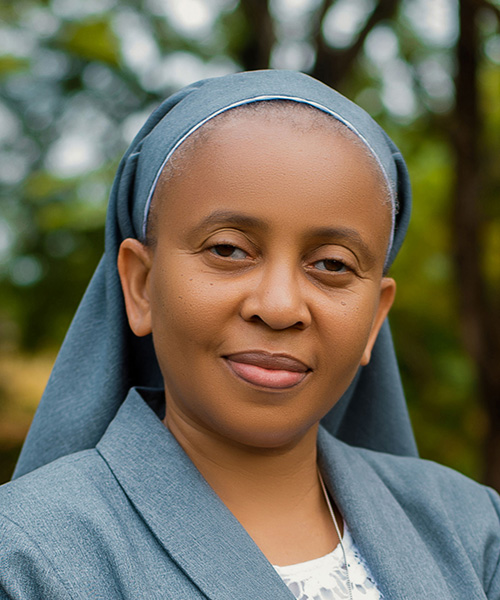
A Conversation with Dr. Ekaete Ekop, Medical Missionary of Mary
With: Ekaete Ekop Berkley Center Profile
May 6, 2026
Background: Sister Ekaete Ekop and Katherine Marshall spoke in Caux, Switzerland, during the Georgetown University Women Faith Leaders Fellowship convening in May 2026. The program’s focus was on women’s empowerment broadly but more concretely on the actual and potential roles of Catholic sisters. Sister Ekop raised the challenges of maternal health and mortality in several settings, with particular reference to Nigeria, where maternal mortality and morbidity rates are especially high. The discussion explored her life journey and motivation, and the underlying cultural mindsets that contribute to stubbornly high rates of maternal mortality. She highlights the vital importance of careful, intensive listening to women’s concerns but also on working with both young girls and their mothers to increase their basic knowledge about their bodies and to open lines of communication about it. Her comments include telling stories drawn from her experience. She comments on problems of trust, in both medical practitioners and in international actors.
Biography: Sister Ekaete Ekop, MMM, is a Medical Missionary of Mary from Nigeria. An obstetrician/gynecologist, she oversees maternity and gynacology services in Mile Four Hospital, Abakaliki, Nigeria, and has organized programs to empower women and girls to take charge of their health, strengthen family relationships, and improve health-seeking behaviors. Her work addresses the social, cultural, and systemic drivers of maternal mortality, to advance women’s well-being and productivity. She received her medical training in Nigeria. She is a member of the Women Faith Leaders Fellowship 2025-2026 cohort.
Let’s start with some fundamentals: Where are you from? How did you come to be a sister? And why a doctor? Are they the same or different stories?
I'm Nigerian from the southern part of Nigeria. I'm a firstborn, of a medical couple. My dad is a surgeon who trained in Nigeria and UK. He's over 90 now and he's getting frail, but he still sees patients. My mom is a nurse who also did her training in Nigeria and UK. She started off in Ophthalmic nursing, continued as a peri-op nurse, and retired as a public health Nurse. They are both still working in my Dad’s clinic.
I am one of five children and I was the only one who chose Medicine. My siblings chose different professions. I love the caring parts of the medical profession and I also love the knowledge, knowing how the human body works—I am very fascinated by that. I graduated from Medical School quite early - when I was 22.
At some stage in medical school, I began getting more serious about God, which grew into a desire to be a Sister. I didn't know really what it was about initially and I resisted it. But then I decided, "Let me see what this is about". I eventually joined the Medical Missionaries of Mary (MMM). I liked the kind of work they did and the simplicity and flexibility of their lives. Long ago, my parents had worked/trained in an MMM hospital. I only made the connection after I had joined.
Where did you go to medical school?
In Nigeria. I went to secondary school in Lagos: Queens College, a boarding school. I did my medical training in University of Calabar after which I had my one year of internship back in University College Hospital, Ibadan - the same hospital where I was born. Then I went to Osogbo in Osun State for my year of National Youth Service. After my Youth Service, I decided I wanted to join the convent.
I joined the Medical Missionaries of Mary in 1995 as a postulant, and I took my first vows in 1998. My first mission after vows was Zaffe in the Republic of Benin, which is why I speak the bit of French I do now. It was a first for MMM – three African sisters pioneering a new mission, a landmark. I learned a lot there and I loved my work. It helped me to spread myself from just core medicine into relationships, mission, and meeting the people in their own context. I was there for three years and a bit, and then I was assigned back to Nigeria to start my residency program in Obs & Gynae.
When I passed my Primaries exams, I went to University Teaching Hospital, Benin (UBTH) and did the residency fellowship program for about five years. I was blessed to pass the exams and became a fellow of the West African College of Surgeons and the Nigerian Postgraduate Medical College of Nigeria.
Let me tell a story that shows how I shifted my way of doing Obs and Gynae [obstetrics and gynecology]. It was 1998. As part of our Novitiate, we are sent to MMM communities to live and work with the sisters. It's part of the discernment process, part of the formation program. I went to work in a rural hospital in Afikpo run by MMMs. It was there I met Sr. Deirdre Twomey. She was Irish, a missionary Obs and Gynae doctor (she's late now). She was my mentor as well as my friend.
One Sunday, I remember, I was on call in the maternity. I hadn’t done my residency yet, so I was a medical officer working in the maternity. They brought in an emergency case, and the emergency bell was rung to summon us. This was a way to pool services as we were short-staffed. Five carried in an unconscious pregnant woman from a taxi. We all swung into action doing different things to resuscitate her. I was trying to put in her IV when the nurse called me, "Doctor." "Yes." I said without looking up. She called again and I said, "I'm listening, keep talking," still trying to get the IV needle in. She called a third time and something in her tone made me look up at her. She shook her head slowly. I looked at the woman’s chest. She had just stopped breathing. She was gone.
At that moment, Sister Deirdre walked in. She used to have that kind of instinct or intuition and would walk in when there was an emergency (we did not have phones at the time). She asked what was going on. "They just brought her, and we're trying resuscitate her, but she was too late." She immediately tried to see if she could rescue the baby. She opened the woman up and found why she had died. The baby was a hydrocephalic baby and the mother had a ruptured uterus. This was the woman’s 11th or 12th pregnancy, and she'd been in labor at home – just beside the hospital. Deirdre was very sad and angry, "Forty years. I have been working here, for 40 years, and nothing has changed. It's the same as it was when I first came, except that they now bring them in cars; in those days they would bring them on a wooden board." She had tears in her eyes. She went out and ushered in the five relatives. She was a small woman, but she had a powerful presence. When they entered and saw the woman opened up, they wanted to run back outside but she stood blocking the door: "I want you to see what killed your sister, because I don't understand why I'm here trying to help these women, and you will still not bring your people to us on time. A C-Section could have saved this woman's life." They started saying that they had been trying to persuade her to come for three or four days and her home was so close to our hospital! "We told her to come but she refused, arguing that the only child she ever had in the hospital died." When Deirdre heard that, she felt so bad, fearing that the patient’s past negative experience in our facility might have put her off hospital births. She immediately went through the Labour Ward registers, found the date of birth and everything. But in the records, we were clean. The woman had delivered the baby and she had gone home with a healthy baby. There was no problem. When she asked further, the whole story came out. It was laughable but tragic. When that child was eight years old, she was hit by a bicycle on her way to the market – she died a few days later from the injuries. It had nothing to do with the birth process, or hospital services. But somehow, by some strange logic, the woman had decided that since her only hospital-born child had died, she was never going have another baby in hospital. You have to love this woman!
But it's what Sister Deidre said that changed me: "Forty years, and nothing has changed." It made me start thinking, "How can we do this differently? What are we missing?" And this is not, in any way, a criticism about how the early missionaries did the work. They came into a crisis situation, and they saved lives in droves. But I was thinking, “Standing on the shoulders of those brave, dedicated, courageous Sisters, what can we do differently?"
What were your next steps, as both a doctor and a sister?
I went back to the novitiate after my time there and took my first vows a few months later. In Benin Republic, in a very rural setting, we started a clinic, and I saw more of these kinds of stories. I got close to the people, and I began to see what was influencing their choices.
I went for my Obs and Gynae training with the wealth of those experiences. Together with my leaders, we discerned where would be the best place to do my residency. Europe was an option, but I wanted to focus on the big things that were killing us, women in Africa. Training in Africa would keep me in sync with what was really going on. My leaders gave me their full support. It is a decision that has paid off a hundred-fold. I did my residency in UBTH. Even in UBTH, with the other Nigerian doctors who had all trained in Nigeria, I realized many did not have the experience I had had. They had not seen what I had seen, living and working with these women on ground, especially in rural settings. I often shared with them the point of view of the average African woman, and the hidden forces that influenced her. It is an aspect of our training I feel we need to put in more attention. Medicine can get very clinical, and we easily miss the nuances, the ambience, the overall picture.
I had a good residency program, in Benin. I can say, at the time, it was one of the best O&G training programs, if not on the continent, then at least in West Africa! It was quite rigorous and there were no ‘sacred cows’. It was strict. It was intense. It was thorough. I remember the Chief Medical Director drilling me when I went to submit my application. He looked at me doubtfully, "You want to do what?" I said, " I want a place in Obs and Gynae." He asked me to go and think about it. “I will offer you a place in ophthalmology or ENT or pathology. O&G is brutal. It's like a military zone. I'm a gynecologist so I know how the department works." I said, "I will try." "Are you sure?" he kept asking. I suppose I did not look like I would weather the storm of residency, but looks can be deceptive. He offered me a place. It was tough and there were times I wanted to quit. But it was a good program. Those of us who trained in Benin at that time have an edge over those who did not. This is not pride. We were trained – not just to pass the exams, but to be good in our practice.
After residency I was assigned to Abakaliki, and at that time Sr. Deirdre was thinking of retiring and going back home. She had served 54 years in Nigeria and was a living legend. She was very happy to hand over to me, and I was delighted to take the baton from her and continue the work she had done.
What took you to the path of administration?
About a year afterwards, my congregation, MMM, appointed me as West Africa Area Leader. It was a surprise and it was not how I had envisaged my life unfolding. But we're Sisters and missionaries – we go where we are sent.
I went into what was supposed to be a three-year tenure. I thought that after three years I would come back to Obs and Gynae. But before the tenure ended, I was elected the Assistant Congregational Leader of MMM. The tenure was six years and I had to move to our Congregational Centre in Dublin, Ireland, which is where the Congregational Leader and her team live and work. As much as I missed my practice, I learnt a lot from my time in leadership. It took me away from medicine, but it took me into seeing things from a global point of view. We were overseeing the congregation in about 13 countries – in Africa, Europe and the Americas. It helped me appreciate what we are about as missionaries, and the different realities that formed the context in which we did mission. At the end of the tenure, I was happy to go back to the practice.
What are the core challenges you faced as you returned to Obs and Gyne?
There are many factors that affect our practice and there are many innate forces women and their families have to deal with. One of the ways in which I work is to try to find out about these women: what drives them? They have taught me a lot. I am trying to compile stories of some of the women I have journeyed with during childbirth. The key is to really listen to them. I used to be very impatient and judgmental. I felt, "It's very obvious what you should do. If you do this, follow this path, you'll be fine. Why are you not taking this way?" But there are so many invisible forces these women have to contend with. As I started listening to them, I said to myself, "Come off your high horse, Ekaete. These women are going through a lot. You need to listen to them and see things from their point of view."
That gave me a very different way of working. It changed the way I practice. Deirdre’s words never left me: “I've been here 40 years and nothing has changed.” Just before she left Nigeria, she said to me, "Ekaete, we could open a hospital on every street, and these women will still die, because it's the mindset.” Wise words. Many of them refuse to access the services. Some will die or lose their babies within the hospital while refusing intervention.” I still feel, there's something that has yet to be heard. So, I'm trying to listen to them more.
Then I started talking to girls. "Do you understand your body? Do you know how it works?" They were coming to the hospital with incomplete abortions, ectopic pregnancies, STIs, pregnancies, etc. It was a bit hard and heart breaking in at first but I kept at it. “Listen, I am not preaching. I'm talking to you as a woman. Let's talk woman to woman." I would go to talk with them before they went home. I would make a few diagrams and explain. Over time, I realized, these girls knew next to nothing about how their bodies functioned. They were engaging in risky behavior with zero information and with no idea of the consequences of their actions.
My Part One long commentary was Knowledge of STIs among Secondary School Children in Egor Local Government. (It was later published.) I recruited 721 students, in four secondary schools. And the knowledge was almost zero. It was a bit better among the boys, but the girls, nothing. Many of them had been sexually exploited before the age of 12. That's abuse. I lived in a town where the girls were really living wild, with no idea of what the risks were.
After I passed my Part One examination, I wanted to do something about my findings, so I started going around talking to girls. I didn't have a projector, so I used to draw diagrams on flip charts, or cardboard paper. I would take motorcycle taxis wherever I was going. Once the word was out, girls/young women groups in the city started inviting me. Some groups were in the University campus. I remember a young student who came to me in the hospital: "Sister, we heard you give talks to girls but, we are not Catholic. Will you come to us?" "You are a woman - yes? That's what all want. I'm not looking for just Catholics. I am trying to help you young women make healthy life-giving choices." So I spent my free weekends during residency going to different churches, different groups, and talked with women and girls.
I was invited once by a scripture group in the university, but when I arrived, there were about 4 or 5 students in the hall. The leader apologized, "Sorry Sister, we had prayer vigil and most of our members are tired and have gone to bed. Maybe we cancel…?" "Not unless you want to. I don't care if you are two or four people. I will give the talk if you are ready." They were happy that I was not going to cancel. There were four or five students in the first-row seats. When I began talking, I noticed some of them typing on their phones. I heard later that they sent texts to their friends: “Come up and hear what we're hearing.” Students who were passing by the hall overhead some of the conversation and came in. There were about 53 or 54 students by the end of the program, coming in from everywhere. To them this was a forum where they could talk about things they couldn’t talk about anywhere else. These were taboo topics, and I was talking about these things freely and inviting them to share their experiences and ask questions. It was the safe space they had always needed. Telling them how their body works. Showing them pictures, asking: "Do you know this? Have you looked at yourself like this before? Do you know why this happens? Do you understand being sexually aroused? Do you understand the cycle and how it works, and what it does to you? Do you know what abuse is?"
I had planned to do a one-hour program, and it ended up taking up to four hours. This happens often. They don’t want to stop; they want to ask the questions they could have asked their moms but dared not. "We don't talk about these things" is the norm.
Many times at some of these seminars or talks, I realized that for many of the girls I was talking with, I was too late. I could sense the regrets in the room, the pain, the heaviness. So I started going to younger girls – secondary school age, so they could make informed life choices.
As time went on, I started getting exasperated. "Why am I telling these girls things their mothers could have told them?" I was planning to do a mother-daughter encounter program, but then I had to move to Ireland. However, God always finds a way. In the COVID pandemic year (2020), my younger sister reached out to me to do a live video. I write a lot, but I didn’t think I could do videos. My younger sister does not understand ‘I can’t’. She was persistent. "Why don't you come on my Facebook page and do a live program?" she pleaded. "Please, please. Women are at home, they're idle and bored. They're eager for engagement. Just tell those stories you often tell me."
So you did?
I did and I couldn’t believe the number of women who tuned in. Following that, people started inviting me to talk in small groups. "Can you talk to us in a Zoom?" It was a door opening up for me. So that year, I began a series, called “Rediscovering Your Teenage Daughter” for African mothers of teenage girls. My focus initially was, "Why are you not talking to your girls? Why do they not have access to your wisdom, your experiences?" As they shared online, it dawned on me that they too were struggling. So the focus changed to supporting mothers who had daughters. We had that program for six months, during the pandemic. I was in Ireland and was reaching out in real time to African women all over – they were not only listening to me, they were listening to each other and learning from each other. It was beautiful. We did this twice a month, for six months. The women would invite other women.
By December, over 150 women had attended at least one session. I announced that we had come to an end in December and in the last session, I asked, "What changes have you noticed in yourself?" Many of them had transformed their relationships with their daughters. Many families had been helped. I was very happy.
The next year, the women started asking, "When are we starting the program for mothers of teen daughters?" I was surprised and told them that that program had only been for the pandemic year. "You can't be serious! No, no, Sister. We've told our friends and other women who have difficulties with their daughters. They are waiting for the program." So that was one of the good things that the COVID pandemic birthed.
Since then, I regularly run programs online for women and talk about different aspects of our life and wellbeing. However, online doesn't do always do it for me. Sometimes, they are in physical spaces that are not safe for them to talk. I prefer the in-person programs when I can actually draw women/girls into an experience and they can interact more among themselves. The focus is not me; I want them to discover their own innate wisdom and live/share it. A parish invited me once and I brought the women and the girls together. The girls first, then the women for the next session, and the third session I brought them together. I tried to help each party see the other in a more compassionate light. "Girls, don't judge your mothers. They're doing the best they can. And mothers, listen to your girls. I know you're scared. I know you are afraid they're going to get in trouble, but don't let the fear lead. Let love lead. Get close to them, so they can tell you when stuff happens. Bridge the gap. Listen to them, so that when they make mistakes, they can come back home. Nobody else will love them like you do.”
I'm trying to work on an approach based on: “Let's talk about our experiences. Let’s discuss these taboos topics. Let us change the narrative – slowly, tenderly.” Some women are sexually abused by spouses, and some mothers tell them and their daughters, "We don’t say these things. That's how it's supposed to be." No, it's not. That you suffered it doesn't make it right. Let’s break unhealthy cycles. Some girls are being abused. When they report to you, you say "Shhh, guard the family name." No, you can't sacrifice a girl’s future and happiness, because of the family name. You are not being fair to either the abuser or the victim. Thus, I create spaces where women can begin to talk about these things. I am happy with the transformation and healing I have been privileged to witness. I have my work cut out for me in the hospital, and this other work as well. Each of them flows into the other - when I see disasters in the hospital, I am moved to go out and prevent some of these disasters from happening. So that's my story.
Please tell me a little bit about your order. You said you came by different routes to be part of your congregation. How big is the congregation? And were you leading the whole congregation?
No, I was not the Leader. I was the Assistant Congregational Leader and so a member of the Congregational Leadership Team – we were four on the council.
The congregation is called Medical Missionaries of Mary. We're not many in numbers, but we're really a powerful group. It started with an Irish lay woman, Marie Martin, who went to Nigeria as a volunteer in 1921. She saw women dying in childbirth and families in distress, and she said, "We need to start a congregation of Sisters that will cater for these women and for these families." She applied to the Vatican, but Rome said No: "Sisters don't do obstetrics, or midwifery.” (There was a Church law at the time to that effect.) But she knew what she had been given to birth. It took her twenty years of talking to bishops, and nuncios, and the Vatican, for the Church to finally give her the approval.
In the intervening years, while still searching and waiting for permission, she had joined the Holy Rosary, on persuasion. She felt, though, that this was not her call. She did not want sisters in the traditional model at the time – praying seven times and covered up with long gowns. She wanted her sisters out there with the people and dressed in a way that was not cumbersome. “No, I want them out there." Her modus operandi was like that. That was very strange at that time, for the Church. In 1937, on the 4th of April, they granted permission. At the time the news came, she was in a hospital in Port Harcourt – she was very sick but she made her vows, lying on her hospital bed. Two weeks later, she was on a ship back to Ireland, and instructions were given to the companions, two priests who were traveling with her: If she died at sea, just to throw her overboard. But, she didn't die then. She died in 1975 – 38 years later. I suppose the joy of receiving the permission was enough to give her a respite.
She then began bringing leprosy care and maternity care to different parts of the world. She opened missions in Africa, Europe, Asia and the Americas. She moved around and established this congregation of women who could move around, live and work with the people, at a time when the Church was still putting sisters in restrictive and very conservative clothing. We had our veils then, the way we have them now, and our sisters were out on bicycles. They used to call us the Mad Gray Nuns, in Ireland! The Mad Gray Nuns, because we're everywhere on bicycles, doing things that sisters didn't do at the time. But that was her. She was radical, way ahead of her time. She saw the maternal mortality crisis and created something tangible to respond to it almost 50 years before WHO responded with the Safe Birth Initiative.
So that's the kind of congregation I belong to: prophetic, with a charism of healing and development. We used to be, though now I've lost count, in 14 countries around the world, eight in Africa and others in Europe and Latin America. We were in Honduras, when it was the murder capital of the world. Our congregation has expanded and our understanding of medicine and healing continues to broaden. Anything that will upgrade the wellbeing of peoples and environments – we are not into education. We have doctors, nurses, all cadres of healthcare workers, and pastoral care workers, as well as accountants, administrators, and social workers.
About how many?
I'm not sure, now. I think we are about 320. We're a small group. But very impactful.
To understand maternal mortality levels, I have heard you emphasize that you have to understand the culture. How is that the main obstacle? What have you learned from listening to people?
Sometimes the health service providers are very far from the women, not geographically, but in terms of thinking. I used to be, too, so I can understand the problem. Let me tell you a story that explains this.
A Fulani woman was admitted during my residency with placenta previa. It was her sixth pregnancy. She had delivered all her previous children at home, but this time the placenta was lying in front of the baby, putting her at high risk. She needed a C-section. She was a third wife. Her husband was involved, the co-wives were attentive, and they all agreed for the surgery. In fact, they insisted that the husband should sign the consent form, even though she could have signed it herself. She herself preferred that he sign, so he did. He paid for the surgery and everything was set for Tuesday morning.
But Tuesday came and emergencies flooded the theatre and by late afternoon we still had not operated on her. I went to apologize and asked her to eat, promising we would do her case first thing the next morning. The next morning, we prepared her for theater. As they wheeled her out of the ward, she kept saying, “My husband has not come.”
I thought she was anxious because he was absent. “Don’t worry,” I reassured her. “He already signed the consent. By the time he comes, the baby will be out.” But she kept repeating it. “My husband has not come.” In the theater complex, as they prepared for spinal anesthesia, she suddenly said loudly, “I will not do it until my husband comes.” The nurses looked at me: “Sister, your patient is not ready.” I was irritated. We had to wheel her back to the ward while I rushed off to a busy clinic, annoyed that she had wasted valuable theater time. Not long after, the husband came looking for me. “Doctor, please forgive her,” he pleaded. “Don’t mind my wife.” I followed him back to the ward and instructed the nurses to prepare her again. And there, standing in the bay in front of several patients, I launched into a lecture about women needing to take responsibility for their own health. Why should a woman wait for her husband before having life-saving surgery? Why should she risk her life like this? The women listened quietly. We eventually did the surgery. Thankfully, all went well.
The baby was delivered safely and, as I was closing the incision, I finally asked her: “Hajia, why was it so important that your husband come before the operation?” Her answer stunned me. “Doctor, I have had five children and never had a problem before. So if this pregnancy has brought trouble, it means I must have offended my husband somehow.” I stopped suturing for a moment and looked at her. “Offended him how?” She shrugged slightly. “Maybe he asked me to do something and I grumbled. Maybe I refused something. I don’t know. But there must have been something.” Then she added quietly: “So he needed to come and forgive me before I entered theater. Because I could die.” I was silent. All my preaching that morning was completely off the mark. She was not refusing surgery. She was trying to enter it at peace. It was not permission she wanted, it was absolution
And if I had listened instead of assuming, she might simply have told me: “I just need my husband to pray for me before we go in.” Instead, there I was—on my high horse, removed from the world she was living in.
There are so many stories like that. We are not in the women’s worlds, understanding the forces that the woman is working with, or what is frightening her, what is making her make what we think are ‘unwise’ choices. So over the years, I started talking with them, listening to them, and trying to debunk some of these myths, gently; trying to meet the woman halfway. I am learning to listen to them, to walk their paths even for a bit. They're not always right, so I find the best way to pass the information, in a way that they can receive it. And not simply to preach or instruct.
For some, a Cesarean section is not a real birth. A woman came to me and I asked her whether she had delivered a child before. I wanted to know if she was a first timer or not. She said, "No." So I took her in and admitted her. While I examined her abdomen, I saw a surgery scar and I asked what operation she had. She answered: "Oh, for my baby." "So you have a child?" I was bewildered. “Of course, I have two children,” she retorted. “But I asked and you said you had not given birth before”. She said, "I haven’t. It was not childbirth. It was operation.”
Where I'm working now, every last Tuesday of the month, I give a lecture using PowerPoint, and I show them pictures and videos to help them understand. We need to meet them, to understand their fears, and to listen to them. It’s a slow process and the transformation won't happen in one generation. We have to be patient and committed. A woman comes in for her eighth child and you wonder why when she has so many complications. And maybe not even enough money to take care of them. Then you sit and listen to her: her seven children are girls. Guess what she's looking for? These things can be handled. We had an MMM Sister, Sr Leonie McSweeney, who did a lot of work with families. She taught women sex pre-selection. If you understand your cycle, you can plan a male or female child. It's 98% successful if you know your cycle. They don't know this. In our hospital, we teach that as well. A woman can plan, and have the number of children she wants and the gender too. We know you can't tell them, "It's okay to have only girls." That's nonsense in the culture.
Culture influences everything—even the doctor’s choices. During a Caesarean section, if a woman bleeds uncontrollably, we are taught to remove the womb to save her life. But I am African, and my patient is African. I know what losing her womb may mean for her. So I fight to save it. Most times, we succeed. Sometimes, we do not. And when the bleeding refuses to stop, I still hear myself asking the nurse: “How many children does she have?” “Four, Sister.” Then the next question: “How many boys?”
It should not matter. But to these women—and sometimes to me—it does.
The statistics indicate that in Africa, one of the reasons women die is the doctors’ hesitation to take out the womb. This is one of the reasons behind the hesitation. We're working within a context. She might have a uterine rupture. A uterine rupture should never have a baby again, according to the books. But we patch the women up and give her another chance with a strong warning. "In your next pregnancy, we will admit you at six months and deliver you before nine months.” Most of them comply to avoid another disaster. We have had many success stories. We do this because we know what premium is put on reproductive potential of a woman, so we try to preserve it. It's not mainstream obstetrics but when you say you are saving life, ‘life’ means different things to different people. For many women, life without children is not life.
Those are some of the things we talk about in our women’s sessions.
And now you're working with the girls?
Yes, I'm working with the girls, and the mothers. I'm trying to get these girls not to make the mistakes their mothers are making. If I can reach them earlier, they will have key knowledge. It matters who you marry. If you marry a man who says, "My wife can't have a cesarean section," you shouldn't marry that man, because you don't know what your reproductive journey is going to be like. We talk about this. We are also trying to get the men on board, but I am less confident there. I'm not sure I know enough to work with the men. I know women and I know them well. I'm a woman, and I've worked with them for years, but I don't know whether I know enough about how the man thinks. But what I try to do is get the men, sometimes, to understand the woman, to try at least to understand how she thinks.
Women need to talk about things that we're not talking about. For instance, I insist on couples coming together for infertility consults. She might say that she’s been married for four or five years and still has no baby. A question I always ask: "How often are you and your husband having sex? How often did you have sex last week?" Sometimes the response is "No, we didn't have sex all last week." "In the last month?" "I think we had sex like twice." "You meet your husband twice in a month, and you're looking for a baby?"
Then we start teaching them about her cycle, and how short the window is for ovulation. She's like, "Oh, really?" Sometimes the problem is the way churches teach young people about sex. They make it look bad or dirty, so when the girl is grown up and gets married, her understanding of sex is all messed up. She was told, "Sex is bad. A good girl doesn't have sex." Now suddenly, she's married and the old record is still playing in her head. In our sessions, we try to talk about these things. I explain: "If you really want to have a child, the first thing you need to do is to meet your husband more often. When you ovulate, the egg is only alive for 24 hours. If you don't get with your husband often, your egg can’t get fertilized." That's basic. But they don’t always know this. I discuss results of the tests with the couple, letting each know what they have and what the partner has. Sometimes some men are uncomfortable about their wives knowing they have low sperm counts but they want to know if their wives have blocked tubes. I know some colleagues who will not say the man has low sperm count in his wife’s presence. They just have this, what they call "bro code" – like a men solidarity thing. That is not good communication. It’s a couple’s problem, we should help them solve it as a couple. Communication and mutual support is key.
It'll take a long time, but we're getting there slowly.
In Tanzania and in Uganda, you hear that the key thing is to get the women to the hospital for childbirth, because the potential for survival and dealing with emergencies is so much greater there. But you're saying that even getting to the hospital it’s not enough. They have to have the confidence and the knowledge, even before the confidence.
The knowledge will bring confidence. But for me, if you can give it to them early, long before they even start thinking about dating or marrying or having kids, you win. By the time you're talking to a pregnant woman, you're struggling against so many obstacles. Her mind is already set about certain things.
A woman came to me. She had had three cesarean sections, and each time for a dead baby. She would go somewhere, and try somewhere to give birth, and then they would bring her as an emergency, and the baby was dead. That happened three times, and the woman came with a fourth pregnancy. I told her not to worry, creating a positive picture in her mind. "This time your neighbors won't come to tell you sorry. They will come to say, Congratulations. Let me help guide you through this pregnancy. So you're going to do some tests today and then come back for the results next week. Every time you come to the hospital, because it is you, I will give you my phone number.” I don't give patients my phone number, but I gave it to her, and told her that I would see her each time she came to the hospital. We did the tests and she came back the next week and her results were good. She was to come every two weeks. The next time I saw her was three months later, when they rushed her in – womb ruptured, baby dead. I remembered her because I had written a note on her folder. I asked her what happened, when we had an agreement. She said that they wouldn't let her come. We took her to theater, brought out a stillborn and took out the womb – it was beyond salvaging. It's over. Her reproductive journey has come to stop. When I met the man with the baby’s corpse that they insisted on taking home, he started crying. I said, “Don’t you dare. Don't even try to justify it. You're lucky we were able to save your wife’s life. You wouldn’t bring your wife to hospital? And now you want to cry?” The men are not the ones carrying the pregnancy but they are the ones making the decisions. Now four times she's been pregnant, and there's no baby. Four surgeries. He is definitely going to marry a second wife, because now she can no longer produce children. He had ended it for her.
It's painful. They are not far from the hospital, in geography, but they're very far in other ways. Accessibility is not always distance. There are times I take some back, winding paths to help these women. This woman said that they would not let her come to hospital. They. Those are the forces we need to understand and engage.
I love working with these women, and I would do a lot to make it better for them. I try to focus now on the younger generation to help them change the narrative as they grow older.
One last question. I've been surprised at what I've sensed among some of the sisters, about skepticism about vaccines. Where is that coming from?
There's a whole propaganda going on. Some western funders are looked at with suspicion. I think there were things that happened long ago that still influence people, especially when it comes to Africa. Many people think Africa is being used as a Guinea Pig. And some people are building conspiracy theories on this. We hear things like “They want to sterilize all Africans. They want to reduce our population. They want to test the vaccines on us.” There are a lot of conspiracy theories going around and this is affecting the uptake of many interventions.
I don't know who brought it up, but it was very dangerous, especially during COVID, because people wouldn't go for the vaccine. There was actually a time, I think it was in Northern Nigeria, where some people came out with what looked like a polio vaccine, that later was found out to have something to do with sterility, or reducing fertility. There's a lot of propaganda about vaccines. I don't know exactly what the story is in Kenya, but these stories get peddled around and it’s hard to know what is true and what isn’t.
There's something going wrong about trusting. There's no longer trust in the global bodies. Everybody thinks somebody is out against the Africans, to put them down. For example, that they're going to test the COVID vaccines on Africans, and it’s just lucky that we're not dying as much. There's a lot of skepticism about, and it's not helping anybody, because people who could have gotten care are not getting it, because of all these stories around. For example we were told that the COVID vaccine was 5G and a chip was going to be inserted in us. “It's going to sterilize everybody. It's going to block our brains." Intelligent, educated people were saying this.
A lot of critical thinking is needed. We joke about it, but it is serious. Even if we leave aside the vaccine problem, there isn't that much trust among the local people with the medical profession. It doesn't help that when people are selling natural remedies, or complementary medicines, they say things that aim to make the doctor look bad, to promote what they're promoting. But the systems should be complementary, with no one trying to harm anybody. They are just doing what they were taught to do. If you have more knowledge, let's add it, not knock something else down because of marketing. By cutting it out, you're reducing the access people have to medical care when they need it. Not everything can be cared for naturally. It's a conversation we need to have, because we're not against each other. Let's stop using this thing to get traffic on our own side. We can work together.
You also expressed a lack of trust in data. We agree, of course, on the reasons why data is important, and perhaps the wrong reasons that people cling to it.
Good data and statistics are important assets. But I know too well that data can be corrupt. If the data were always accurate, there would be no problem. But I know some things happen, including politics, that can influence data. That's where my concern is. They will tell you, "Maternal mortality has been reduced". Sometimes this is said to justify the huge expenditure that has gone into that initiative. The data collecting system, especially in remote areas, needs to be improved on. That's my skepticism. I think we should use data for decision-making, but I'm not sure the data that we're being fed is accurate. You have to have systems to monitor that the data being put in are correct.
I'm very aware of the need to have a positive story. We hear that now, about Africa. Bad stories about Africa mean that people don't invest. But a false positive story is not helpful, in the long run.
I agree. Many stories in the media about African countries create bad images. We need to tell all the stories, especially the good ones. Sometimes people will ask us to share pictures that depict poverty, helplessness, "Give me a picture of a woman coming to hospital with her bicycle stuck in the mud." Because they feel this is what will tug on the heart strings of donors. Does anyone think about what that does to the dignity of the people? How do we encourage people who are doing the right thing, who are inventing and uplifting the people if all the story going out is, "They are needy, they are dying. Nothing is happening"? There should be a balance between the two. There are wonderful things happening too. Like people who go out of their way to build free schools or those who invent equipment to save babies’ lives.
Another problem is that attention spans are so short. People only listen for an instant. The complexities, the different layers, the stories you tell, takes time and patience and interest.
I think we need to learn to listen more to be able to make a difference. If the W.H.O tells you that there are five main causes of maternal mortality, they're not wrong. But that's very superficial, because there are stories behind each statistic. Take postpartum hemorrhage, for example. Women bleed after childbirth in Switzerland, in Algeria, and in Nigeria. But the outcomes are not the same. If bleeding alone were the problem, why are women dying in far greater numbers in Nigeria?
We're looking at things like people not wanting to donate blood, or people who are scared of receiving blood or they are too far from the hospital and arrive too late, blood banks not available, failed referral systems. There are many layers. That's where my reflection really goes. "Why did this woman die?" I'm tracing it back a bit, looking for the source, so I can prevent another 10 or 15 from coming down that same road. That's the way I look at it. A deeper reflection is needed. I am looking to see if I can get people who have the power to reflect a little bit deeper. There are no instant answers to this problem.
How can we help girls make different choices as they grow into women? I once asked a group of women in church, "What do you know now that you wish you had known when you were still girls?" And I couldn't get them to stop talking for the next hour. They were so full of regrets. I asked another question, "Now that you know these things, are you ensuring that your daughter knows them too?" "No. We don't talk about these things." It’s that silence we need to end.
I like what I do. It is an honor and a privilege to accompany women and help improve their wellbeing. I desire to do more and do it better. This Women Faith Leaders Fellowship is challenging to reflect more, keep listening and be open to new possibilities. For this, I am deeply grateful.