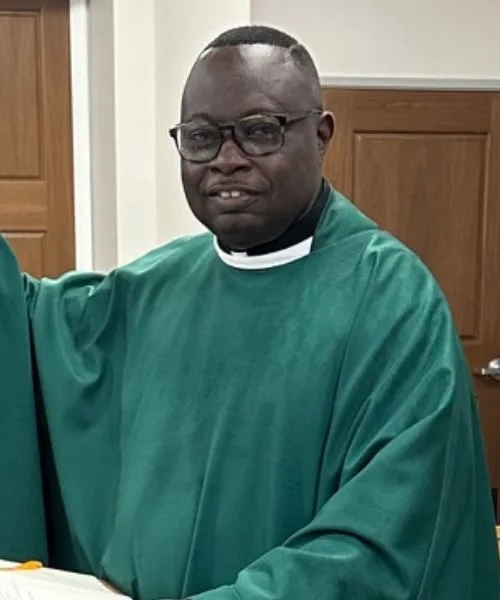
A Conversation with Fr. Peter Alpha Konteh, Caritas Sierra Leone
With: Peter Alpha Konteh Berkley Center Profile
May 11, 2026
Background: Father Peter Konteh and Katherine Marshall met in Taiwan, during celebrations for the 60th anniversary of the founding of the Buddhist Tzu Chi organization. Tzu Chi is active in Sierra Leone, beginning with emergency support during the Ebola crisis and expanding to other areas of compassionate support. The conversation took off from the Tzu Chi events, extending to other areas, drawing on a book about Fr. Peter’s journey and work, that reflected wide ranging shared priorities and concerns. Those include the roles that Caritas and the Catholic Church play in Sierra Leone, its role in health care, responding to the Ebola and COVID-19 pandemics, peace making and reconciliation after Sierra Leone’s bitter war, and social challenges like drug use. The issues of trust and the need for mindset changes was an underlying theme. Father Peter’s 30 years as a priest and activist have seen him involved in many challenges, seeking solutions that are fully grounded in community realities.
Sent to Heal a Wounded Nation: The Story of Father Peter Konteh, by Agnes Aineah, 2025, Paulines Publications Africa, focuses on Father Peter’s story, especially during the war years.
How did you meet Tzu Chi? We can begin there, though I hope we can explore some of the many parts of your life story.
During Sierra Leone’s Ebola epidemic, we were very challenged, both because so many lives were lost, and the need to address the means of transmission (including burials that were what people expected but contributed to the spread of the disease). So we are totally stuck. And then economic life got shut down. I wrote to a man working for the UN who was head of UNIDO, Kandeh Yumkella (he is now aspiring to be our president!). I told him: "We're in a difficult situation," and he answered, "I know this group, Tzu Chi, and I will link you up." Fortunately, a Sierra Leonean, Steven Fumba, was volunteering for Tzu Chi (in the Philippines), and he told them that Sierra Leone was asking Tzu Chi to come. Fumba led the team to that responded to us in that emergency.
Tzu Chi had never been active in Sierra Leone before that?
Never. That was their first encounter. But since then, the relationship has continued from one place to the other. It’s now about 12 years old. The first 10 years were all about compassion and relief, all relief. After 10 years, they had our university to do an assessment of the impact. Out of the impact analysis, we realized that the next phase could not be just receiving aid, like rice. We needed help to sustain the effort. So what we are doing now is supporting farmers with seeds and food for work. In the past, Tzu Chi had sent quite a lot of rice to help our people, including the Ebola survivors. They shipped a lot from Taiwan that we (Caritas Sierra Leone) distributed. We have now agreed to reduce the amount of rice that comes in to 60%, and we buy 40% from the farmers. The overall amount has not been reduced, but now the effort is empowering the local market, giving jobs and opportunities to family economies. As we progress, we'll continue to reduce the amount of rice coming from Taiwan and strengthen local farmers. For me that's sustainability.
They're also helping us with medical materials for our hospitals and clinics. They ship medical supplies and of course the emergency things like blankets and multi-grain food packets.
They are also supporting some youth programs (alongside the Healey Family Foundation). At the moment we have a high incidence of young people taking drugs, especially a local version called Kush. That is devastating our future, because it’s not only the dropout boys, but even in the universities. I recently built a center for rehabilitation. We started first with girls, and we are now constructing ones for the boys. I wrote the project for a group in Spain that supports us, linking it with agricultural and skills training. But I forgot about some basics. So I ran to Tzu Chi again, saying "Listen, these are girls, they need sanitary pads." That was not in my mind when I was writing. Tzu Chi have helped us with basic things that were omitted in the project design. I've asked them for support for sewing machines, not just in the rehabilitation center, so they will develop skills. We are involved in psychosocial response, with mental health doctors. There is a collaboration of different teams. At the end, the people need skills to survive when they go back to their community, so they do not revert back to what they were doing or become prostitutes or all sort of things. We are building their minds but also building their ability to survive.
This is all Caritas? How long have you been involved with and leading Caritas in Sierra Leone?
Yes, all through Caritas. I've been a priest for 30 years, and for 24 of those years I have been in Caritas.
How active and large is Caritas Sierra Leone?
We have four dioceses in the country, based on the regions. We are in the city and in rural areas. My staff strength is 120, which includes the hospital and clinic staff. We have various departments, and we are also big in research; we collaborate with Harvard and Boston University to do various projects on child soldiers, on Ebola survivors, and other areas. We have a large gender department, because there's high violence against women and rape. We are doing all kinds of programs to help young people and for them and us to lobby to the government for stronger laws.
Caritas has three departments. A justice and peace department has volunteer lawyers who come and give us support when there's a rape case, when a poor man's land is taken from them, for example. We try to mitigate problems in communities, because we had 11 years of war and the war escalated because people seek personal revenge. The department jumps in and tries to solve those community issues. We have the health department that involves not only hospitals and clinics. We also do a lot of awareness work. We have a mobile team that goes into slum communities to provide support, for example to those who cannot go to the hospital.
Caritas internationally is based in Rome, the headquarters. Caritas actually started in Germany in a place called Freiburg, but Rome is the headquarters. Then every continent has their own continental office: Caritas Europe, Caritas Africa, etc. And then there's a national Caritas. I have served at all levels, including the diocesan level (I'm still the director of Caritas Freetown), and I'm the national coordinator. I was once part of the team of Caritas Africa, based in Togo.
So many issues flow from your story! How does the Caritas health work? How do you fit with the national system? Does Caritas own and run hospitals? How does that relate to the Catholic health work?
We have a structure called CHASO, Christian Health Association. We're all members. We are board member of CHASO, and coordinate all the faith-based health, which constitutes 60% of the healthcare in the country. Among that we (Catholics) have 25% on the facilities nationally. The others are like the Methodists. They are independently funded and run by the different faith organizations.
Is there an MOU with the government?
We definitely have an MOU, and I was among the signatories. At that time I was very involved with CHASO to make sure we had clear understandings. For example, we have duty free privileges, so that we can bring medical supplies and other products in without duties. The Government is supposed to keep their own obligation to subsidize some of our medical personnel, but that part of the MOU is very slow. We've not got that working. But in terms of advocacy, they do support us: if we are doing a campaign, there's always somebody from the ministry of health that will represent or come join us in our activities. We take part in the national campaigns like for vaccination. We are always part of that team. But the hospitals and clinics are independent. In terms of grants, in terms of funding, we don't get much on the financial side.
Is there talk about nationalizing all the health facilities?
There is talk about that, but it's been just talk. When it's election time, you have politicians campaigning along that line. There's talk about getting the national insurance. But it's not there.
You had the Ebola crisis and then COVID. You've lived through successive crises.
After Ebola, we were just trying to rebuild our lives. We were trying to regain our economy and institutions after the long war, and then Ebola struck. Then we moved on to another phase, where we had a huge mudslide, and a lot of people died. Then there was COVID.
COVID didn't affect us as much healthwise, for various reasons, but it affected us economically quite a lot, because a lot of people depend on remittances from families who are outside. They were affected and so it affected us. But on the medical side, I was very worried as the news came and we reflected on what would happen if COVID really hit us, because there were only two ventilators in the entire country. But because of our experience with Ebola, we know how to do family contact tracing. That knowledge helped us quite a lot, and during COVID, less than 200 people died, because our experience with Ebola helped us to do the basic things that we could do to prevent spread of disease. But economically it affected us so much.
You were involved in the critical effort to address tensions around burials during the Ebola crisis. The process is viewed as a pivotal moment and an illustration of wise religious engagement during a crisis.
Negotiating the dignified burial process, during the Ebola crisis, was one of the most sensitive and emotionally challenging moments for us as religious leaders and humanitarian workers. In Sierra Leone and many parts of Africa, burial rites and family participation in funerals are deeply connected to culture, faith, and respect for the dead. During Ebola, many families initially resisted the “safe and dignified burial” procedures because they could not touch, wash, or traditionally bury their loved ones. Some communities even believed the process was disrespectful or that Ebola itself was not real. As religious leaders, we worked closely with health authorities, communities, and international partners to build trust and understanding. We helped explain that the temporary restrictions were necessary to save lives and stop the spread of the virus. Through dialogue, prayer, community sensitization, and the involvement of faith leaders, many people gradually accepted the process. The goal was always to ensure that, even under strict health measures, the dead were treated with dignity, respect, and prayer.
Were you part of the WHO, World Health Organization, networks during Ebola or COVID?
Yes. We had a lot of coordination and team working together, at the local level, not at the international level. For example we interface a lot with Sister Barbara [Brilliant; from Liberia]. She's a wonderful person.
We also had some contact with her about AMR, anti-microbial resistance. Has that been an issue in Sierra Leone.
That's certainly an issue, because there's a lot of fake drugs in our markets. A lot are produced in India, Nigeria. So you take Panadol, you don't feel the effect. And people self-prescribe the antibiotics. In our place there's no regulation. You go to a pharmacy and buy whatever you want to buy. Nobody asks you for a prescription. So it's been abused.
We were involved in meetings in Rome on AMR some years ago. An issue raised there was the need for better water systems in hospitals across Africa.
Can we go back to the war, Religions for Peace, and the Interreligious Council. Tell me a little bit about that story, how you got involved and what you did.
I was at the initial point at the beginning of the Interreligious Council. Fortunately, a Catholic priest from the World Council of Religions for Peace, from New York, traveled and stayed with me: Father Macaulay. He was part of the World Council for a long time. So he came to establish this Interreligious Council in Sierra Leone This started before the war. Two months later, our war started. We then became a valuable tool. We became the voice of the voiceless. I was part of it. All traditions were involved: Catholic, Protestants, Evangelicals, Muslims. The Muslims are a big force, even up to now. At that time, our government was forced out by the rebels. They were in exile. So we were the ones going to the government, trying to get them to come back, and we were in contact with the rebels. We made several trips to establish contacts and move forward. So the Council became a valuable voice in the country. Ever since then, when there are issues, we all come together and challenge them, including big issues about corruption, whatever topic arises.
During part of the civil conflict, the government of Sierra Leone operated in exile in Guinea after the coup. During that difficult period, we as members of the Inter-Religious Council of Sierra Leone made several visits to Guinea to engage in dialogue and peace negotiations. Our mission was to help facilitate understanding, encourage reconciliation, and support efforts toward the peaceful return of the government and the restoration of constitutional order in Sierra Leone. Those encounters taught me deeply about the importance of dialogue, faith, patience, and national unity during moments of crisis.
So it's not just blah, blah.
No, this is really about action.
What are the biggest issues that you think that council can deal with?
We are trying to fight against tribalism, which is affecting our society. If the government politics is divided into two and based on region, people don't vote because of the manifesto or position, but because "my father was in this." So when one party takes over, they employ only people with their same ideology. People who are qualified or who could do the job are pushed out because it's not their party in power. This is one issue we always talk about: we are one people regardless of your ideology. We are one people. That’s something we always highlight. And youth violence is a big issue. These politicians give drugs to the youth and that makes them violent. So we are campaigning and also educating the youth that, "You are destroying your future by involving in this trouble."
Rape is another issue. There was ridiculous raping going on, because of rituals. So somebody will say: "If you sleep with a virgin, everything will be okay with you financially." So they started raping even two year olds, maybe just with that mentality. So we went after the ritualist who prescribed those things. We had to arrest several of them.
There is much talk about deliberate efforts at reconciliation in Sierra Leone. How much are you involved with that and how effective is it?
After the war, we had what we called the TRC, The Truth and Reconciliation Committee. It made recommendations and part of the recommendations was that we religiously should try to reconcile our community, because it was very clear, even in our churches after the war, that there was great need. Many, ourselves, wondered, "How do I preach that God loves you?" when you see a victim and a perpetrator, somebody who has raped somebody's wife sitting down beside you. And you tell the whole community on the Sunday morning, God loves you all. So it was very difficult. The consolation and reconciliation were hard. For me, there was a need to build a structure there, rather than focusing on the buildings that were destroyed. Gradually, gradually we came through to a point that people who were bitter enemies because of the atrocities will now sit and talk, at least at that level.
It's not a sort of systematic process. It's a parish by parish?
Parish by parish, faith by faith. There was the official national reconciliation, which on the surface has not produced much healing. But the actual healing took place in our parishes., I remember once a vivid experience. There was a guy begging in front of the cathedral. I was in a cathedral, and then a well-dressed guy with a suit wanted to him give money. The guy who was begging said, "I don't need the money. You were the very guy who chopped my hands off, though I begged you that I needed these handa." There was a big scene and I was called. I came and tried to get them together. The guy said, "Father, I heard your sermon about reconciliation. But let this guy imagine that my eight-year daughter has to help me when I urinate. Do you know how humiliating that is for me?" The guy was crying. Eventually we succeeded in bridging the tension.
In your book, there’s a story about a donor who wouldn't accept a receipt because it wasn't signed, but the guy involved was a double amputee. Is that true or just used as an example?
No, it’s very true, and a clear example. The point of that story is that when you sit in the headquarters your heart may not be in the project that you support. There was a priest who helped me to get funds from an organization in Italy for a pension for those who could not work. We used to give them a monthly allowance. I wrote a beautiful report. But then the lady in Italy called saying "This is unacceptable. They told me you were a honest guy and this happens. Why?” I answered by asking them if they would allow signatures signed by the man’s feet as both his hands were chopped off. I said I would stamp it. The lady cried. For her, it was really just a checklist. She had no concept of what it was about. I told her: "So your emotion is not even in the project that you're supporting." She apologized.
There’s a disconnect sometimes between what is required and what makes sense. For example, we implement a project and the deadline for your report is Tuesday. Tuesday, no report. Why? We don't have an internet connection for four or five days. But the person sits there and does not understand, thinking that the guy is not serious. They fail to contextualize our real problems.
Those are good if unfortunate examples of stupidity that happens all too often.
We're here in Hualien, and I see you sending back messages all the time. Who is your community that you are communicating with, and what interests them particularly? You are serving as a reporter!
I'm responsible for communication in our archdiocese. I am also the head of National Catholic Communication. I have a media team that publishes regular newsletters and update news. We have a radio station. As I'm here, I broadcast some things live, sometimes not even about here, about the current situation. I'm very strong about opposing the war and I've been in the center of keeping people informed. I do it daily, and the national newspaper always have a column for me, with some quotes or daily activities. I also have to approve certain office things, so it's ongoing communication. I’m also a parish priest. Parishioners will want contact with me about some issues. So I'm nonstop on all the tasks
Going back, why did you decide to become a priest? How old were you?
Perhaps I would say a lady disappointed me. That's the simple answer! But it’s not true!
There was a priest who came to our school when I was in primary school, as early as that. He had cuts all over his face. I was a mass server, and after mass, I said, “Father, what happened to you?" He answered that he had to cover like 10 parishes and he was driving from one to another and he slept off and had an accident. So in my little mind I said, "If I give myself up, then there will be less accidents." That was my first thought about being a priest! I got inspired, and I went to a junior seminary, that's the first stage. After junior seminary, I did two things. My dad was the head of the police, in the British police. When we got our independence, he was recalled to head our police, because he was already in the British system. He wanted me to be a lawyer and he pushed me. Though it was not my wish, I went to the law school and did all the academic work, but I was not called to the bar. I thought at first that it was a waste of time, but the law training does help me a lot in dealing with all our legal issues. Even our justice and peace departments, I would review all the cases and work with my friends who were my classmates and go to court. So it was not a waste of time. But after my studies, I said to my dad, "I've done what you wanted me to do. Now let me do what I want to do." I said I wanted to do a Jesuit priest." So he said, "Okay, I respect you."
I was in contact with the Jesuits, and I did a pre-novitiate in the Dominican Republic, all the way there. When I was about to continue, they asked me to come back so that the bishop could give me a recommendation. I came back, but the bishop said, "No, I'm not going to recommend you. First of all, we took care of you as a student, and being a Jesuit will not help us. So go to the diocese." The bishop took me to my parents and, "I'm going to take him now. Don't allow this boy to get his way all the time." He took me to the diocese and seminary. That bishop, even after he retired, when he wants something from me, he will call me and remind me: "You know, you would have been a missionary, and nobody would have known who you are. You would have been in Japan, but I'm the one who made you. So now, can you help me with this?" Each time he starts with that story. And I tell him, "What can I do to help?" So that's how my vocation story ends,
What about the sisters in Sierra Leone? How many congregations? What are their roles?
Off hand, I would say there are many different congregations. I just finished a workshop with them before coming here, with mostly younger sisters, on communications, social media, and its effects. So there is a good collaboration, and the sisters are working with us. A couple of them are in Caritas. The medical ones are helping us, and one is helping us with administration. I mentioned Sister Angela. They are always willing to support us. They are doing a lot of social work in the country. We even have a Sierra Leonean who has joined the Mother Theresa Sisters. We have the Holy Rosary, originally from Ireland, and others. So we have a few Sierra Leoneans who are there. We have Guadalupe Sisters who are also big in one area. There are a lot of local vocations. Quite a variety, but one spirit.
The Hilton Foundation is focused on the idea that the Catholic sisters have a rare and valuable experience and a talent that's not well used. I'm interested in whether you have that perception.
I had a collaboration with the Hilton Foundation through the Hillies Organization. We went to them in California. That's where I met Sister Jane, and they supported us to train the sisters in non-conventional administration, medical, so a couple of them benefited from that. That was like a one-off thing.
Non-conventional what?
Training biochemists, for example. Things that are not like sisters are known for, like being a school teacher. Pushing the sisters to take higher leadership and in new areas. I agree that our sisters need more empowerment.
It’s good for us all to understand that social media is good, but also the disadvantage it has.
That's something everyone is trying to figure out. Are you focused yet on artificial intelligence?
It is coming. I am doing online studies now on cybersecurity and artificial intelligence, so once in a while I get the priests and sisters together to update them about what's going on and the dangers and how to analyze things. You see these AI generated videos. I once saw my archbishop forwarding to everyone a report that the president of Burkina Faso had a dialogue with the Pope, but it was not real.
What subjects do you want to focus on next?
I always say the Catholic Church promotes monogamy, but Caritas Freetown is very polygamous, in terms of always looking for partners to support what we do, because we do quite a variety of activities. Our box is too open. We are even doing a strategic plan to see how we might respond to a plea from the bishops that we narrow down. And of course we've been affected badly by the USAID cuts; 60% of our projects just went down like that. We're looking for new relationships. For our research program, we had a group in Canada, that took over research. But a lot has stopped, including with Boston University. They used to ask us for reports. Now we are reminding them that we cannot transfer the next tranche until they send their report. The change of roles looks very good! Sometimes they are like really angry. "Why did we allow this guy to take on this role?"
Do you see much hesitation on people trusting vaccination?
It's the issue of trust, in public health and in doctors, in the vaccine coming from outside. We had a meeting of the Interreligious Council to talk about some religious leaders who were promoting anti vaccination ideas and campaigns. People were believing them. So we took a strong stance to get a structural campaign, stressing the advantages of vaccination, so that everyone will speak with the same voice about vaccines. Because it's ridiculous to see how those that are all highly educated are promoting that kind of agenda. Who knows why? First of all, they are suspicious of Gates. There is a lot of mistrust. There's that level of: "Who is giving the money for this vaccine. Why do they want this vaccine? They want to control our population." So those kinds of vibes coming in are not helpful to the process. It’s part of a general atmosphere of mistrust.
But the trust issue touches interpersonal relations.
Some of it is a legacy of the conflict. It takes a long time to fix. But some is deeper and we need to work to rebuild or build more confidence, in our government, but even in our religious leaders.
Sierra Leone is one of the countries that has potential that never seems to be fully realized. If you were the president, what might your priorities be?
There's a lot of the youth talent that is unchallenged, and they are not fully engaged. There's a big generation gap, that never went to school because of the war. So that gap is real. They are not employable even if there's employment. Skills training is needed for those gaps in lost schooling. We need to look to alternatives. Now everybody seems to want to work in the office. Many skills are dying out. It's more profitable to be a skilled worker than to work in an office, but people don't realize that today. They look at the farmer as a low caste, though in some countries the farmers are the rich people. So we need a shift in mentality also to see how they could move in new directions.
And, of course, corruption. The biggest kind of blatant corruption has to be dealt with. Traffic police will stop you and everybody sees when he demands money. Those kinds of obvious corruption should stop. And the first step is to change the mindset. I was once in Italy, and I saw this old woman, she'd probably be in her 90s, and she came to a bus and was struggling in the crowd to go and validate her ticket. I said to myself, "In my place this will never happen." People refuse to pay taxes because they don't see the results. They think that the government is going to eat it, to take the money as a personal thing. So you don't have that morality like that old woman’s who was willing to struggle, though it was inconvenient for her, to do the right thing, to go and validate her ticket without anybody controlling or telling her to do it. In our place, everybody will hold off until they see somebody forcing them to do it. I said, "This is a way of thinking. This is an understanding that I cannot cheat myself." So we need to get to that level, that the growth and development of our country depend on every one of us. It's not only a government issue. Understanding that when we start to cheat ourselves, our development is not going to take place at all.
You are obviously a fighter for much that is good! Thank you.