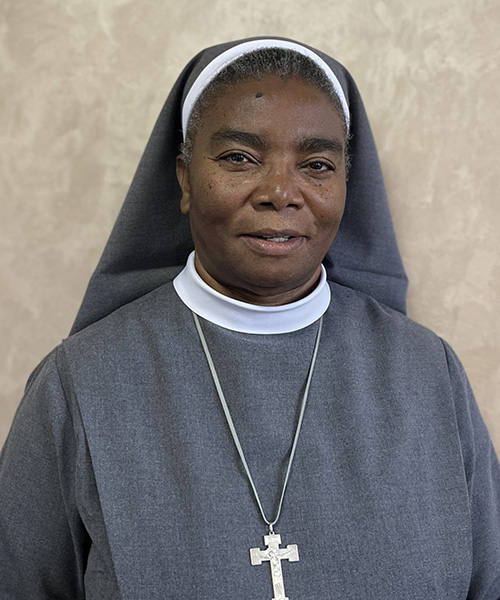
A Conversation with Sister Agness Lungu, A Franciscan Missionary Sister of Assisi
With: Agness Lungu Berkley Center Profile
April 9, 2026
Background: Sister Agness Lungu is a member of Georgetown University’s Women Faith Leaders Fellowship 2025-2026 cohort and a Franciscan Missionary Sister of Assisi. A nurse by training, Sr. Lungu also holds bachelor’s and master’s degrees in business administration. She has held leadership and management positions at numerous clinics and hospitals in Zambia and Malawi. She served as the National Health Coordinator for the Zambia Conference of Catholic Bishops, overseeing Catholic health institutions nationwide.
Sr. Lungu spoke with Luisa Banchoff via Zoom on April 9, 2026. In their conversation, she reflected upon her journey to becoming a Catholic sister, her career as a nurse and hospital administrator, and the challenges and opportunities facing the health care sector in Zambia. She also discussed her capstone project for the Women Faith Leaders Fellowship, which helps women and girls affected by gender-based violence to rebuild their lives and gain economic independence.
Biography: Sister Agness Lungu is a member of the Franciscan Missionary Sisters of Assisi. She has over three decades of experience in the health care sector in Zambia, Malawi, and Kenya. She worked as a nurse for over a decade before transitioning into hospital administration, managing numerous hospitals, including the 300-capacity Likuni Mission Hospital in Lilongwe, Malawi. Sr. Lungu earned bachelor’s and master’s degrees in business administration. In 2021, she was appointed the National Health Coordinator for the Zambia Conference of Catholic Bishops, a role in which she coordinated the efforts of the Catholic clinics and hospitals across the country. She has served as a board member for several hospitals and was a member of the Zambia Country Coordination Mechanism for the Global Fund to Fight AIDS, Tuberculosis, and Malaria from 2022 to 2025.
Could you begin by introducing yourself? Where are you from?
I am Sister Agness Lungu, a Franciscan Missionary Sister of Assisi. My parents are originally from eastern Zambia, specifically the Petauke District, and both belong to the Nsenga tribe. After getting married, they relocated to the Copperbelt Province, known for its copper mines, where my father began working. I was born and raised in the Luanshya District, where I attended school and eventually became a sister; this place holds significant importance for me. I am the firstborn in a family of eight children, consisting of four girls and four boys.
Did you grow up Catholic?
I was baptized when I was two months old, as both of my parents were practicing Catholics. I grew up in an area where about 90% of the population was Catholic. In Zambia, Christians make up the majority, which includes Catholics, Protestants, and Pentecostals. There are also Muslims in the country.
Were there Catholic sisters in the community where you grew up?
I first encountered the Franciscan Missionary Sisters of Assisi, the only congregation present in our area at the time. On Sundays, they would come to church accompanied by children from Dagama Home for the Physically Disabled. I was deeply moved by the way they cared for marginalized individuals, especially children with disabilities. Their witness of compassion and service inspired me, leading me to choose to join them.
At that time, I was unaware of the existence of different congregations. I believed that all sisters were the same and did not understand the distinctions between them. It was only later that I learned about other congregations, but I have never regretted my choice to join the Franciscan Missionary Sisters of Assisi. I believe it was God’s plan for me to be exposed only to this congregation, allowing my vocation to be shaped by their spirit of love, simplicity, and dedication to the vulnerable.
When did you first consider becoming a sister?
My desire to join the sisterhood began in Grade 5. I first shared this desire with my mother. She didn’t say much, but she advised me to talk to my father. I suspect she knew he would not agree, as I was the firstborn and a girl. In Africa, as a girl child, the choice between joining the sisterhood and attending school is a significant decision; one must fully commit to achieving one’s goal.
Initially, my father didn’t object to my desire. He probably thought I was still too young and that this was just a passing interest. However, when I entered Form 1 (now Grade 8), he saw that I was still seriously committed to becoming a sister. That’s when he began to express some objections. By the time I reached Form 3 (now Grade 10), he recognized that I was serious. Eventually, he relented after I persisted and involved my maternal uncle, who had the final say since we follow a matrilineal system.
I officially joined the sisterhood after finishing Form 5 (now Grade 12), and I was very excited to join the Franciscan Missionary Sisters of Assisi. Throughout my journey, my parents have been incredibly supportive because they recognized that this was my true desire. Other members of my family have also shown their support.
Could you speak about the history and charism of your congregation, the Franciscan Missionary Sisters of Assisi?
The Franciscan Missionary Sisters of Assisi were founded in 1702 in Assisi, Italy, by Father Joseph Anthony Marcheselli and Mother Angela Maria del Giglio. Mother Angela, a pilgrim to Assisi, was moved by the plight of young girls displaced by war. Together with Father Marcheselli, she established a congregation dedicated to offering these girls education, security, and social well‑being. From its beginnings, the congregation has remained faithful to this charism: caring for the marginalized, especially women and girls, in the spirit of St. Francis of Assisi. We live as St. Francis lived: embracing simplicity, prayer, and a shared community life. Prayer and communal life are our foundation, and our mission is expressed in service to the poor and vulnerable. We believe that educating a woman or a girl is an investment in the future of the nation.
About 60 years ago, the Franciscan fathers invited sisters from Italy to go to Zambia to help form local vocations. The first four Zambian sisters traveled to Italy for their formation, and upon their return, they began the mission in Zambia alongside the Italian sisters. This collaboration marked the beginning of a vibrant local presence.
Today, our congregation serves across continents. In Asia, we are present in Korea, China, Vietnam, the Philippines, and Indonesia. In Europe, we continue our mission in Italy and Romania. In North America, we are in the United States. In Africa, we serve in Kenya, Malawi, and Zambia. Across all these regions, our charism remains constant: to uplift the marginalized, especially women and girls, through education, compassion, and faith‑driven service.
You have a background in nursing and hospital administration. Could you speak about your academic and professional experience?
I joined the Franciscan Missionary Sisters of Assisi at the age of 22 and professed at 25. My first assignment was in Lusaka, Zambia, where I lived for three years and served at St. Francis Primary School as an untrained teacher. I later moved to North‑Western Province, dedicating over a year to pastoral work.
Recognizing a deeper calling to service in health care, I pursued nursing studies and completed two years of initial training. In 1992, I began my professional career as a nurse, marking the start of a lifelong commitment to health care and leadership. In 2001, I advanced my training further, qualifying as a state‑registered nurse.
By 1994, I was entrusted with managing a health center that later grew into a hospital. This responsibility set me on a path of continuous leadership in both public and mission hospitals. To strengthen my skills, I studied hospital management at CORAT Africa Training Institute in Kenya. Later, I advanced my academic journey with an advanced diploma, a Bachelor of Arts, and ultimately a Master of Business Administration.
In 2012, I was appointed to lead Likuni Mission Hospital in Lilongwe, Malawi. It was a 300‑bed facility on the brink of closure. Over nearly ten years, I guided its transformation by introducing a strategic plan, establishing conditions of service, and forming a supportive board. Together, we rebuilt structures and expanded services to meet the needs of the community.
I was later appointed National Health Coordinator for the Zambia Conference of Catholic Bishops. In this role, I drew on decades of experience in hospital leadership, strategic planning, and faith‑driven service to strengthen Catholic health provision at the national level.
What were your responsibilities as National Health Coordinator?
My main role as National Health Coordinator was to bring together health‑related efforts across the country, working with all parishes and Catholic health institutions. At that time, we had about 76 institutions, and I collaborated closely with the 11 dioceses, each with its own health coordinator. Together, we supported hospital administrators, meeting annually to review our performance and discern how we could strengthen health provision in line with Catholic teaching.
The work was never done in isolation. We partnered with the Ministry of Health, complementing their efforts, and worked hand‑in‑hand with the Churches Health Association of Zambia, which oversees church‑related health institutions nationwide. The responsibility was immense, but it was deeply fulfilling. I could see, year after year, the difference our collective efforts made in addressing health challenges and bringing hope to communities.
For me, this role was not just about administration, it was about living my vocation. Coordinating health services across the country allowed me to serve both the Church and the nation, ensuring that our faith‑driven mission translated into real, tangible care for the people most in need.
What would you say are the biggest challenges facing the health care sector in Zambia today?
One of the major challenges is limited funding, which prevents health care institutions from delivering quality care. Annual government allocations are inadequate, restricting the ability to expand services, improve patient care, or invest in innovation.
Another challenge is human resources. Many young people have qualified as nurses and doctors, yet they cannot be employed due to a lack of housing and insufficient funds for salaries. The government’s budget for health care staff is not sufficient to accommodate new employees, so recruitment only occurs when someone retires. This leaves hospitals understaffed and unable to meet the growing needs of communities.
A further challenge is infrastructure and equipment. Some mission hospitals, built as early as the 1920s, have never been renovated. Their aging structures and outdated medical equipment compromise service delivery. Since government funding does not cover renovations or the procurement of new equipment, hospitals must rely on external support to modernize facilities and replace obsolete tools.
What was your experience during the COVID-19 pandemic? Were you involved in response efforts?
During the COVID‑19 pandemic, mission hospitals stood at the frontline of an overwhelming crisis. As National Health Coordinator, I witnessed firsthand how fragile health systems struggled under the surge of COVID-19 cases. With limited resources, we relied on the generosity of partners such as Misereor and BEGECA in Germany and some local partners, who provided essential supplies to help mitigate the spread of the virus. Their support enabled us to establish quarantine areas, equip diocesan health coordinators’ offices, and provide medical personnel with disinfectants, hand sanitizers, and protective masks.
Despite these efforts, the situation remained deeply challenging. Communities found it difficult to accept new public health measures, particularly the requirement for the immediate burial of the deceased, which conflicted with traditional mourning practices. In African culture, mourning is a communal process that lasts for days, and it was painful for families to abandon these traditions. Yet the urgency of preventing further infections required difficult decisions that were not easily understood.
Amid sorrow and resistance, mission hospitals persevered. By mobilizing support from different partners, we continued to serve, ensuring that COVID-19 did not spread unchecked. This experience revealed both the vulnerability and resilience of our institutions. It underscored the critical role of external partners in sustaining health care delivery during emergencies and highlighted the need for stronger investment in mission hospitals.
To prepare for future crises, we urgently call upon donors and collaborators to strengthen these institutions – through funding, staffing, infrastructure, and equipment – so they may continue to uphold the dignity of every patient, safeguard communities, and embody the compassionate care at the heart of Catholic social teaching.
In many places, the pandemic led to the spread of misinformation and negative backlash against health care professionals. Was this the case in Zambia?
Yes, it was. Health professionals were trying to encourage people to follow restrictions, but many individuals were focused on reinforcing their culture and traditions. Some even resorted to using force against health professionals to gain access to patients in hospitals; they wanted to visit, feed, and bathe their loved ones. Nurses and doctors explained that this could lead to the spread of COVID-19 because its transmission is different from other diseases like malaria, where visiting a patient typically poses no risk. This lack of understanding created significant problems and contributed to the spread of COVID-19, as people unknowingly put themselves at risk.
The situation also varied depending on the environment. We faced more challenges in rural areas. In urban settings, more people understood the risks of transmission and were hesitant to visit hospitals. However, in rural areas, the level of understanding was lower, making it a much bigger challenge.
What work are you doing at the moment?
I am currently waiting for my next appointment. While I wait, I am actively involved in social work in the nearby parishes, where I assist women facing various challenges. I encourage girls to stay in school and avoid early marriages. In Zambia, there are many instances of gender-based violence, and women come to me for counseling and help in taking appropriate action. Additionally, I am involved in a new project within our congregation aimed at empowering women who have been abused or have experienced gender-based violence. I coordinate with the Congregation Project Coordinator on this initiative. Our goal is to construct a Sanctuary of Peace, Healing, and Purpose to empower women and support vulnerable communities.
How has your experience in the Women Faiths Leadership Fellowship been so far? Could you share your plans for the capstone project?
I am grateful to be a part of the Women Faith Leaders Fellowship cohort this year. It has broadened my perspective in many areas. Now, I have the tools to analyze and assess myself and identify gaps in the leadership style I aspire to embrace.
My capstone project is titled “The Establishment of the Safe Haven Center of Excellence, Peace, Healing, and Purpose.” Along with my sisters in the congregation, I developed the idea for a center that will serve as a structured place to provide services to women and girls experiencing gender-based violence. Currently, we support women in their homes by visiting them and identifying those who are vulnerable in the community to determine how best to empower them. We conceived the idea of a dedicated center where we can care for these women, providing them with skills to improve their lives. The project focuses on empowering both women and girls, encouraging them to continue their education and avoid rushing into early marriages.
What are some of the important skills you’ve learned in your career?
I have developed skills in proposal writing, resource mobilization, project management, networking and partnership, and community engagement, and these are the areas I wish to continue improving.
The Women Faith Leaders Fellowship has provided me with valuable insights into my role as a leader in the community and society. My experiences have taught me the importance of delivering my leadership skills with confidence. I have come to understand that I should focus on transformative leadership, not only seeing myself as a leader but also considering the positive changes I can bring to society and to women. My goal is to empower them to become leaders in their communities and homes. This journey is transforming me as a person and positively impacting the community I serve and the sisters I live with.
Through sharing experiences with other sisters, I’ve realized that I cannot accomplish my goals alone. Collaboration is essential; teamwork plays a crucial role. A good leader must be there to support others. Together, we can learn from one another and strive to change the world for the better.
That’s a wonderful note to end on. Thank you for your insights, sister. All the best to you in your work.