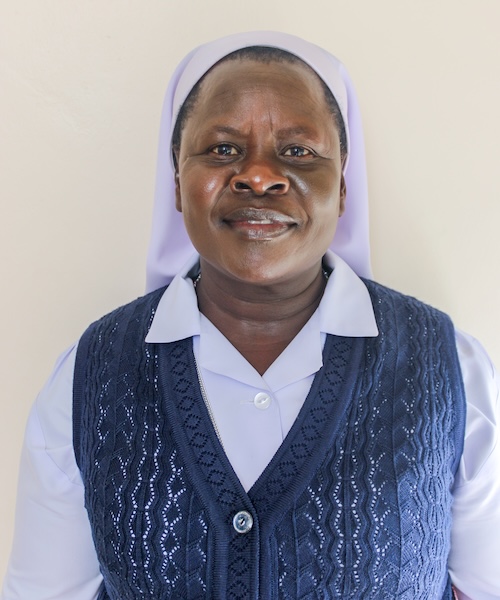
A Conversation with Sister Alice Anzoyo C. Dralu, A Sister of the Sacred Heart of Jesus
With: Alice Anzoyo C. Dralu Berkley Center Profile
November 25, 2025
Background: Sister Alice Anzoyo C. Dralu is a member of Georgetown University’s Women Faith Leaders Fellowship 2024-25 cohort and a member of the Sisters of the Sacred Heart of Jesus. Sr. Dralu has an academic background in finance, business administration, and organizational leadership, and she is currently pursuing a Ph.D. in social transformation. She has served in the provincial leadership of her congregation and has since focused on developing training programs for women religious in leadership roles.
Sr. Dralu spoke with Luisa Banchoff via Zoom on November 25, 2025. In their conversation, she discussed her journey to becoming a sister, her academic experience, and the skills she has developed across her career. A key focus of the conversation was leadership development for Catholic sisters; Sr. Alice reflected on her work in creating the Professional Development for Congregational Leaders (PDCL) program at Tangaza University’s Centre for Leadership and Management. She also discussed her Ph.D. research, which explores the root causes of intergenerational conflict in congregations and proposes strategies to manage such conflicts.
Biography: Sister Alice Anzoyo C. Dralu is a member of the Sisters of the Sacred Heart of Jesus, a congregation of Catholic sisters founded in present-day South Sudan. She holds a bachelor’s degree in business administration and management, a master’s in ethics and organizational leadership, and a master’s in business administration. She is currently pursuing a Ph.D. in social transformation at Tangaza University in Nairobi. She serves as director of the Centre for Leadership and Management at the university, where she developed and implemented the Professional Development for Congregational Leaders, which equips sisters with practical skills for leadership in their congregations. Her capstone project for the WFLF focuses on developing transformative leadership strategies for sisters to manage intergenerational conflict within their congregations.
Can you tell me about yourself? Where are you from?
My name is Sister Alice Anzoyo. I grew up in the northwestern part of Uganda, very close to the border with South Sudan and the Democratic Republic of the Congo. I'm the third born of four children, three girls and one boy. My dad passed on when I was only eight years old, so we were largely brought up by my mother. She was very passionate about our education, because she herself didn't have the opportunity to go to school. She ensured that we all went to school by taking on domestic work, subsistence farming, and other petty businesses. wanted her children to speak English, a language she herself didn't speak.
Were you raised Catholic?
Yes. I was baptized into the Catholic Church when I was about a month old. The area where I grew up was about 95% Catholic at that time. We had a small percentage of Muslims from the neighboring district. Other faith groups have since moved into the area; it's now quite mixed.
When did you realize you wanted to be a Catholic sister?
My local parish church had a group of sisters. As children, we prayed and attended Mass with them. I observed the sisters in their habits, looking holy and devoted. They sang so beautifully. That attracted me at a very young age. Back then, I thought you were born as a sister, so I began wishing that I had been born one. But when my older sister turned 14, she left home to go to a convent. When I learned that my sister had done that, it clicked for me that sisters are not sisters from birth.
After that, my mother transferred me to a mission school. I was in the upper primary level, years 5, 6, and 7 [grades 5-7]. At the school, there were some young girls who were staying in the convent. Some of them became my friends, and we had a lot of conversations. In the process of interacting with them, I learned that they had come to the convent to become sisters. When I was in primary 5 [grade 5], I started considering going to the convent to become a sister. My sense of vocation started building and transforming itself.
My desire to become a sister posed a challenge because, in our culture, the girl children are expected to get married and bring bride wealth back to the family. I knew it was going to be an uphill task to convince my family, but I nevertheless took the risk and told my mom I wanted to go to the convent and become a sister as well. She immediately objected, saying it couldn’t happen because my older sister had already gone. She was only protecting herself; she knew my uncles would also oppose my wish because they wouldn’t receive bride wealth. One of the requirements to go to the convent was to get written parental permission. Since I knew I wouldn't get this, I forgot about it.
I continued to study, but when I reached primary 7 [grade 7], the desire to become a sister came all over again. I went back to my mom and said I would really like to try to be a sister. This time, she kept quiet and reflected upon my request. After two days, she called me to her and said that she did not want to fight with the spirit of God. She told me that if God was inspiring me to become a sister, then I should become a sister. But she didn’t want me to embarrass her, because if I were to go to the convent but didn’t live the good life that was expected of me, it would be embarrassing to our family. So she gave me permission. I was so excited about that.
The written permission to go to the convent is supposed to come from both parents, but since my father had passed, I had to get permission from my paternal uncle. He refused to give it. I was thrown into disappointment again. So my mother went by herself to ask her own brother, explaining to him that she didn’t want to fight with the spirit of God. He gladly accepted, and they wrote a letter and signed it.
I went to the convent at the age of 15. It was the convent of the Sisters of the Sacred Heart of Jesus, the very same sisters I used to see in the church. Since I was still quite young, I spent eight years in formation before professing my first vows. During that time, I studied at secondary school so that my decision would be concretized by a mature sense of self.
Could you speak about the history and charism of your congregation, the Sisters of the Sacred Heart of Jesus?
The Sisters of the Sacred Heart of Jesus originated in what is now South Sudan. The congregation was founded in 1954 in a parish called Loa. The founder was Bishop Sisto Mazzoldi, a Comboni Missionary who was then the Apostolic Prefect of the Vicariate of Juba, a very large area of jurisdiction. The charism of the Comboni Missionaries is to evangelize Africans so that they can take up the task of evangelization among their own people. The congregation was founded for Indigenous women to evangelize Indigenous communities.
Nine years after the congregation’s founding, there was a civil war. All the foreign missionaries were expelled, including Bishop Mazzoldi. The young congregation was left to grow on its own, but it was not mature. It had no assets, no financial resources. Soon, the congregation found itself in great difficulty, so the sisters decided to follow their founder into refuge in Uganda. They settled in Moyo District in 1964. Bit by bit, the congregation settled in Uganda and opened their doors to Ugandan girls who wanted to become sisters. It was during this time that I first saw the sisters praying in church. I wanted to join the same congregation that inspired me to be a sister.
During my formation years, I learned that the congregation’s charism is love, zeal, humility, and compassion, all of which stems from the pierced heart of Jesus Christ. Our founder very much wanted to form sisters who are teachers, catechists, and evangelists who would be able to preach the gospel through theirs words and through their example. The living conditions and health of the local people were also a big concern for our founder, so he included primary health care as part of our charism. The charism of the sisters is expressed through those three activities: catechesis and evangelization, teaching, and primary healthcare. Our founder always encouraged us to remain open to the signs of the time, as the times kept changing. Over time, the expression of our charism expanded to include a social work apostolate, which involves working with vulnerable women and children.
Can you tell me more about your educational background?
At secondary school, I did well in mathematical subjects, so my initial thought was to go on to study commerce. But after four years, I left school to undergo formation for my first profession of vows. I spent four years in formation and one year in pastoral work, so I was away from school for five years. When I returned to do my A-Levels in commerce, I found it a bit challenging. So I chose economics, history, and divinity as my subjects instead.
As I was awaiting my A-Level results, I was sent to teach in a secondary school. During that time, I taught mathematics in senior 1 and 2 [grades 9 and 10]. When you teach mathematics, you give your students daily exercises, so I had a pile of exercise books to mark every day. I decided I wouldn't study education because I wanted to avoid marking. But since I was fairly good at mathematics, I thought I could study business administration and management, which were part of my passion.
First, I did a diploma in accountancy. Then, in 1992, I was seconded to work as an assistant financial administrator in the Diocese of Torit. The diocese is in South Sudan, but the work was based in Nairobi. I worked for five years in this role, managing the finances and accounts of the diocese. In 1997, the diocese wanted to sponsor me to continue my education, so I returned to Uganda and pursued a bachelor’s degree in business administration and management at Uganda Martyrs University. I performed well and the university gave me a scholarship to continue with an MBA in business administration, focusing on finance.
You have served in the leadership of your congregation. Can you speak about that?
As I was completing my MBA degree, I was elected to the leadership of our congregation for the Uganda Province, which covered Uganda, Kenya, and parts of South Sudan at the time. After graduating, I went to work in the provincial leadership. I was Vice Provincial for three years and was then elected Provincial for four years. As Assistant Provincial, my role was to take care of the financial administration of the province. I was sourcing funds and looking for additional funds for specific programs. During that time, I was appointed to serve as novice mistress for two years, which meant I accompanied the novices in formation. When I became Provincial, my role was more focused on personnel management.
Altogether, I served in the provincial leadership for seven to eight years. During that time, there were around 137 sisters in the province. When my term ended in April 2009, I was assigned to my current location in Nairobi. In January 2010, I was hired by Tangaza University to work as the Assistant Kenya Coordinator of the DePaul University Completions BA Program in Leadership and Management, which is where I am currently working.
You are the director of the Centre for Leadership and Management at Tangaza University. Can you speak about the work of the center?
The Centre for Leadership and Management (CLM) is a department in the university that offers academic studies in leadership and management areas. We offer a degree in leadership and management with five focus areas: business finance, human resource management, international relations, public administration, and public relations. We also offer a master's degree in ethics and organizational leadership.
One of my responsibilities as director of the CLM is teaching leadership studies and competence-based, experiential methodology courses. Initially, I was teaching finance courses, but then shifted to leadership studies. I took an online value-centered leadership course from DePaul University in Chicago. From that course, I was able to develop some value-centered leadership courses to teach at the CLM.
We developed the Professional Development for Congregational Leaders (PDCL) in 2015. It’s a professional leadership training to empower sisters who are new in congregational leadership. This program was started because many women religious, including myself, get into leadership roles when they are not prepared for it. They get appointed or elected because other sisters see them as decisive, assertive, and capable of taking on responsibility. Taking on leadership roles with goodwill is a good thing, but sometimes the sisters end up making mistakes because they have not received professional training in leadership.
There are three modules. The first module focuses on developing the leader within. We believe that everyone has some leadership gifts but they are not always aware of them. If they are aware of their gifts, they can bring them to the forefront in serving their congregations. One topic the module covers is building a leader’s personal self-awareness. Another topic is the transformative experience framework, a methodology we adapted from Faith and Praxis for Global Leadership. The methodology helps leaders analyze issues from four different perspectives: the faith perspective, the context perspective, the systems perspective, and the person’s perspective. The leader must look at these four perspectives in order to analyze the situation, lead effectively, and avoid haphazard judgment.
The second module is about creating a faith-filled congregational culture, which is important because congregations have members from various cultural and ethnic backgrounds. International congregations also include members of different nationalities. But our faith in Jesus Christ invites us to create a faith culture rooted in Christ.
The third module is about leadership for mission. The ultimate end of our religious vocation is mission-based. We help leaders to better understand their own charism in relation to their mission and to identify the negotiables and non-negotiables within their charisms. The root or foundation of the charism is non-negotiable, but there are certain fruits that can be negotiated given the signs of the times. This goes into building congregational culture.
We require participants to come as a team, because congregational leadership is made of a team of five people and we want them to learn as a team. Our approach is participatory in the sense that it’s about the women sharing their own leadership experiences. We have seen congregational leaders opening up and sharing their challenges very openly and freely with one another. We have also noticed the leaders from different congregations creating networks to discuss challenges and lessons they’ve learned.
Once the sisters go through these three modules, they graduate and become PDCL associates. We help all trainees practice and implement what we teach them. We give them the material we used for facilitating and encourage them to use it to facilitate workshops in their own congregations. In some cases, they can become facilitators through three rounds of trainings for trainers. The program runs in Kenya, Uganda, Tanzania, and Eritrea; the facilitators in all these countries have gone through the program and received training to facilitate the program in their own country. We also carry out monitoring and evaluation. It helps us know how the women find the training, how they have applied it, and which gaps we can seal or additional topics we can include.
You're currently doing a Ph.D. What is the focus of your research?
I started my PhD program quite a number of years back, in 2016, but my studies were frequently interrupted. After completing my first semester, my sister passed on. It devastated me, so I adjourned my studies for a year. As I was returning to resume my studies in 2018, my brother passed on. Once again, my studies stopped for some time. Every time I started the journey again, something would happen and stop me. It happened four times: I lost my three siblings and then my mom. I felt so devastated that I didn't want to continue. Then, I started going to therapy; I decided I would return to resume my Ph.D., and my therapists encouraged me. When I finished my coursework and comprehensive exams, I was supposed to start developing my thesis proposal. Then I was appointed as the CLM Director. The new job and responsibilities hindered the progress of my PhD studies.
During this time, I was also part of the team for the PDCL program. In the leadership training sessions, we realized intergenerational conflict was a huge issue. Sisters were pointing fingers at each other, particularly the older sisters pointing fingers at the younger generation. They would say that the younger sisters are not keeping to the ways of the convent and congregation: they are not maintaining silence, they are always on their phones, and so forth. This inspired me to carry out research on the root causes of intergenerational conflict in congregations of women religious.
I was inspired to carry out research on this issue because women religious play a crucial role in the society: they empower marginalized women, work with vulnerable children and elderly people, and so forth. If they spend more time engaging in conflict within their congregations, they will have less time to do this important work. The congregation will continue to receive younger members, and members in the congregation will continue to grow old, so this gap between the young and the old is something that will continue to exist. Therefore, it’s important to develop strategies that can help sisters to manage these relationships amicably so that they can focus on the most critical aspects of their mission.
I started developing this as my thesis proposal. Around then, I was selected for the Women Faith Leaders Fellowship. I inquired if my capstone project could also be a research project, and I was told yes. My research proposal focused on identifying the root causes of intergenerational conflict in congregations of women religious, and my capstone for the WFLF focused on finding transformative leadership strategies to manage these conflicts. I’m currently carrying out research in collaboration with the women religious themselves to identify what is causing conflicts and how they can manage them.
What are some of the important lessons you've learned and skills you've gained over your career so far?
I have learned that collaboration and teamwork are huge assets in leadership and facilitation work. When I started work at the Center for Leadership and Management in 2010, my initial approach to teaching and facilitating was very different from my current approach. Coming from a finance and accounting background, I was very theoretical and would spend all my time on the theoretical level while teaching and facilitating. The experience of going through training for the professional development program taught me something: effective learning happens when it's experienced collaboratively between the learner and facilitator. Focusing on the learner-facilitator relationship opened me up to become a lifelong learner, so much so that each time I facilitate and teach, I learn from the participants and students themselves. They have so much wealth of experience to share. Learning is mutual and enriches the learning space. I have embraced the work of teaching, and I enjoy doing it now. I continue to learn as I grow.
I'm delighted about the opportunity to be part of the Women Faith Leaders Fellowship. I have been exposed to various ways of facilitation that have enriched my approach. I am hoping to continue to help women be better leaders.