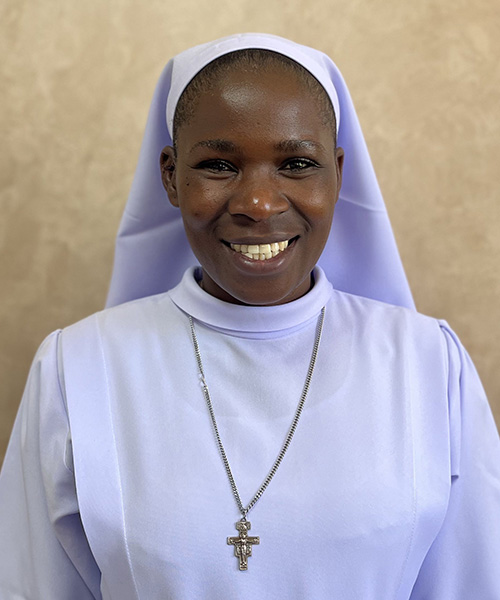
A Conversation with Sister Angeline Nanzala, A Member of the Little Sisters of St. Francis
With: Angeline Nanzala Berkley Center Profile
September 3, 2026
Background: Sister Angeline Nanzala is a member of Georgetown University’s Women Faith Leaders Fellowship 2025-2026 cohort. She belongs to the Little Sisters of St. Francis, an order of Catholic women religious founded in Uganda in 1923. A teacher and social worker by training, Sr. Nanzala is the Project Manager at Mother Kevin Shelters in Kajiado County, Kenya, a non-profit dedicated to assisting and empowering vulnerable groups, especially women, girls, refugees, and migrants. Sr. Nanzala runs initiatives that provide microfinance and vocational skills training to women and girls in the community.
Sr. Nanzala spoke with Luisa Banchoff via Zoom on September 3, 2026. In their conversation, she shared her personal journey to becoming a sister, the charism of her congregation to help marginalized people, and her passion for transforming lives through social work. She also reflected upon the challenges facing women and girls in Kenya’s Maasai community and the importance of dialogue and finding common ground with different cultures. Sr. Nanzala also spoke about her capstone project for the Women Faith Leaders Fellowship, which provides vocational skills training for teen mothers.
“As a social worker, I can really touch people’s lives. Just by my presence and words, somebody can be move out of whatever desperate situation they are in. Social work gives life to people.”
Biography: Sister Angeline Nanzala is a member of the Little Sisters of St. Francis based in Kenya. She has extensive experience as a social worker and currently serves as the Project Manager of Mother Kevin Shelters. She collaborates with numerous organizations in her work, including the Association of Sisterhoods of Kenya. Sr. Nanzala holds a diploma in social ministry and is currently pursuing a degree in sustainable human development.
To begin, could you tell me about your background, maybe where you grew up, and we can take it from there?
I'm Sister Angeline Nanzala. I was born during the hunger season, so I was given the name Nanzala, which means hunger. I'm from the western part of Kenya, in the county of Busia and sub-county of Nambale. I am the last-born of a family of seven boys and four girls. My father and mother were both Catholic and we grew up in the Catholic faith. They raised me with much love.
My father’s background was in farming and my mother was a housewife. We were raised doing farming. My father was a retired chief of my village. He valued education so much. All of us children went to school from the initial stages through high school. I went to a primary day school, and later on to a boarding school for high school.
What inspired you to join the religious life?
During the initial stages of my education, I was not so interested in becoming a sister, but in high school, I felt the wish to become one. A good number of us girls wished to be sisters. I attended a mixed-gender Catholic boarding school. When we had big occasions such as the sacrament of confirmation, the sisters would come. They’d also visit the school to do vocation promotion. That is where my interest came from. If you wanted to be a sister, you had to complete your form four [US grade 12], and do well; seeing the sisters motivated me to perform in school.
After my form four, I visited the sisters together with a friend of mine who is also a sister now. It was the same congregation that I ended up joining. I admired the way they dressed and longed to be one of them. I admired one sister in particular. She had a corded belt that she wore around her waist, and when she was moving around, she would twirl the cord. I wanted to put on the same cord. The sisters were kind, talking to us nicely and motivating us. I just felt that this is where I belonged.
Because I was the last-born, my elder brothers and sisters had gone to college by the time I was finishing high school. Immediately after completing form four, I told my dad I wanted to be a sister. He was a bit hesitant because he wanted me to go to college. But I insisted. I went to the congregation and informed the sisters of my wishes. We made an arrangement for the sister in charge of vocation promotion to come visit my home to discuss my joining.
The first time she came, my dad didn't want to talk to her; he just walked out of the house. I felt really bad. I told my mom, and she said I had to get permission from my dad. Later on, when the sister came to visit a second time, my dad gave me his blessing. I think he had wanted to test if I was serious about what I wanted. When he saw the sister coming the second time, he gave me his blessing to be whoever I wanted to be. That’s where my journey began. I was so happy – it was the best day of my life.
I joined the religious life in 2003. I went to Uganda for my formation. It was so calming and good for me. I enjoyed the process of formation, which took four years. When I took my vows, I invited my parents to come to Uganda, and they were so happy.
You belong to the Little Sisters of St. Francis. Can you speak about their congregation’s charism and history in Kenya?
The Little Sisters of St. Francis were founded by Mother Mary Kevin Kearney. She was an Irish lady who visited Uganda together with the Mill Hill Fathers. She saw that the local women and girls were being mistreated, particularly with regards to health. There was no equipment or training to ensure the safe delivery of babies. Most of the women giving birth were girls below the age of 18. Some were also forced to undergo abortions via crude methods. Mother Kevin founded a hospital called Nsambya, which still exists today. She used her own knowledge and skills to make sure that quality healthcare was provided to women and girls. She also worked to ensure that women in Uganda were respected. Mother Kevin’s mission was to help vulnerable people, especially women and girls.
After that, the mission expanded. More girls wanted to join the congregation, and Mother Kevin opened doors for them. The congregation expanded to Kenya, beginning in the western part, where I am from. We are also present in the eastern part of the country, including Nairobi and Mombasa. We’ve also moved to Tanzania and have missions in the U.S.
Our charism as Little Sisters is to bring the newness of Christ into the world. We reach out with compassion to the marginalized in the spirit of St. Francis of Assisi and Mother Kevin. We are shaped by Franciscan spirituality, because St. Francis believed in embracing poverty and giving himself for the sake of the marginalized. Our vision is holistic transformation of self and the world: I am transformed and the world is transformed toward the reign of God. Wherever I am, when I'm in Kajiado with the teen girls, I bring that newness and fullness of Christ into the lives of the people.
Tell me about your experience as a social worker. How did you get into this line of work?
After my formation, I was sent on district missions. I came back to Uganda and worked there for some years. Then I was transferred to Kenya. I developed an interest in teaching, so I pursued a diploma in teaching. After that, my congregation saw a need for me to do social work, so I pursued a diploma in social work at Tangaza University in Nairobi. After completing the course, I went to work in Kajiado County. That's when I got interested in the challenges facing girls from the Maasai community. The social-cultural norms won’t give space for girls and women to be who they want to be. I informed my superiors that I wished to continue the mission in Kajiado County. They decided to open a house for me to continue my work.
I bring together and mentor vulnerable women, such as single mothers or widows. I convene groups of women, talking, empowering, motivating, and mentoring them to gain a sense of value and dignity. I guide them, but they are the ones who come up with ideas for what they can do for their own survival. I do table banking with them, helping them build savings. Women borrow money from a common account in order to enlarge their businesses. The loans open doors for them. There’s a group of market women who sell basic things like tomatoes, oranges, and the like. They’re able to save around 100 Kenyan shillings every week. With the interest, we grow the group. The interest can also be used to help women get a plot of land or own their own house so they don’t have to pay rent and can spend the money on taking care of their children.
I also help teenage mothers, most of whom are not stable financially. I run mentorship programs for them and collaborate with other organizations to help them access the essentials, such as sanitary pads. Their children don’t go to clinics for medical checkups, so I collaborate with other organizations to see that their health is taken care of.
Thanks be to God for the Women Faith Leaders Fellowship, which has helped me provide skills training to this particular group. Giving handouts alone is not enough: today you may be giving someone necessities or medication, but tomorrow they will need the same thing and their finances may not cover them. So I was looking for a way to make sustainable change for the teenage girls. With the support of the fellowship, I am now doing training for these girls in tailoring and crocheting. They make products that they are able to sell. They participate in table banking and are now able to sustain themselves.
I enjoyed teaching because you share knowledge and transform people. But I am even happier now as a social worker because I can really touch people’s lives. Just by my presence and words, somebody can be move out of whatever desperate situation they are in. Social work gives life to people.
I’m struck by that concept: social work gives life to people. Is there a particular story you can share of someone you helped through your social work?
There are so many examples. One is of a teenage mother. Her father was not present at home. Her mother, who had raised the children single-handedly, chased her away from the house when she got pregnant. The girl needed shelter and food. Through people of goodwill, we were able to find her a place to rent out. I looked into training her in a skill to sustain herself. She was staying close to a market center, so she went to a beauty salon to learn how to plait hair. She's now able to run her own business. She began as a mobile hair stylist, moving around and looking for customers. Now I’m looking to find a place for her to open her business. She had been lifeless and homeless person, and now she’s able to have a meal, a shelter, and a sense of their own dignity.
You serve as the administrator of the Mother Kevin Shelters. Can you tell me about the organization and your role?
The Mother Kevin Shelters began in 2022. It is named after our foundress, Mother Mary Kevin Kearney, and is based in Kajiado County, among the Maasai people. It was through my initiative and the support of my congregation that it came into existence. It’s a shelter mainly for girls, though we include boys who need mentoring.
I’ve already explained many of the activities that we do, including table banking for women and teenage girls. We also collaborate with the Association of Sisterhoods of Kenya (AOSK), which has an initiative to educate vulnerable groups. I have groups of teenage girls who wish to go back to school rather than just learn a skill; some of them are very bright. So I collaborate with AOSK and they’re able to finance some of the girls’ academic studies.
A lot of my work involves talking to the girls. It’s also very important to talk to the community. The culture in the community is very patriarchal. The fathers are the ones who have the say, not the mothers. I remember one time that I met with some mothers, and there was a woman who was crying because she felt that if she were to send her daughter to school, she would be beaten by her husband. This is why it’s also important to have meetings with chiefs, elders, and men, to talk to them and to help them see the value of taking girls to school. The boys have no issue in this particular community: if they want to go to school, they go. But the girls have no say of their own. So this particular work also means empowering men to see the value of women and girls.
Can you speak more about the challenges facing women and girls in Maasai communities?
Early marriages and female genital mutilation (FGM) are major challenges. In the Maasai culture, once a girl reaches the age of nine, ten, or eleven, she undergoes the process of FGM. After that, a girl is deemed ready for marriage. It doesn’t matter that she is only a child; she is forced to marry. She is given in marriage to an older man who already has wives, not a boy her age. So the three issues are intertwined: FGM, early marriage, and polygamy.
Are there certain approaches you find effective when speaking to men about the value of educating women and girls?
There is a feeling among some of the men that I’m going to snatch their women from them. They think educating women will lead them to make their own decisions and disobey men.
My strategy is to go to the leadership, including the local chiefs. I just talk to them. Some of them understand the need for the girls to go to school. They see the value of education. I assure them that I'm not trying to take their girls or women away from them. I want them to see that girls who have education or who work are still going to get married to the local men.
When I go to the leader, he’s able to coordinate meetings with men in the community. It’s a bit challenging, because many of the men see a woman as a child, but at least we are able to talk. I explain that we are just helping children get an education, and this will do good things for the family and help them get out of poverty. The educated girls can earn something and they’re going to sustain themselves. This will ease the men’s burden of supporting the family.
Does being a Catholic sister change the way you are regarded by men in the community?
Yes. Being a Catholic sister gives me a sort of authority to speak. I receive respect from the men. When I speak to them, they see the Church, not just a woman.
What skills are especially valuable to you as a social worker?
The first skill is dialogue and communication. The way you talk to people can make them either come back tomorrow or go away forever. You have to talk to people in a way that recognizes their dignity. They identify their needs as they speak. Some may not talk much, but you can tell by observing their behavior.
Being able to observe a situation is very important. If I call for a meeting with the parents of the girls I help and there are no men present at the meeting, then I know that the men do not think it is a safe place for them. And because there are no men, there tend to be fewer women because they are afraid. So I know I have to do something different. Maybe I need to go back to the drawing board, talk to the local leader, and find out what the issue is.
Another skill is being able to know how to help in a particular situation. Some of the girls I help have been harassed and abused sexually. Some run away from their marriages because of the abuses they’ve experienced. They may not be able to talk about it; they’ll just cry. It’s key for me as a social worker to observe the way they talk, the language they use, their form of communication.
How has your experience been with the Women Faith Leaders Fellowship so far?
I really appreciate the Women’s Fellowship Program for the opportunities I’ve received. The fellowship has enlarged my spectrum of understanding; it has been so educational for me. I shifted from just understanding the situation at a local level to a regional level and then to a global level. Now I’m thinking not just about helping the girls to gain a skill but how I can help them beyond that. For example, I’m thinking of how I can help the girls access more markets for the products they make. For me, the program has been an eye-opener.
I’ve collaborated with new people, especially my fellow sisters in the cohort. All the sisters of the cohort are working with women, but everyone has their own way of doing things. One of the sisters here in Kenya works with local women and is also doing table banking. I’m able to learn from her how to improve this particular type of banking, for example by registering the group and trying to get loans and grants from the Kenyan government. There are ministries and departments that give money to vulnerable people. The collaboration has helped me so much, and I’ve really been enriched.
I’ve also enjoyed learning about programs and organizations working here and around the world. For example, the Kenya Red Cross. It was good to encounter these organizations, hear from them and learn how they view poverty. It challenged me to think about how to relate my project and the issues facing these girls to the problem of poverty worldwide.
Could you speak a bit more about your capstone project? How many women are involved?
My capstone project involves 45 teen girls. I’ve already had three mentorship sessions with them. Now we’re beginning the skills training sessions. We have our third week of training this week. A group of girls is doing crocheting, another is doing tailoring, and a third is doing beadwork. I’ve gotten people on board as trainers.
Next month, I will begin the dialogue aspect of the project. I will go to the community and talk to them about what we are doing. Of course, they already gave their permission for me to train the girls, so the dialogue process has already begun. Now we want to them realize how the training transforms their own lives and the lives of their girls.
I appreciate the organizers of the Women Faith Leaders Fellowship. I pray that the fellowship continues and that God finds ways for it to touch more lives, because it is through the fellowship that we are able to touch the lives of people in our communities. Thank you very much.
And thank you, sister, for sharing your story. I wish you all the best for your capstone project and future endeavors.