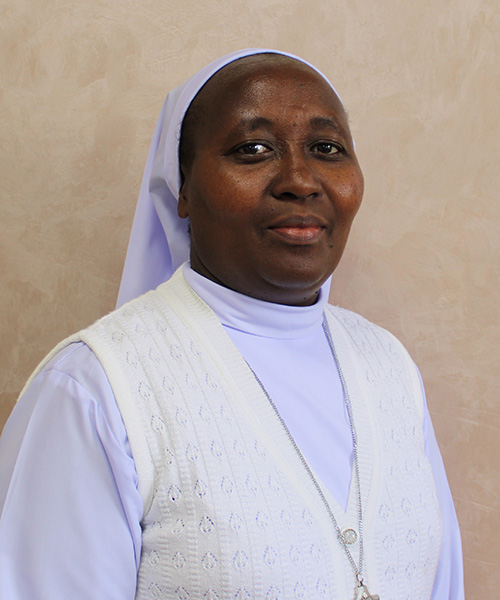
A Conversation with Sister Bernadetta Nzioka, A Member of the Daughters of the Sacred Heart
With: Bernadetta Nzioka Berkley Center Profile
September 15, 2026
Background: Sister Bernadetta Nzioka is a member of Georgetown University’s Women Faith Leaders Fellowship 2025-2026 cohort. Sr. Nzioka coordinates the Justice, Peace, and Integrity of Creation program at the Association of Sisterhoods of Kenya, which trains community members in peacemaking and human rights advocacy. She also serves as the coordinator of the Bakhita Partnership for Education, helping girls who have dropped out of school to complete their education. Her other efforts include supporting sisters in community-based work and mobilizing women candidates for political office.
Sr. Nzioka spoke with Luisa Banchoff via Zoom on September 15, 2026. In their conversation, she reflected upon her journey to becoming a Catholic sister, including her devotion to the Sacred Heart of Jesus. She also discussed the importance of empowerment in her work, whether helping girls go back to school, giving rural women the tools to run a small business, training local peacemakers and human rights advocates, or supporting women political candidates. Finally, Sr. Nzioka spoke about her experience in the Women Faith Leaders Fellowship and her capstone project, which provides low-interest loans to rural women entrepreneurs.
Biography: Sister Bernadetta Nzioka is a member of the Daughters of the Sacred Heart. A social worker by training, Sr. Nzioka has extensive experience working with women and girls, empowering them through access to education, vocational skills, and finance to grow their small businesses. Based in Nairobi, Kenya, she currently serves as coordinator of the Bakhita Partnership for Education and the Association of Sisterhoods of Kenya’s Justice, Peace, and Integrity of Creation program. Sister Nzioka holds a diploma and master’s degree in social transformation as well as a Master of Business Administration.
To begin, could you introduce yourself and share a bit about your background?
I’m Sister Bernadetta Nzioka of the Daughters of the Sacred Heart. I grew up in the eastern part of Kenya, in Makueni County. I was born, grew up, studied, and worked there up until I joined the congregation.
I come from a very Catholic family. I’m the fourth born of nine children and grew up with my extended family. I didn’t call the children of my uncle my cousins but rather my siblings. That’s the kind of family I was brought up and that formed me as a Christian.
I went to primary and secondary school like any other village girl. My primary school was a government school, and my secondary school was sponsored by the Catholic Church. It was affiliated with my parish and offered Catholic formation. Twice a week, the Brothers of St. Peter Claver and the Sisters of the Precious Blood came to our school to talk to us and give us moral and spiritual support. So I grew up like any other young girl in the village.
At that time, the area where I grew up was around 80% Catholic. There were a lot of activities by and for Catholics in the community, especially for the young people. While I was still in secondary school, I served as a Sunday school teacher in my parish.
How did you become a Catholic sister? Can you share about your journey to joining a religious congregation?
As I young girl studying at a Catholic school, I was surrounded by a lot of Catholic spirituality. While I was still in school, I became involved in the Focolare Movement. I spent two years in the movement after finishing secondary school. It had a formative impact on me. I was doing a lot of charity work as well as other activities in the movement. Initially, I wanted to join the movement formally. There are members of the Focolare Movement who take vows similar to religious sisters. They also live in community. But unlike the sisters, they do not wear the habit. They also do have specific activities they do within in the church as sisters do. Focolare puts a bit more focus on reflecting on scripture, or what they call “the Word of Life.” We would read a passage from scripture and reflect on it for a month or so. It was beautiful.
Yet I wanted to be in a religious congregation. Whenever I saw the Most Precious Sisters working in my parish, they looked holy, and they were holy. When I saw them dressed in white, I wanted to be like them. I admire their ambience and the way they treated me. They ran a hospital. I wanted to serve people like them, to offer myself and do what they do. That’s what pulled me more towards the sisterhood.
During the time that I was active in the Focolare Movement, I was also in a youth group. Each of the girls in the group eventually joined congregations of women religious. At that time, we didn’t know we would all eventually join congregations; we only knew we wanted to serve God.
I wanted to join a congregation connected to the Sacred Heart of Jesus. My family was devoted to the Sacred Heart, and I loved this devotion. When I told the parish priest about my vocation, he gave me a directory of different congregations. I saw “The Daughters of the Sacred Heart,” and I thought they could be the ones I was looking for. I applied and they accepted me, so I started the formation with them. That’s how I ended up a Daughter of the Sacred Heart.
Could you say more about the history and charism of the Daughters of the Sacred Heart?
The Daughters of the Sacred Heart were founded in 1903 in Malta by a young Maltese woman, Maria Teresa Nuzzo. We like to joke that Malta is the full stop of Europe because it’s a small island!
Maria Teresa Nuzzo felt called to educate poor children. From the beginning, the spirit of the congregation was about education: forming the heart and educating the mind. Our foundress especially wanted to educate the girl child, because back then, only few girls could access education. She accessed education through her aunt, who later died and left her a school to take care of.
Her devotion to the Sacred Heart was nurtured by her father, who was himself very devoted to the Sacred Heart, and the Eucharist, and the cross. After the passing of her father, she took up this devotion. In fact, she changed her name to Maria Teresa Nuzzo of the Crucified Jesus. She also wrote a set of beatitudes inspired by but different from the beatitudes we read in the Bible. She said blessed are the humiliated and the forgotten, and that you should be happy when you are humiliated for telling the truth. If you are forgotten because people don’t notice you, it’s a blessing.
The congregation has the charism of charity, simplicity, and humility. Those three concepts are very key to us. We anchor our life in them, whether our apostolates are in school, hospitals, social work, or pastoral work. Those are the four main areas in which we serve the people of God. They are all connected to education. Whether you’re working in a school or as a social worker, you’re giving an education that can form the heart and educate the mind of a person.
Our work is guided by the spirituality of the Sacred Heart. We draw strength from the heart of Jesus, which was pierced because of love of humanity. When I think of that, I think of how I can let myself get out and serve humanity, and also feel that I've offered something of my life to humanity. So we strive to be a dynamic religious congregation that continues to encounter Christ in today's world.
How long has the congregation been in Eastern Africa? Are you in other parts of the world?
At the beginning, the sisters were a bit closed off from the rest of the world, as they were located on an island. They first went to India in the 1960s to start a new province of the congregation. Today, the majority of our sisters are from India. In the 1980s, the congregation established a community in Kenya. We now have several communities in Kenya and we have also expanded to dioceses in Tanzania, Uganda, and Zambia. The congregation has also stretched its wings to the U.S., where we have two communities in Dallas and El Paso. We also have a community in Rome, Wales, and in the Philippines. Our sisters worked for many years in Libya but when the war broke out in 2011, the sisters had to leave because it was not safe for them.
Could you speak about your educational background? What did you study, and how did you come to focus on social work?
After completing my secondary education, I wanted to study something related to science and technology. But when I joined the congregation, I thought this could wait for later. During my novitiate, I found that I was drawn to working with people: touching their lives, listening to their stories, and helping them find the power within them, especially women. I felt I could be a voice for the voiceless.
Before I went to university, I was working in one of my congregation’s communities with single mothers who were HIV positive. I could feel and hear the pain of these women. I learned about how they were infected and how they came to be single mothers. This experience pulled me towards wanting to do social work. So when I went to university, I did my diploma in social transformation and then later a master’s in social transformation, which focuses on the transformation of society, especially with regards to women and girls.
You have also earned an MBA, is that right?
Yes. I like doing things related to innovation and business. Most of the women I work with do not understand finance. Rural women especially don’t know how to access finances and do their own accounts. During my first apostolate, I journeyed with over 200 women in Kibera, an informal settlement in Nairobi. The apostolate was focused on socio-economic empowerment for these women. I realized how illiterate women are in terms of understanding their finances. This made me want to learn about business so that I could be more effective in supporting these women and helping them manage their accounts. That’s what pushed me to do an MBA, which I did concurrently with my M.A. in social transformation. I remember when I attended the course, a priest asked me if I was sure I wanted to do an MBA. He asked me what my area of business was, and I told him I wanted to do business with people.
You currently work for the Association of Sisterhoods of Kenya (AOSK). Can you speak about your career journey and your current responsibilities?
Before I joined the AOSK, I was working in different projects for the congregation. I worked with an organization called HelpAge International. They were helping old people to age gracefully. I also worked with Liliane Fonds, an international organization that helps children with disabilities.
When I joined the AOSK, I focused on socioeconomic empowerment. Gradually, I switched to the gender office of the Association. Later on, I became the coordinator of the program on Justice, Peace, and the Integrity of Creation, which champions injustices that happen in our communities. We formed a team, including stakeholders in the field, whom we call AOSK peacemakers. These peacemakers were initially all women, but now we’ve brought men on board, because if you want peace in families and communities, both men and women have to be included. We have also trained people working in institutions of learning as human rights teachers. They champion issues of human rights in schools, including injustices that happen to children. They also train children in responsible citizenship, respecting the law of the country and the law of God. The people we train are not only Catholics, because issues of gender, leadership, and advocacy are not for Catholics alone, they are for all of humanity.
We also train women in leadership. Leadership is not only about the political arena. We start by focusing on leadership in the family and the community, and then we expand to the country. We champion women to become political leaders. For example, we are currently heading towards an election next year. We have a group of 94 women candidates, and we are pushing them to get into politics. Because if you want to change a system, you have to become a part of it. If you want to shape decisions, sit at the table where decisions are made. This is what we tell them. We find ways to sit at tables full of men so that we can change patriarchal systems. I also coordinate programs for sisters across the country. Many sisters are involved in issues of gender.
What are some of the challenges you train people to address in schools and communities?
The first challenge that comes to mind is gender-based violence. This problem is structural: women are violated because they are women. There is discrimination against women.
We tell communities that women can also be leaders who can bring ideas for peacebuilding. For example, there are cattle-rustling conflicts in some of the communities. Women should be a part of the process of coming up with solutions along with men. AOSK trains women, including sisters, who enter into communities and help them to settle disputes in a nonviolent way. A family or a community doesn’t have to fight to get to a solution. These are some of the simple things we do.
When it comes to schools, we teach children about their rights and responsibilities. It’s a child’s right to be educated in school, but there is also a responsibility attached to that right. The human rights teachers teach the children that rights come with responsibilities. I have a right to have a space to sit at in school, and my responsibility is to take care of that space. We also teach the children about the integrity of creation. How do they manage their waste? Are they allowed to litter everywhere for somebody else to clean up? No. If they need to eat fruit, they also need to plant trees. These are simple ways of helping young people understand responsibilities attached to rights. We have formed clubs in schools with children so that they can champion these issues to other children in the school.
The teachers also become educators in their communities about human rights, teaching the communities how to grow in peace. Kenya has so many good laws, but these are just the written laws. We push community members to be advocates and to put them into practice. On integrity of creation, we have helped our trained peacemakers and human rights teachers understand the call of the late Pope Francis in Laudato Si. The cry of Mother Earth is the cry of each one of us, and it is the cry of the poor. We know that with the upcoming El Niño, poor people will suffer more than the rich. But we don’t just sit there and wait for the rain to come. We encourage the people to do something. For example, if they are living close to a river, we encourage them to try to move. If they are throwing litter that blocks drainage systems, we help them to change this practice. These are simple things we do to help communities realize they have a stake in building their community.
You mentioned the importance of having women in leadership at all levels. Can you say more about your work in encouraging women to enter politics in Kenya?
Most of our political leaders are men, so we are telling women they can sit where men sit and do what men do. We push women to run for political office in order to shape and write policy. We want them to take up the mantle of leadership.
It is not easy for them. After every election, we debrief what happened to those candidates who did not win. They share how difficult it is for them because politics is male-dominated. We advise them to emphasize the values and virtues of women. A woman is caring, a woman is motherly, a woman is trusted by the people. We give them the example of a hen that covers the eggs, finds food for them, and fights for them.
We mentor women candidates online and in person. Some months before the election next year, we’ll have an in-person meeting with them. We will sit together and bring in experts to help strategize about how to run in the election. Some of the women give up because it’s not easy for them. But those who succeed do us proud.
You are also the coordinator of the Bakhita Partnership for Education. Can you tell me about the partnership’s work and impact?
The Bakhita Partnership for Education is an initiative supported by the Conrad N. Hilton Foundation. It is focused on educating the girl child and bringing her back to school. Most of the girls involved in the program dropped out of school after the COVID-19 pandemic because of poverty, early pregnancies, or because they were married off. This program has given a second chance to these girls, especially those from very poor families and those in the Maasai community. Even some of those girls who were married or had children were able to go back to school through the program. Girls who were sexually abused also received help: we engaged in advocacy to get justice for them as well as to help them return to school. They were all given a second chance to have an education.
The partnership started in 2022. There are 16 schools involved so far, and each has had around 20 girls, so there have been 320 beneficiaries so far. We are in five countries: Kenya, Uganda, Tanzania, Malawi, and Zambia. Most of the girls who have been through the program are now in colleges and universities. Some have also graduated from technical schools and are doing well.
It’s a very vital and timely project. Some people say that girls have become more empowered than boys, but the way I see it, the girl child is still far behind. Women are still being abused. I’m currently dealing with the case of an educated woman who is experiencing gender-based violence in her marriage. Her husband is a very educated person. That’s where the words of my congregation’s foundress come in: his heart was not formed; only his mind was educated. We must form the heart and educate the mind so that the two can coordinate with one another.
What has your experience been in the Women Faith Leaders Fellowship? Can you share a bit about your capstone project for the fellowship?
I was drawn to the fellowship because of its focus on advocacy. I wanted to be able to advocate and speak on behalf of the voiceless. That’s what interested me in applying. The fellowship has helped me network and champion the issues I work on. I’ve gained a lot of insights from the other fellows, especially regarding gender norms and leadership.
My capstone project is about the economic empowerment of women. To me, economic empowerment is key: if women are empowered, the community and the family will be at peace. For the project, I wanted to set up a table banking initiative. I wanted to set it up in two different countries; however, I have started with one county and will hopefully reach out to many more counties in the future. This is a revolving fund that women can borrow money from; they return it with very little interest. I’ve chosen to set up the initiative with a rural women’s group because women in rural areas are often left behind, especially with regards to education. They depend a lot on agriculture and on their husbands. Many of them are abused.
The story of this project began one day when I was at home and a young woman came running to me. She had been fighting with her husband because neither of them had found work that day. It's not easy in rural areas for women to find casual work. The only work they can do is gardening or washing clothes. But how many clothes can you wash in a rural area? If a family has their clothes washed today, they won’t call you tomorrow. It’s not easy.
I met with these women some months ago and asked them what to do to economically empower them. I gave them some options and they asked to do table banking in order to grow their money among themselves. This week, we hope to start the table banking. We’ve done the preliminary work, so now we are working towards disbursing the funds. There are 23 women in the group. Hopefully, as they grow, they can help others to grow. Because the money can grow with very minimal interest, you can increase the numbers of the women involved. (Update from October 6, 2026: The women are in their second month of table banking now and have made tremendous progress. They have grown their finances within the first month. Other women want to join, but since the funds are not sufficient, the group remains at 23 women.)
What sorts of businesses are participants using the loans for?
The women are doing simple business activities that can bring in some income. They wanted to do table banking because there is a market for their business but they didn’t have the capital to start up. Most of the loans are for mama mbogas. These are women who sell small things within their communities. Other women are doing cone farming. It’s a type of farming in which you can grow different types of vegetables in a small space. It’s a good technique for areas where water is scarce and you have to fetch it from afar. The women then harvest and sell the vegetables. (Update from October 6, 2026: The women are calling their cone vegetable gardens miracle gardens because they can feed their families and sell the extra vegetables. They have brought peace to the family and their husbands are embracing the initiative. One woman’s husband said, “Sister, you need to talk to us men about this, because it is a big step for us.” This is a step toward reducing gender-based violence and economically empowering women.)
Thanks very much, sister, for sharing your story. Is there anything you would like to add?
Thank you for listening. It’s not only my story but also the story of people I work with because they are a part of me. It’s the story of rural women who has not been able to tell their stories. I tell it on their behalf.
I’m also grateful for the opportunity to learn. The fellowship has challenged me to become a leader and to take on opportunities to share my experience. I’ve learned a lot about how to form groups of women and to journey with people, understanding where it is they want to go, not just where I want to take them.