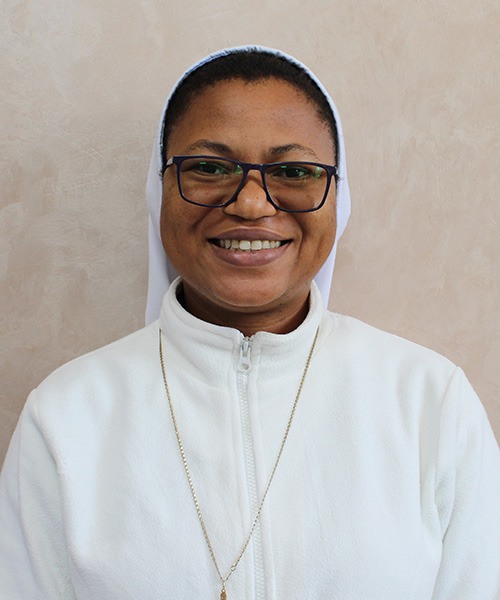
A Conversation with Sister Blessing Ekanem, A Religious Sister of Charity
With: Blessing Ekanem Berkley Center Profile
November 19, 2026
Background: Sister Blessing Ekanem is a member of Georgetown University’s Women Faith Leaders Fellowship 2025-2026 and a Religious Sister of Charity. Originally from Nigeria, Sr. Ekanem is based in Zambia. Between 2020 and 2026, she served as coordinator of the Maamba Youth Project, a vocational training institution for Zambian youth. Sr. Ekanem has also run projects related to safeguarding of vulnerable groups, focusing on such issues as child marriage, teenage pregnancy, and child sexual abuse.
Sr. Ekanem spoke with Luisa Banchoff via Zoom on October 6, 2026. During their conversation, she reflected on her journey to becoming a sister, her educational and early career experience in safeguarding, and the challenges faced and lessons learned in leadership, collaboration, and trust as coordinator of the Maamba Youth Project. She also spoke about her time in the Women Faith Leaders Fellowship and her plans for her capstone project.
Biography: Sister Blessing Ekanem is a member of the Religious Sisters of Charity. She has extensive experience in safeguarding initiatives focused on child marriage, teenage pregnancy, and child sexual abuse. She served as coordinator of Maamba Youth Project, a vocational training institution in the Southern Province of Zambia, before being transferred to Lusaka in late 2026, where she will continue her safeguarding work. Sr. Ekanem holds a BA in sustainable human development from Tangaza University in Kenya.
To begin, could you tell me about your background and what led you to become a sister?
My name is Blessing Ekanem. I am a Religious Sister of Charity working in Zambia, but I am originally from Nigeria. I am the fifth of a family of five children.
I was raised Catholic, but I hadn’t thought about becoming a sister until I was finishing secondary school. People used to tell me that they would not be surprised if I ended up as a sister, but I would just brush them off because it did not cross my mind. As soon as I finished writing my secondary school exams, it dawned on me: what should I do with my life? I had thought of becoming an accountant, and I also had my own dreams of getting married and having kids. But after a homily I heard, I started having thoughts about different vocations.
One weekday evening, I decided to go to Mass. There was a particular priest that day who preached about people missing their vocation. Sometimes we miss the call of God, and so our lives don’t turn out as wonderful as they could have. The priest gave a lot of examples, such as someone who was called to be a doctor, a lawyer, or a teacher but who pursued a different career and then encountered a lot of obstacles. If you have put all your effort into something and things don’t work out, it is probably because you are not on the right path, like a square peg in a round hole. Living your vocation doesn’t mean that there will be no challenges in your life, but it will be much easier to accept and deal with them. He also spoke about religious life, priesthood, and being a lay person. You might be called to religious life but choose not to answer, or maybe you are not called to religious life but force yourself to be there.
What the priest said touched me. It got me thinking: what really was my vocation? I wanted to be an accountant, but could it be that there was more? So I started reflecting. At the same time, there was a local man whom we saw as being very pious. One day, after Mass, the man came to me and asked, “How many congregations have you applied to?” I was so surprised. I told him, “None. Did I tell you I want to be a sister?” He said, “Think about it,” and we both walked away.
Then everything started adding up. I remembered my childhood, when my parents or older siblings took me to visit the Religious Sisters of Charity at their convent. On one of those visits, I remember the atmosphere was so serene, so quiet, so prayerful, it just felt like God was there. Sometime in August, I made inquiries at the convent. That is how I started the process. At every step, I kept daring the Lord. I would say, “If this is what you want, let this or that happen,” and it would. Even after my first profession, I was still doing the same thing. Then one day a voice just said to me, “Are you not certain enough? I have given you all the proof you need that you should be here.” That was when I stopped. I said, “Okay, I’m here now.”
Could you share about history and charism of the Religious Sisters of Charity?
The Religious Sisters of Charity were founded by an Irish woman, Mary Aikenhead, who was born in 1787. As a teenager, she felt drawn to serve poor people in Ireland. She thought joining a religious congregation would help her serve God better, but she wanted to be in touch with the poor. The women’s congregations in Ireland at the time were cloistered, and she didn’t think that joining them was her calling. Together with a friend, she went to York to join the Institute of the Blessed Virgin Mary. After that she returned to Ireland and, together with the support of the local bishop, founded the Religious Sisters of Charity in 1815.
Our congregation’s charism is service to the poor. We follow Ignatian spirituality; our constitution and vows are exactly the same as those of the Jesuits. We are involved in a number of ministries depending on the context. In Nigeria and Zambia, we are involved in health, education, pastoral care, social work, spirituality/formation, care for our common home, safeguarding, and anti-trafficking. Some sisters run workshops and spiritual retreats.
Can you speak about your formation and education? How did you end up working in Zambia?
I came to Zambia first in 2013 as a novice. After my first profession, I was missioned to Zambia; I arrived in 2015 and was attached to a basic school. Between 2017 and 2020, I did my BA in sustainable human development at Tangaza University in Kenya. While there, I visited Zambia during breaks or for research.
When I graduated, my congregation sent me to work on a child protection program for about eight months. It focused on preventing child marriage, child sexual abuse, and other issues related to children. Our job was to do sensitization and report cases. We also had trained animators in villages to report cases of child marriage and sexual abuse to us, which we then reported to the police.
After that, I worked as a coordinator of Maamba Youth Project, a vocational skills training center in southern Zambia with courses in computer studies, fashion design, carpentry, and food production. I worked there for almost six years, from the end of 2020 until summer 2026. I have now been given a new assignment in Lusaka.
Can you speak more about your work at Maamba Youth Project? What are your responsibilities as coordinator?
My role as coordinator is to ensure that things work out as they should. I didn’t get a manager until last year, not because we didn’t want to hire people but because we hadn’t found the right ones for the job. Until then I was doing everything, including some of the accounting work, because we couldn’t keep an accountant for long. I also do a lot of the tech work; if the employees have tech-related challenges, they call me for help.
Who comes to the center for training?
The center has between 60 and 80 students each year. Most are between the ages of 16 and 40, although one time we had a lady over fifty; she was a role model to some of the other trainees.
Most of the youth who come have dropped out of school; a few have never been to school, and some have completed high school. Because we are accredited by the government’s Technical Education, Vocational and Entrepreneurship Training Authority (TEVETA), there are categories for people who come to train. TEVETA has a syllabus tailored to each category of students.
What are some of the challenges you’ve faced in your work?
When I arrived at Maamba Youth Project in 2020, the institution was almost collapsing, as there had been a vacancy in the leadership for five years. Some sisters even said it was a waste of time, so I had to work extra hard to prove that it was not. I had to convince people that there are a lot of youth who want to be trained at a Catholic institution. I believe you should leave a place better than you found it. That has been my working principle, and the staff caught on to it.
I made my first year at Maamba Youth Project a learning year: I wanted to see how the staff did things and decide where we could do things differently. I made decisions bearing in mind how things had been done before but stepped in with full force when introducing something new. There were a lot of things I introduced during my time, including a financial policy and regular stock-taking.
Another big challenge was that the center’s accreditation had expired. Accreditation costs a lot of money, and you also have to meet minimum training standards for your equipment and facilities. Between 2015 and 2020, the unpaid fees had accrued, and we could not reopen the institution without clearing that debt. Eventually we managed to re-accredit and pay it off. We made progress, which was evident to a lot of people.
What are some of the most important skills you have gained and lessons you have learned over your career so far?
I have learned that a sign of trust is to entrust. One way I show that I trust somebody is to give them responsibility. When we hired a new accountant, a lady in our finance office didn’t trust him. On his second day, I sent him to the bank, and she was very skeptical. I told her that if the money went missing, it would be a learning process. We could not hire an accountant and still send someone else to deposit the money. So I have learned to entrust responsibilities to other people. I have also learned about taking risks: if he had lost the money, it would have been painful for us as an institution, but we needed to take the risk.
I wouldn’t say I have learned patience, but I have been reminded, time and time again, about the value of patience. If someone repeatedly fails to deliver, I let them do the bare minimum and do the rest myself. This is partly why I get very busy. But I have to remind myself that I need to be patient.
Finding a balance between work and play is another thing I have learned from the people I worked with. I have a very serious face, and when people look at me, they think I am mean. To break the ice, I make a deliberate effort to be down-to-earth, to go into their circles and mingle with them. I know when to be light-hearted and easy with people, when to laugh about things. And yet, when there is something that needs to be done, they know the mood is different. If I need to raise my voice, I do. I don’t have resources to motivate people, so I use words. I help them see reality as it is: if we don’t do things a certain way, they will not work. Sometimes people forget that I am the boss and say things that sound insulting, though they don’t mean to. When that happens, I remind them who is supposed to be giving instructions, and they apologize.
The truth is, I am not just a leader. I am also a sister and a Christian. If I am to bring the love of Christ to people, it is not through going around and preaching. It is through how I relate to people. If someone needs advice or needs to hear something positive, then we can talk about God’s love and mercy. Even when I challenge them, I say, “God doesn’t just sit and do nothing. He works, he’s busy, so you too should not just sit.”
How has your experience been in the Women Faith Leaders Fellowship?
I feel privileged to be a part of the fellowship because of the other sisters I met. They were elites, not in the material sense of the word but in the intellectual sense. They were very high-profile people: doctors, PhD holders, people who have gone places. And there I was, the youngest of the group, coming from my little community with very limited experience, only the grace of God. “Small girl, big God.”
The sisters’ insights and humility enriched me a lot. These women, who are very influential, came together in one mind and heart, bringing themselves down to the level of everybody else in order to relate to them. It was also a privilege to interact with the facilitators and organizers. It was a great experience traveling overseas, visiting places, and meeting all the people we met.
At the same time, I felt that some of the people we met were not of much use to me in my work. The experience was great at an individual level, but I cannot remember any contacts I made that are helpful to me now. Maybe for others it was more helpful. My point is that, as interesting as the experience was, I didn’t always see a connection to my reality.
Could you share about your planned capstone project for the WFLF?
When I was working at Maamba Youth Project, I realized the local people needed a recreation facility. From 4 p.m. to 7 p.m., you would find people roaming the streets with nothing to do. So I thought of creating an arts and recreation center for people to use in the afternoon. The purpose of the facility was also to sensitize people on various social issues. When youth gather, it is always an opportunity to tell them something, and they are open to learning. There would be days when we could just sit and talk, and other days when we could do a skit or a poem about an issue like drug abuse.
The plan was in motion, and I had complete my proposals. A coal mining company that was already partnering with us on skills training was willing to give me the premises for the facility. However, this plan was cut short because I was being transferred to Lusaka. The capstone project might change when I get there. I need to settle into my new location first; before then, I cannot know what the needs of the place are. The context is completely different: before, I was in a developing rural community. But now I will be in an urban area. So I am a bit reluctant to replicate the idea, and I am thinking of changing it altogether.
Thank you for sharing about your work and your project. I wish you all the best in your capstone project and all your future endeavors.