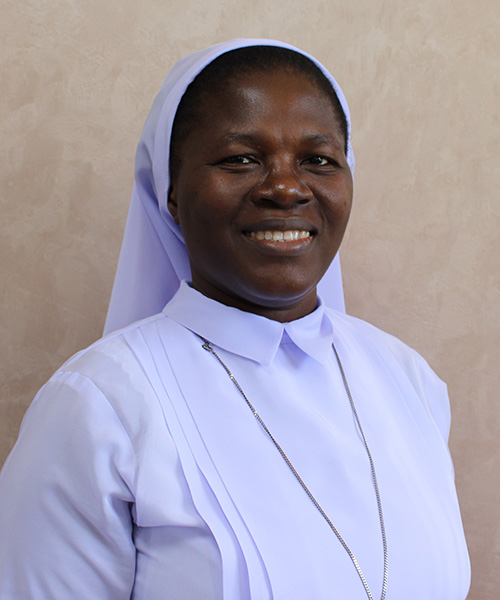
A Conversation with Sister Evelyn Otchere-Boateng, A Member of the Society of the Infant Jesus
With: Evelyn Otchere-Boateng Berkley Center Profile
June 2, 2026
Background: Sister Evelyn Otchere-Boateng is a member of Georgetown University’s Women Faith Leaders Fellowship 2025-2026 cohort. She belongs to the Society of the Infant Jesus, established in Cape Coast in 1962. Sr. Otchere-Boateng has decades of academic and professional experience in the finance and accounting sectors. In addition to working as a lecturer in the Department of Accounting at the University of Cape Coast, she serves as the general bursar of her congregation and finance officer for the Catholic Sisters Elderly Care Network Ghana.
Sister Otchere-Boateng spoke with Luisa Banchoff via Zoom on June 2, 2026. In their conversation, she reflected upon her journey to becoming a Catholic sister, shared her extensive academic and professional experience, and discussed pressing issues in Ghanaian society, including foreign investment and economic growth. She also highlighted the impact of the Women Faith Leaders Fellowship in her development as a leader and advocate, including how the fellowship helped her draw on her own difficult life experiences to help equip young women with the tools to cope with challenges.
Biography: Sister Evelyn Otchere-Boateng is a member of the Society of the Infant Jesus. She has an extensive background in finance and accounting. Her Ph.D. in Business Administration, which she earned in 2023, focused on inclusive growth in sub-Saharan Africa. She serves as a lecturer in the Department of Accounting at the University of Cape Coast and also works as the general bursar of her congregation and the finance officer of the Catholic Sisters Elderly Care Network Ghana, which cares for the needs of aging women religious. In addition, Sr. Otchere-Boateng is currently pursuing a master’s in education at the University of Cape Coast.
Can you begin by telling me where you're from?
My name is Sr. Evelyn Otchere-Boateng. I am from a town called Heman in the Ashanti Region of Ghana, but I grew up in Bibiani, in the Western North Region. My mother and father were separated when I was about four years. They had four children, but one died. We are now two women and one man, and I'm the youngest among them. My father had other children. We were around 27 in number, but we are currently left with 18.
I spent most of my childhood living with my father, stepmothers, and other brothers and sisters. When I was nine years old, my father took me to live with him and my other siblings in a town called Sefwi Asawinso, in the Western North Region. We later relocated to Bibiani. At that time, I was in primary school. I became the school prefect and was a very smart and intelligent child. Because of my academic performance, I was promoted from stage 3 to stage 6 [equivalent to US Grades 3 and 6].
My father later decided that it was not necessary for me to go through junior high school, so I went straight to senior high school at the age of 11. I completed my O-Levels after five years, before I turned 17.
After completing my O-Levels, I began working with my father. He was a road contractor, a timber contractor, and a hotelier. He had two hotels, one in Accra and the other in Bibiani, and I moved between the two hotels at different times. I was first trained in procurement and kitchen work, then in catering and restaurant operations. Later, I was sent to the reception to be trained there as well, so that I could understand the different areas of hotel management. Eventually, I became the manager of the hotel in Bibiani.
During my time in secondary school, when I was about 12 years old, I had heard the call to become a religious. After working with my father for some time, I took a bold step and told him that I wanted to join the convent. In 1996, he reluctantly allowed me, and I was able to begin my journey into religious life.
Did you grow up Catholic?
Yes. My mother was a deep lover of God. I grew up knowing her commitment and love for God. She was initially a Catholic, but due to challenges and difficulties in life, she found herself moving to a different prayer group, which drew her away from the Catholic Church for some time, although she later came back. However, before I left to live with my father, she had already given me deep roots in the Catholic faith.
My father was also Catholic. He would not allow his children to go to any other church. When I was around 11 years old, I met a girl one day who told me she was going to catechism class. She asked if I wanted to join her, and I immediately did. I started going to catechism class, and when I was ready for my first holy Communion, my father was very happy and approved. Two of my siblings also joined me for the catechism class, and we all received holy Communion and Confirmation together.
I am a little sad to say that currently, among my 18 siblings, only my elder sister from my mother’s side and I are Catholics. The rest of them all attend other churches. Where I grew up, there were many other churches around us. While my father was still alive, my siblings would secretly join these churches so that my father would not know. But after he died, they started freely worshipping in other churches.
Even my brothers who joined me in the catechism classes are no longer Catholics. They now belong to different Pentecostal and charismatic churches. But my elder sister is Catholic, even though her husband is a Methodist, and their children are also deeply rooted in the Catholic Church.
How did you discover you wanted to become a Catholic sister?
As a child, whenever I was sleeping or found myself in trouble, I would sometimes see angels come to rescue me. Whenever I was feeling ill, God would speak to me, but my vocation was not yet clear to me. I only knew that I loved God.
At the age of 11, I had a vision in a dream. In the dream, I was going to a party with one of my sisters. The clouds gathered and it was about to rain. I followed the storm cloud and saw it turning into the form of a rainbow. I excitedly followed it, and before I realized, I had left home and was walking along a footpath. When I reached the horizon, there was a man sitting there wearing a turban. He told me that if I wanted to serve God, I should read the good news. I did not understand what it meant, but then I saw myself carrying a sick person to this same man for healing. It was a kind of revelation I received from Jesus. In another dream, I found myself with my sister in a big garden full of fresh tomatoes. Then a voice said to me, “I am the God of Abraham, the God of Isaac, and the God of Jacob. Walk before me and be blameless.” It was so beautiful.
I could not understand these things at that time. I had not encountered any Catholic sister, and I did not even know that such women existed. But after my first holy Communion, one day as I was going to church, I met the assistant headmaster of the school I was attending. He was also the organist of the church. He told me that I looked like a nun and that I should become one, and therefore I should not engage in anything that would make me unholy. I thought, what is this man saying? I didn’t understand.
After that, many people also told me that I looked like a Catholic sister. I kept asking myself what it meant. Then, fortunately, the sisters came to our parish for a vocation drive. They announced that all those who wanted to become sisters should attend a retreat for aspirants. I told my father that I wanted to join, because everyone who saw me kept saying that I looked like a nun.
At that time, nothing interested me more than going to church. All my attention was focused on the Lord. I would go to church before going anywhere else, even before going to school. No matter how late it was in the day, I would still want to go to church. At that time, it was not common to see young people in church on weekdays. Only a few adults, about 10 to 12 people, went to church frequently on weekdays. But I was always there because I wanted to receive holy Communion and encounter the Lord.
It took me years before I finally got the opportunity to enter the convent, because there were many challenges as I was growing up. That was how I came to realize that I had a call. Through consistent visions and the deep yearning in my heart, I came to know that this was where God was leading me. As a teenager, all I wanted was to become a sister, even though I did not fully understand what it involved at that time.
Tell me about your congregation, the Society of the Infant Jesus. How did you get to know them?
I initially wanted to join a different congregation, the Handmaids of the Divine Redeemer of Accra. I went to their aspirant retreat every year until I completed school. My home life was very difficult at the time because I was abused a lot by my stepmothers. After I graduated, my dad asked me to work in his hotels, and he didn’t initially want me to go to the convent. It was a tug-of-war. I had written to the Handmaids of the Divine Redeemer, but it took time for them to respond to me. As I was waiting, I worried they would not accept me.
A priest in my parish told me that his aunt was the superior general of another congregation called the Society of the Infant Jesus. About five members had visited my town earlier, so I had already met them. They were a happy group. I wanted to talk to the leader and tell her I was interested in becoming a nun. But my stepmother found a way to prevent me from meeting the woman, so I didn’t have the opportunity to express interest to her. When the priest found out I was still yearning to join the convent, he generously gave me the contact of his aunt, the superior of the congregation. I wrote to her, and the moment she got the letter, she responded and invited me to visit them. I lived with them for about three months and made the decision to join them that same year, even though the Handmaid Sisters had also responded positively. So, on September 25, 1996, I joined the congregation and entered postulancy on October 7, 1996.
The Society of the Infant Jesus was founded in 1964 by Most Rev. John Kodwo Amissah, the late Archbishop of Cape Coast. He was the first Ghanaian archbishop in Ghana. The Society is a diocesan congregation, and we recently celebrated our 60th anniversary. We are currently about 76 sisters, serving in two archdioceses and two dioceses, with fourteen communities across these dioceses. Our apostolates are mainly in health, education, care for the aged, and vocational skills development.
Your academic and professional background is in accounting and finance. What drew you to this field?
When I entered the congregation, I had already completed secondary school under the old educational system. However, by the time I finished my formation, that system had been phased out, and I needed to start secondary school again in order to qualify for tertiary education. My superiors asked whether I was willing to begin again, and I agreed. I first attended a girls’ secondary school in Kumasi for a year, where I intended to pursue business secretarial studies. However, because the science background of the school was not strong enough and could affect my progression, my superiors encouraged me to move to Holy Child Secondary School and start again from Form 1 [equivalent to US Grade 7]. At Holy Child, business secretarial studies were no longer being offered, so I was placed in business accounting class. That was how my accounting journey began, and it later led me to the University of Cape Coast, where I pursued a Bachelor of Education in Accounting and Business Management.
After I completed my first degree, my congregation saw the need for someone with audit experience. I was therefore blessed to work for three years at KPMG, one of the Big Four accounting firms in the world. After that, I returned to the convent and worked as the accountant of Mercy Women’s Catholic Hospital, which cared for fistula patients as well as providing obstetric and general hospital treatment.
I worked there for two and a half years before pursuing a Master of Commerce degree in accounting. After completing the program, I became the general bursar of my congregation. In this role, I handled matters relating to the congregation’s finances. I also offered internal control services and workshops for my congregation and its institutions as well as another diocese. During that time, I also served as a member of a finance committee formed by the Bishops’ Conference to review the finances of three major seminaries in the southern part of Ghana, a role I played until 2022.
I later went back to school to pursue a Ph.D. in Business Administration, with a focus on accounting. I completed the program in 2022 and graduated in 2023. I am currently a lecturer in the Department of Accounting at the School of Business of the University of Cape Coast.
I am also pursuing a master’s degree in education and preparing for the professional examinations of the Institute of Chartered Accountants Ghana. I have completed 13 of the 14 required courses, with one final-level course remaining before I qualify as a chartered accountant.
In addition to my academic and professional development, I still serve as the general bursar for my congregation and as the finance officer for the Catholic Sisters Elderly Network Ghana. This explains how my interest and professional path in accounting gradually developed.
What was the focus of your Ph.D. research?
My research focused on inclusive growth in sub-Saharan Africa. The title was “Industrialization, Capital Influence, and Inclusive Growth in Sub-Saharan Africa: The Moderating Role of IFRS Adoption Speed.” The study was based on the idea that industrialization is important for reducing poverty, creating employment, and promoting inclusive growth in sub-Saharan Africa. However, industrialization requires capital, and many African countries do not have enough internal capital to support it fully. This makes it necessary to attract external investment.
IFRS adoption is expected to help attract such investment by improving the quality, transparency, and comparability of financial reporting. However, my argument was that adoption alone is not enough. The speed at which a country adopts and implements IFRS also matters, because rapid adoption without strong implementation systems may not produce quality financial reporting. Countries therefore need proper structures to ensure that IFRS is not only adopted in good time but also applied effectively.
In this way, IFRS adoption speed, supported by quality implementation, can help build investor confidence. When investors trust the reporting environment, they are more willing to provide capital, and such capital can support industrialization, job creation, poverty reduction, and inclusive growth.
Is there much foreign investment in Ghana at the moment?
While there are many construction projects in Ghana and investments are increasing, most of the money still goes to those who are already wealthy or to sectors that do not create wider employment opportunities. Foreign direct investment is increasing in sectors such as mining, oil, and gas, but these sectors do not employ many local people. For most of the major positions that generate revenue, companies bring in expatriates, and these workers often take their earnings back to their home countries. As a result, these sectors do not create enough jobs for local people, whether educated or not. This is worrying, especially because there are so many unemployed graduates in Ghana at the moment.
In the manufacturing industry, however, people with higher degrees can be employed in certain positions, while those who have not had much formal education can also benefit through direct and indirect job opportunities. For example, manufacturing can employ people on the factory floor and also generate income along the value chain. If raw materials are needed, manufacturers may rely on farmers. Someone who has not been to school can cultivate the product, supply it to an agricultural company, and the agricultural company can then transfer it to the manufacturing company for production. In this way, one product in the manufacturing industry can affect the whole value chain and reach many people.
This helps to widen the net and reduce unemployment. People feel happy because they are part of the change and are creating value. It is inclusive because they are not simply begging or receiving handouts. If people only receive handouts, they may not value the process in the same way. But when they are part of the production process, contribute to it, and share in its benefits, it enhances their dignity and promotes inclusive growth, both horizontally and vertically. They become part of the economic process. In that way, the money coming into the economy does not only go to people who are already rich.
Tell me about your work for the Catholic Sisters Elderly Care Network Ghana.
The Catholic Sisters Elderly Care Network Ghana was established about five years ago through the support of the Hilton Foundation. It became incorporated in September 2024. Sisters spend all their lives caring for humanity, but when they get old, it can become very difficult for them because of the way systems and structures are. We do our best to take care of them, but there are a lot of sisters to take care of, and they don’t always get the care they need in their old age. Some become very vulnerable, others are afflicted by infirmity, and many feel lonely. Some have emotional and psychological issues because of hardships they have gone through. Most of the time, the congregations do not have enough funding to care for their special needs.
We formed a network of congregations and, through the benevolence of the Hilton Foundation, set up a fund to take care of the elderly and infirm sisters among us. We have certain structures in place when sisters need help. Some of them need medication, nutritional support, or help moving around. In some cases, they live upstairs in their convents, and it is very difficult for them to move in and out of the building.
My role came about because my congregation was the fiscal agent of the network during its first two years. We handled the registration process and set up its board, ensuring the idea would become a reality. During this phase, my superior and I wrote concept notes and applied for the grant from the Hilton Foundation. Now the network is registered and we have a project manager in place, as well as an office and staff. Since I had been part of the network from the very beginning and had journeyed with it through its formation and growth, I was asked to continue supporting its financial work. This was also because of my background in accounting and my understanding of the financial structure the network needed at that stage. I therefore continued as the finance manager, helping to shape and strengthen the financial systems of the entity as it grows.
Everything is operating very well. There are programs going on, webinars on health, emotional health, and other topics. There are wellness coordinators who go to the various convents across the country, visiting the elderly sisters to know their needs so that we can address them. We also give sub-grants to member congregations to take care of the sisters.
How has your experience been in the Women Faith Leaders Fellowship?
I heard about the fellowship through another sister who had been my lecturer on a certificate program in theology at Hekima University, Kenya. She sent me a flyer about the program, and I decided to apply. By the grace of God, I was selected to be part of this cohort.
My experience in the fellowship has been formative and transformative. The fellowship has expanded my horizons. It has helped me to understand life better through the various topics covered. The experience of traveling has also been very rich; the fellowship has taken me to places I never dreamed of visiting, such as the United Nations in Geneva.
The experience has also led me to reflect deeply on things hidden within me, things I believe God wanted me to bring out in order to help humanity. As I reflected on my traumatic life experiences with my stepmothers, as well as the challenges I have faced in religious life, I realized that these experiences were not without meaning. I began to see them as part of the way God was preparing me to become useful in helping others who may be going through similar struggles or other difficult life situations. This reflection helped me to understand that what emerged during the fellowship was not only something in my head, but something inspired by God. It showed me that my own life experiences could become a source of strength, compassion, and support for many people.
My capstone project is titled “Positive Encounters Initiative (PEI): Creating Enabling Environments for Young Women to Thrive”. The project focuses on supporting young women in tertiary institutions who are carrying negative life experiences, including financial challenges, loneliness, lack of parental support, and the absence of positive role models. Many of these young women are going through unnamed struggles, but they often have no trusted person with whom they can share their experiences.
Although young women in Ghana now have greater access to education and there is some level of equity in school enrolment, access alone is not enough. When young women are brought into school without an enabling environment that allows them to feel safe, heard, and supported, they may not be able to express themselves fully or achieve their potential. Some of them cope with their pain in ways that worsen their situation and eventually affect their academic work, personal development, and sense of self-worth.
The Positive Encounters Initiative therefore seeks to create a safe and supportive space where these young women can express themselves, unearth their negative experiences, and encounter people who listen to them without judgement. The initiative focuses on young women who have potential but are limited by painful life experiences. Through positive encounters, mentoring, counselling, and support, PEI gives them the room to heal, grow, and rediscover their value. The aim is not only to help them remain in school, but to create an environment where they can become women of substance, capable of transforming their own lives, their families, and society.
We just had our launch. It was very emotional: some of the girls were crying. It was a very special moment. The capstone project has opened my eyes to see life from different angles, not only as a sister or at work, but much more. There are a lot of challenges out there that require me to be a vessel of God.
What sorts of activities or opportunities are you providing these young women?
We provide mentorship, counseling, spiritual direction, life development workshops, and limited practical support. Some women who have progressed in their own fields have generously volunteered to be mentors. They are ready to share their experiences, guide the young women, and help them recognize their own potential.
We are also bringing professional counselors and clinical psychologists on board to support those who may need deeper emotional care. The spiritual direction is optional because the participants come from different faith backgrounds, and we want the program to remain inclusive and respectful.
In addition to one-on-one mentorship, we organize life development workshops on topics such as positive mindset, inner healing, confidence-building, academic focus, decision-making, and resilience. Where necessary, PEI also offers limited support for urgent academic-related needs. Overall, the initiative creates a safe and supportive space where young women are listened to without judgement, encouraged, and helped to grow with hope and purpose.
Is there stigma around mental health in Ghana, as there is in so many parts of the world?
Yes, there is still stigma around mental health in Ghana, as there is in many parts of the world. In universities, counselors are available, but some students are afraid to go to them because they fear being labelled or judged. This is one of the reasons why my capstone project focuses strongly on relationships and safe spaces.
Through the Positive Encounters Initiative, we want to create an environment where young women can share their struggles without fear of judgement. They will be listened to, supported, and guided to navigate their challenges in a healthier way. The aim is to help them understand that their painful experiences do not have to define their future. Instead, those experiences can become stepping stones for healing, growth, and positive transformation.
I am very grateful to the Women Faith Leaders Fellowship for this great opportunity. I feel privileged to be part of the cohort and to have met the team members and the other sisters. Their mentorship, guidance, and support are helping us to shape and implement our capstone projects in a way that can make a meaningful difference.
Thank you, Sr. Evelyn, for sharing your story, your inspirations, and the impressive work you do. I wish you the very best in your capstone project and beyond.