Biography:
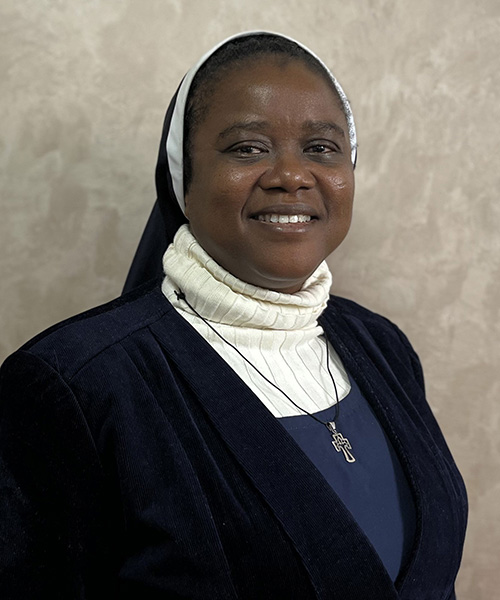
Sister Gertrude Elelegu is a member of the Sisters of St. Louis in Nigeria. She has 17 years’ experience in Nigeria’s education sector, including serving as principal administrator of a school for seven years. Sr. Elelugu has served on the leadership team of the Sisters of St. Louis, Nigeria Province since 2023, where she is responsible for safeguarding and communications, as well as overseeing activities across several Nigerian states and the Republic of Benin. She holds a bachelor’s degree in biochemistry and microbiology, a postgraduate diploma in education, certificates in education and theology, and a higher diploma in pastoral care for human mobility.
To start, can you tell me about your family background? Where did you grow up?
I am Gertrude Elelegu. I am from Delta State in Nigeria, from a village called Umunede. I come from a family of nine, including my parents. I have four sisters and two brothers. I am the second child and first daughter.
Were you raised Catholic?
Yes. My parents are Catholics, and all my siblings are Catholics. The area where I grew up is religiously mixed. There are Catholics, Anglicans, Methodists, and Pentecostals.
What made you decide to become a sister?
I started nursing the idea when I was young, even though I had never met a sister before. I felt that I wanted to serve God in a special way. As I grew, I told myself I was going to be a medical doctor in order to save souls for Christ.
In 1984, when I was in Primary 5, I met a group of sisters for the first time, the Daughters of Charity of Saint Vincent de Paul. They helped destitute people, lepers, old people, and so on. I befriended them and fell in love with their way of life.
My parents didn’t want me to join religious life before finishing tertiary education. They felt that once I had graduated, I would be sure of what I wanted. My mom didn’t want me to become a sister. As I am the eldest daughter, she believed I need to take care of the family. I didn't receive much opposition from my dad, but he also did not give his approval. So I continued with school.
After tertiary education in Nigeria, you do a mandatory year of service to the country. When I finished my tertiary education, as I was preparing for my youth service, I gave away some clothes I wasn't using. My mom saw me and said, “What are you doing? I hope you are not still interested in going into religious life.” I laughed and said, “I am.” She called my dad and said, “Your daughter has started again.” My dad said “She’s of age.” He was telling me I could go if that is what I want. I jumped at that opportunity, because I love my parents so much and didn’t want to disobey them. I wanted them to give their approval for me to go. That was how I stepped into the religious life and started my journey as a sister.
Tell me about your congregation, the Sisters of St. Louis. How did you get to know them, and what work do they do?
When I was an undergraduate, I met a Sister of St. Louis. I loved her way of life and the way she related to the students, which was not exactly like in some other congregations. She was very free with the youth. She mingled with them so much that sisters from other congregations thought that she wasn't a sister. That attracted me. I felt that if you are a sister and you really want to serve God and bring people to God, you should interact with them freely.
I asked the sister about her congregation, and she told me they had a community in my home state. When I visited them, I saw that they were in a very remote village where the roads are not good. There was no electricity and they were living beside a river with a lot of wild animals around. I thought, how can people be living in such a place just because they are serving God? That drew me closer to them, and I began to ask questions. From there, I applied to join them. I began my formation in the year 2001.
Before I joined, I had the opportunity to learn more about the congregation’s history. Their founder was a priest from France, Louis-Eugène-Marie Bautain. From the start, the congregation focused on girls’ education. At that time of their founding, in the 1840s, women and girls were marginalized and not allowed to go to school. Today, the sisters teach both boys and girls at the primary level, between ages 4 and 10. The sisters teach also girls at the secondary level, between ages 11 and 18. The sisters also work in hospitals and help people. Education and health care are the two major ministries the congregation is involved in. But over time, as they were looking at what was happening in the society and reading the signs of the times, they also engaged themselves in pastoral care, ministering to people in parishes and to the elderly, and doing social work.
You completed your tertiary education before going into religious life. Can you speak about your educational background?
Before I became a sister, I attended the University of Nigeria, Nsukka. It’s one of the biggest and most well-known universities in Nigeria. I studied biochemistry and microbiology. After that, I joined the Sisters of St. Louis.
Since then, I’ve done a lot of programs. I did a postgraduate diploma in education in order to work in schools, which I did from 2003 to 2019. Within that period, I was the principal administrator of a school for seven years. I also took courses on project management, human trafficking, basic counseling, and monitoring and evaluation. Between 2001 and 2003, I did a certificate course in theology. I also did an ordinary diploma and higher diploma in pastoral care for human mobility. I've also done various courses on leadership. These are the skills I have acquired along the line to carry out my responsibilities. At the moment, I am doing a course on facilitation.
You have worked across a wide range of areas, including education, human trafficking, and congregational leadership. Tell me about your professional journey.
As a sister, you don’t choose where you work. You are assigned based on what the congregation needs you to do at a particular time. I had my first profession of vows in 2003. After that, I was assigned to work in a boarding school. I spent three years there and then went to another school. In 2019, I was posted to a primary school for one year. I taught Primary 4, 5, and 6. After that, I worked as a bursar in our retreat center. I did that for more than a year. While I was there, I did a course on human trafficking and project management. In 2021, I started working in the congregation’s anti-human trafficking ministry. I am still working there at the moment, but I am doing it part-time because I’m in the congregational leadership, which I’ve been doing since 2023.
What are your roles and responsibilities in the provincial leadership of the Sisters of St. Louis?
As the Sisters of St. Louis, we have what we call the team leadership. There are five of us. I am in charge of Oyo State, Lagos State, and the Republic of Benin. I’m also in charge of safeguarding and communication for the province. I ensure that our newsletters are published every month. In our congregation, we have people whom we call Friends of the Sisters of St. Louis who support us financially; I am in charge of liaising with them. I'm also in charge of the provincial choir.
How did your congregation become involved in anti-trafficking work?
In 1996, Sister Patricia Ebegbulem was provincial leader of the Sisters of St. Louis and also the president of the Nigeria Conference of Women Religious. She traveled to Rome for a meeting of the major superiors of congregations. While there, she was shown some girls who were working in prostitution on the road at night, half-naked and in a pitiable state. When she saw them, she was heartbroken. She came back to Nigeria, went to the Catholic Bishops’ Conference of Nigeria, told them about the issue, and said we need to do something. That’s how the Church’s work on anti-human trafficking started in Nigeria.
The Catholic Church essentially began the fight against human trafficking in Nigeria. In 1999, Nigeria Conference of Women Religious founded an NGO called the Committee for the Support of the Dignity of Women, or COSUDOW. When Sister Patricia finished her tenure as president of the Nigeria Conference of Women Religious, she worked for COSUDOW. In 2013, COSUDOW decided to relocate from Lagos to Benin City because it is the hub of trafficking in Nigeria. Some people who had been working with COSUDOW said they needed a place in Lagos as well. COSUDOW was not ready to have an additional outlet in Lagos, so Sister Patricia came back to the Sisters of St. Louis and told them that there’s a need for an NGO to fight against human trafficking. The Sisters of St. Louis embraced this ministry, with Sister Patricia spearheading it. In 2014, the Order of Malta heard about the work we were doing. They renovated, furnished, and donated a building for us to use as a shelter. It can accommodate about 30 people.
That was how we started. Since then, we have been doing anti-human trafficking work as a congregation. Sister Patricia is also a member of the Board of Trustees for the Network Against Child Trafficking, Abuse and Labour (NACTAL). This was an NGO founded by the wife of the country’s vice president at the time. This continued until 2003, when the government formed an agency called the National Agency for the Prohibition of Trafficking in Persons (NAPTIP).
In 2021, I joined Sister Patricia to work in the shelter. We give accommodation to people. We don’t call them survivors or victims but “treasures” because we want to make them know that they are treasured, irrespective of the situations they have passed through. We give them accommodation and meet their basic needs. We take care of food, clothing, and medical needs. We also do a lot of counseling and psychotherapy. Some of them have psychiatric cases, so we take them to the psychiatric hospital for treatment.
While they are living in the shelter, the treasures also engage in occupational therapy. They learn small handiwork skills, like crafts and soap-making, to keep them busy until they are stable. It helps them make up their mind to decide to go back to school or learn a trade. For those who want to go back to school, we try to reunite them with their families. Those who want to learn a trade or skill stay with us until they finish acquiring that skill; then we help them set up their business and economically reintegrate them into society. We trace their families and reunite them when possible. Some of them face rejection from their families because they come back empty-handed.
Are most of the women and girls trafficked in Nigeria sent abroad?
Not all of them are sent abroad, but most are, especially within Africa. Only a few are moved within the country. They may be brought from a remote village to Lagos, where they are coerced into prostitution or domestic servitude. However, the majority of the people are trafficked outside Nigeria. They used to travel as far as Europe, passing through the desert. A lot of awareness raising has taken place, so they no longer take that route as much as they used to. Now they travel by air: the traffickers get them tickets and passports in order to take them by air. In the past four years, we have very few women coming back from Europe. They are mainly trafficked to African countries, like Ghana, Cameroon, Mali, Libya, Burkina Faso. Last week, we had six women come to our shelter from Burkina Faso. In the past month, about 30 were brought from Burkina Faso.
What are the underlying causes of trafficking in Nigeria? And what measures are taken to counter it
The root cause of trafficking is poverty. Unfortunately, the present instability in the country is increasing poverty. You have people being displaced from their homes and being out of work. High unemployment is another cause. When people are looking for a job, including educated people, they are in a vulnerable state, so they are exploited. Another cause of trafficking is the demand. If there were no demand for sex, there wouldn’t be such supply. The trafficking network is highly complex and traffickers are highly connected. That is why we are asking that the government of every country to work against it.
We work to reduce trafficking primarily by creating awareness in schools, churches, and marketplaces, and through radio and television. You would think that this awareness creation would have reduced the problem. But you will find people who tell you that just because others did not succeed in this work does not mean that the same will happen to them, so they want to give it a try. They become deceived with the promise that they will have a better job. There is also the appeal of the quality of life elsewhere. Life in Europe and other places seems better than life in Nigeria. Medical care is better, and there is government welfare even if you don’t have work, which doesn’t exist in Nigeria. There is also the difference in currency exchange rates. The dollar is stronger than the Naira, so if somebody is earning something like $100, you are talking about 130,000 Naira, which is a lot of money in Nigeria. People want to go abroad for greener pastures. This makes them vulnerable.
Apart from raising awareness of the issue, we empower those who have been trafficked. The government has started, in a gradual way, to carry out their responsibilities. They have prosecuted perpetrators a few times and have supported the empowerment of survivors. These are the things that are being done.
Do you collaborate with the government much?
The government does not support us financially or materially, but when we are doing awareness creation or sensitization, we inform NAPTIP. They send personnel to join us, especially if we are going to sensitive areas. They use the avenues we have made to create awareness themselves. When women come to us, we take them to NAPTIP to register them.
Whom else do you collaborate with in this work?
We collaborate with people and groups, both on the domestic and international levels. On the domestic level, the Catholic Church assists us with material things like clothes, toiletries, food, and finance. Some Pentecostal churches also help, and some individuals and groups hear about what we do and support us. We collaborated with Slaves No More, an anti-trafficking group that was based in Rome. We worked with them until they dissolved about two years ago. The Order of Malta donated our shelter in Lagos and also support us financially. We also collaborate with the International Organization for Migration. They do a lot of rescuing. When they rescue people who are trafficked, they bring some of them to us, especially those who are under 30. But if they bring us a vulnerable person above 30 who needs care, we can make room for them. We are flexible.
Tell me about your experience in the Women Faith Leaders Fellowship.
I was very happy when I was nominated for the WFLF. I was supposed to be part of the first cohort, but unfortunately I didn’t have my visa, so now I’m part of the third cohort. I didn’t realize how much I had in me and how much I could give. I didn’t know I had the ability to plan and execute a project.
For my capstone project, I found a way of helping my congregation’s anti-trafficking efforts. In my years working with the treasures, I found that many of them are not able to sustain the businesses they started. While in the shelter, they go through counseling and are also trained in skills based on their interests and abilities. They are excited and ready to settle. But give them one year and they are back to square one. They are not emotionally stable and feel a deep sense of inadequacy. They need more counselling and psychotherapy, because this will enable them to be emotionally stable and enhance their ability to sustain whatever is given to them. From my experience, the women who are emotionally stable do well.
I think that if we invest more in psychotherapy, it will help. So my project will offer psychotherapy to the treasures who are in the shelter. I also want to offer them training in basic life skills, business skills and financial management skills. If they have this knowledge, it will help them.
Is there stigma around therapy and mental health in Nigeria?
Yes. When you suggest therapy to someone, the next question from many people – even educated ones – is “Am I mad?”. There is a lot of phobia around it. But we are creating awareness. There are times I go for therapy, because the work I do has a lot of emotional impact on me. There are times I hear stories from these young girls that I can't bear but weep. I manage not to break down in their presence, but when I am in my room, my mind ponders what I have heard. So, I also go for therapy. We create awareness that people who go for therapy are not mad.
I intend to bring a therapist to the shelter. We have previously taken some of the treasures out to have therapy sessions in some homes. But there was resistance from some of them. It's better to bring a therapist to the shelter, because by the time the person is talking, they'll be disposed to it.
What are some of the biggest lessons you’ve learned as a member of the WFLF cohort?
People tell me that I have a lot of self-confidence, but they don't know that I struggle. I struggle to come out to do things sometimes; I have to encourage myself. The Women Faith Leaders Fellowship has boosted my confidence. If I have to go somewhere to carry out a project or carry out an assignment. I found out that I could easily rise up to the challenge, knowing that I have that ability.
Secondly, I have learned to think outside the box to create new ideas. Before, if there is a project that has already been created, I could follow it through and maybe add one or two things, but not to create, plan, manage, organize, and execute a project, which is what I’m doing now. I am also recruiting people to work with me because I can’t do it alone. I’ve started talking to those that I want to work with me. The fellowship has also enhanced my leadership skills.
I feel privileged to be part of the WFLF cohort. I am glad to have the opportunity to travel and meet people. I encourage this program to continue as much as possible to amplify the work of women. There are a lot of women who are doing good things that nobody hears about. If there is a way to connect all those who have participated, the alumni, that would be great. That way, those who are coming after us can see that there are people who have done something, and they too will believe that they can do it. That’s how it will keep going.