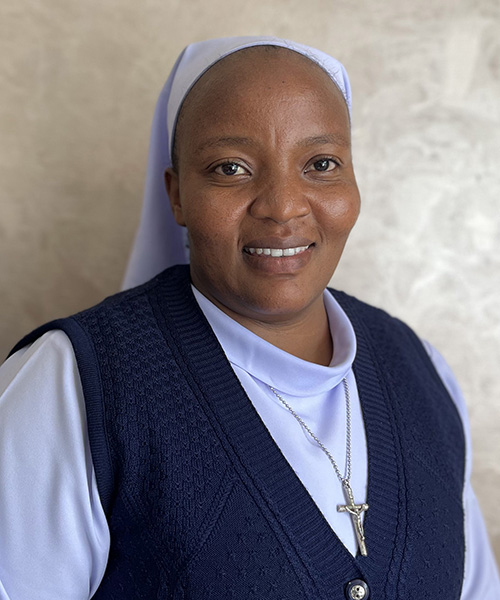
A Conversation with Sister Mary Karanja, A Member of the Servants of the Holy Innocents Sisters
With: Mary Karanja Berkley Center Profile
July 21, 2026
Background: Sister Mary Karanja is a member of the Women Faith Leaders Fellowship 2025-2026 cohort. She belongs to the Servants of the Holy Innocents Sisters, a congregation of Catholic women religious founded in Kenya. Originally from Nakuru County, Kenya, she serves as director of the St. Theresa of the Child Jesus Catechetical Centre in Kahama Diocese, Tanzania. Her ministry as a social worker has taken her across the African continent; she has studied and worked in Côte d’Ivoire, Kenya, and Tanzania, and Togo.
Sr. Karanja spoke with Luisa Banchoff via Zoom on July 21, 2026. During their conversation, she reflected on her upbringing and journey to becoming a Catholic sister, her passion for women and girls’ empowerment, and her work as a social worker and counselor in different settings. She also discussed the complex challenges of challenging entrenched gender norms and caring for those with mental health and substance use issues, which sits at the heart of her congregation’s charism.
Biography: Sister Mary Karanja is a member of the Servants of the Holy Innocents Sisters. A social worker by training, she has worked in hospitals, rehabilitation facilities, fertility clinics, and community centers across Africa. She runs the St. Theresa of the Child Jesus Catechetical Centre in Kahama Diocese, Tanzania, which trains catechists in leadership and pastoral care in rural Catholic communities. She has also worked as a counselor at her congregation’s rehabilitation center for people with mental health and substance use issues and has led numerous seminars on gender-based violence, mental health, addiction, and family life. Sr. Karanja holds a bachelor’s degree in social work and a master’s degree in ethics and governance with a specialization in peacebuilding and conflict management.
Can you begin by introducing yourself and sharing your background?
I am Sister Mary Karanja. I'm from Nakuru County, Kenya. I belong to a congregation known as the Servants of the Holy Innocents. Our charism is healing the wounded in society: men, women, youth, and children. Our congregation’s name reflects our belief that everyone is holy until they lose their innocence due to experiences they go through. We believe that no one should be sent away: no one is an outcast. We are there for people who feel they are on the outside; we take care of them as dignified human beings and let them know that they have rights.
I was born into a big family. We were 10 children, eight girls and two boys. In the culture I come from, when a family has many daughters, people point fingers at the father. They see a man as being weak if he only has daughters. But my dad always appreciated his daughters. We were not rejected because we were women. Today he is a very proud man because his girls make him proud. Even people in the neighborhood admired our family because we collaborated and worked hard.
From early on, I had a love and appreciation for women that was cultivated at home from seeing my elder sisters: how they worked hard and made my parents proud, how they collaborated and worked together as women. Whatever was planted in me those many years ago has grown. I appreciate the fact that I'm a woman.
Can you speak about your journey to becoming a sister?
There was a congregation of Franciscan sisters that had a house in my home parish. I used to appreciate the way they looked and what they did. I saw them as friends of everyone. I am a very social woman, and I like being a friend to everyone, even people whom others find unapproachable. I wished to be with these sisters and know how they felt, what they liked, and how they lived life in general. I admired them and wanted to be one of them, though I did not know many details of their life at that time.
From secondary school onwards, I felt a desire to join the religious life. But at that time, my dad told me I needed to study and equip myself with skills before joining a convent. So I went to college and studied financial management. Then I worked one year as a cashier in a big supermarket in Nairobi. While I was there, I interacted with sisters who belonged to the Servants of the Holy Innocents, and the desire to become a sister came back. After learning about their charism and work, I was very touched, because they deal with mental health as well as women’s and youth empowerment. They also have safe homes for women who are beaten or who become pregnant and are rejected. These women have nothing, but the sisters welcome them. The sisters also feed and interact with street children. They care for people who are at the very bottom of society, people who are considered outcasts. This really touched me. I recognized this was the charism I wanted to embrace.
At the same time, I was studying and learning about women's rights; I realized I wanted to defend these rights. For many years, we have spoken about human rights, but only later have we come to talk of women’s rights. Women’s rights were denied for a long time. As a woman, I wanted to work for women who are denied their rights. I wanted to help these women, encourage them, and give them tools to deal with difficult situations. This really pushed me to join the Servants of the Holy Innocents: they do the same things I love doing in service to humanity. So I went ahead and resigned from my job and joined the religious life.
Could you share some more about the history of the congregation?
Our congregation was founded in 2020 by Sister Veronica Nkirote Rukunga. She belonged to a local congregation in the Catholic Diocese of Meru in Kenya. She was inspired by what was happening in our modern society. There is a certain drug that in Kenya that is called miraa in the local language and “Khat” in English. This drug destroys so many young people, both men and women; it has affected many families. Sr. Veronica saw that there were not many Catholic sisters active in rehabilitation work. You will find many sisters working in schools and in hospitals, but there are not many working in rehabilitation centers. It's a rare and timely apostolate. Through the gift of the Holy Spirit, she was pushed to serve people struggling with mental health problems and substance use issues.
There are even priests who are affected by drugs and alcohol. We welcome them at our rehabilitation center. They are coming not only from Kenya but from surrounding countries such as Uganda and Tanzania. We care for them, because most people who care for other people don’t have someone to care for them. Our charism has helped many people.
Can you share about your educational and career journey?
I did my formation in Tanzania before returning to Kenya. From there, I was sent to Togo, where I was in charge of a spiritual house for people to pray and rest. After that, I was sent to Abidjan, Côte d'Ivoire to study spirituality and social work.
When I finished my studies, I worked in different places. When you are a general social worker like I am, you assist at every level. I was taught to fit into different contexts. I started in West Africa, where I worked at a social center, a place where men and women of every caliber would come to get different types of assistance. Some of them were couples who fought at night. Some were women who came to claim help from the man who abandoned them and their family. I also worked as a social worker in a hospital, in a ward focused on HIV and TB. I loved the experience very much; it opened my eyes and taught me to see life in different ways. I also worked in a laboratory focused on the issue of infertility for couples.
Then I went back to university. I did a master's in ethics and governance with a specialization in peacebuilding and conflict management at the Jesuit University of Abidjan. While I was doing my master’s, whenever there was a discussion of women right’s, I would get animated. People knew that whenever the topic of women came up, Mary would be there. Even my teacher knew it!
When I was choosing the topic for my master’s research, I was thinking about social conflict. Then COVID came, and there were many cases of gender-based violence. So I chose to focus my research on the causes of gender-based violence. Though my master’s was in peacebuilding and conflict management, the research focus did not need to be on conflicts between nations. I saw gender-based violence as a war within the family that forms the basic unit of a society. When I was doing my master's, I was also working with an NGO that focused on women's rights.
I want to do a Ph.D. one day focused on the experiences of women in the church. We see Catholic sisters in white habits, smiling with shining faces, but we don't know what they go through. They are often not able to air their problems or to speak up because people look up to them. These women ask themselves, “What will people say if I talk about my problems?” Maybe one day I will get an opportunity to research this topic, because I have this passion and I would like to pursue it.
It was a very nice experience in West Africa. Studying and working in Francophone countries was not always easy, but I’m grateful because now I can speak and write French as well as English. After almost 10 years, I came back to Kenya and went to our congregation’s rehabilitation center, where I worked as a counselor. I ran different therapy sessions – for families, individuals, and groups – as well as vocational skills training programs for women. We taught them catering, dressmaking, cosmetology, and other such skills.
While I was working there, the bishop of Kahama Diocese in Tanzania requested that someone from my congregation take charge of the St. Theresa of the Child Jesus Catechetical Centre; my superior decided to send me. In rural areas, parishes are served by outstations. The priest cannot go to all the outstations, because our parishes are very big – some have up to 24 outstations – so the catechists assist the priest in these outstations. The bishop wanted catechists to be trained and equipped to handle different situations and problems that people come to them about. I equip the catechists with knowledge about these problems and how best to address them. We teach them about psychology and counselling. Their first calling is to be teachers of faith, but we also teach them to address social problems.
Can you speak more about the challenges facing women and girls in the communities where you’ve worked?
During my master’s research, I noticed many negative things women go through in society. If you trace the origin of many cultural behaviors and traditions, it is selfishness on the part of men. But we've grown accustomed to these things; we think this is the order of the day. People grow up in families being told that certain things are for women and other things are for men. Women themselves often are not aware this is happening. It’s hard to tell them that what they’re going through is not right, that it is a form of mistreatment. They think it’s just their role as a woman, which is not true.
In the village where I am based in Tanzania, women have no rights. When a woman is greeting a man or boy, she has to kneel or to bow. Even an older woman will kneel for a boy, but a young man or boy does not bow or kneel for women. Many men view women as their possessions because they’ve paid bridewealth. This is meant to be sign of appreciation, but they see it as a payment for a woman. They tell their wives they have to cook and clean and do everything. When you tell these men that they have to help their wives at home, they cannot accept it. How do you explain to them that gender roles are socially constructed? They can't understand. This way of seeing things is the same in East Africa and West Africa.
I’ve been working here for one year and a few months. In this time, I formed a group of women who are living in extreme poverty. Their economic power is very limited. Some of them have to ask their husbands for money for food or other necessities. One woman told me that if she goes to her husband to ask for money for food, he will slap her before he gives her 2,000 shillings, which is not even worth one U.S. dollar.
I told these women that we can do something by ourselves. Women are powerful when they join together. When we work together, one day they won’t depend totally on their husbands. So far, I have a group of 45 women. We meet once per month, on every last Saturday. From time to time, I invite women who are knowledgeable to come and give seminars. This is to empower the women, because some of them are not confident. They have been put down to an extent that they cannot even stand up and say their names. We tell them they are important and can do something.
Each woman contributes a small amount so we can start some projects. We plan to start a poultry project, a beekeeping project, and a car wash near the highway. We also have a savings and loaning group among the women. They can take out a loan and pay it back with a small amount of interest that goes towards keeping the group going. We’ve been teaching them financial literacy so that when they get money in their pockets, they know how to manage it. We want to teach them to save money in order to get a loan to do something bigger. I think the project is bearing fruits. The women are very grateful.
In your experience, what strategies work in shaping attitudes and ideas around gender roles?
Changing the minds of people doesn’t need fancy words or big actions. It is about working with what you have, building upon it, and boosting women’s confidence.
When I first came to this village, I found that the women didn’t know their worth. They didn’t think they were important. When our bishop visited for the first time, they didn’t think they would be able to cook for him because they have never cooked for “big” people before. So I brought together a group of local women. I sat them down and told them, “We are going to start with what you know.” I got a coach and together with some sisters, we taught them how to welcome people and talk to them, how to prepare a nice meal and how to present it, how to carry oneself around those “big” people. I bought them very smart caterers’ uniforms with nice aprons and chef’s hats. I told them that the guests will not know that they are women from the local area; they will think that I’ve hired caterers. You only need to be confident, you only need to work hard, you only need to learn, and then you will see that it is not a big deal. You start with what you have, with what you know, and with who you are.
Today we don't need to hire outside caterers. We have many celebrations and ceremonies, and we are very comfortable with these women who have been trained. They’re often asking us about the next events, telling me they are preparing something special.
It’s not easy. You cannot change the mind of people within a day. To work with them is a journey, but slowly but steadily, you get somewhere. I can testify that if you walk the journey together, you will get somewhere.
As a Catholic sister, do you find that you are treated differently than other women?
Tanzania is a very religious milieu. Wherever we are, sisters are very respected. This makes it easier for me to deal with people. If I call someone, they will come. It’s easier for me to give instructions as well. But I don’t take it for granted that I can dominate other people. I try to understand their culture and beliefs and then slowly to venture into their mind. If there is a way of thinking that we want to change, I communicate to them about it. If there is something to encourage, then I do. But generally, people really respect the sisters.
Can you speak more about the issue of mental health and how your congregation is addressing it?
The question of mental health is very complex; nobody want to be associated with it. When you mention it to someone, they think you are saying they’ve gone mad. Sometimes, when you approach someone who is not doing well, that person will tell you they’re not sick because they fear being labelled. Young men especially are having issues with mental health. Life is just messy, and people find themselves in trouble.
How do we handle this issue? We create awareness around it. We run campaigns and seminars on mental health. Last year, we ran a program called the Sober Life Initiative that raised awareness. We told people that if they come across someone with a mental health problem, they shouldn’t point a finger at that person because when you point a finger at someone, you have three fingers pointing back at you. There is no one who can say that there are no problems in their family. It may not be your son who has a problem, but it could be your cousin or some other relative. Your neighbors should also be of concern to you: if they have a problem, you have a problem, because you are living together. So if you see someone going through depression, don't wait until they end up on the roadside.
We go to schools and churches to talk about these issues. We also go to barazas, which are public gatherings that take place in villages. From this awareness-raising, people come to us and tell us about problems their family members are facing. We inform them about our rehabilitation center that they can visit. Sometimes important people come to the center – doctors, teachers, even religious leaders – because of depression or a lot of stress. It is very confidential. We’ve had success stories of people who have come to receive help. They’ve recovered and assisted us in our awareness-raising campaigns.
Finally, can you share a bit about your experience in the Women Faith Leaders Fellowship?
Participating in the fellowship has been a great experience. I’ve enjoyed meeting the other fellows and listening to their stories. The trainings helped us learn how to deal with different challenges, how to be good leaders, how to direct groups of women. We also learned how to deal with burnout and feeling overwhelmed, because sometimes we do a lot. We also learned a lot about networking: you cannot remain on your own, you have to move outwards and create connections. You have to open up in order to be helped. I've gotten the courage and strength to keep moving, because sometimes the work can be discouraging. It is not straightforward every day.
The fellowship invited people who are experienced in the field of women’s rights. They shared a lot of insights that opened our minds. We visited the UN in Geneva and were free to ask questions. It helped us meet people we would not have otherwise met. Sometimes we think that these spaces are for a certain kind of people, but we learned that they belong to us, too.
I have received a lot of knowledge through the fellowship, and I think it has really cultivated a new energy in me that I didn't have before. Now the responsibility is on me to network, to try to help more women, and to reach more lives. I will continue the good work that was begun in me.
Thank you very much, Sister Mary. I've really enjoyed learning your story, and I wish you all the best in your future endeavors.