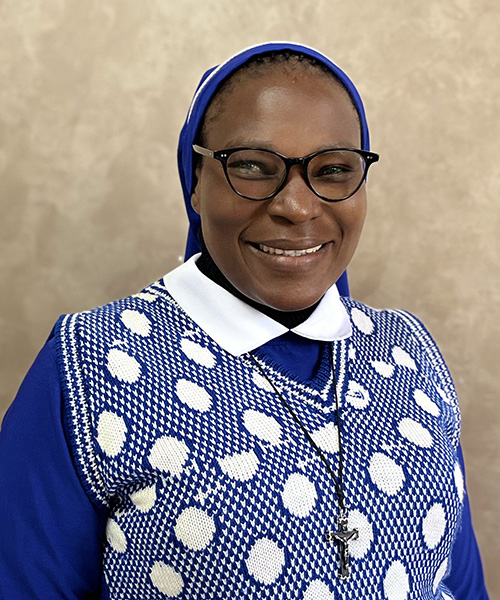
A Conversation with Sister Monica Yahaya, A Member of the Missionary Sisters for the Poorest of the Poor (Anawim Sisters)
With: Monica Yahaya Berkley Center Profile
June 10, 2026
Background: Sister Monica Yahaya is a member of the Women Faith Leaders Fellowship 2025-2026 cohort. Originally from northern Nigeria, she is currently based in Ghana’s Northern Region, where she is the national coordinator of the Missionary Sisters for the Poorest of the Poor. Sr. Yahaya is also the deputy coordinator of Yendi Diocese’s child and vulnerable protection initiative and a member of the Talitha Kum Ghana Network, the Africa Faith and Justice Network, and the Justice, Peace and Integrity of Creation Ghana network. Sr. Yahaya has extensive experience in social work, ministering to abandoned children, the elderly, prisoners, sex workers, and rural communities. She leads efforts to assist and empower elderly women accused of witchcraft in northern Ghana.
Sr. Yahaya spoke with Luisa Banchoff via Zoom on June 10, 2026. During their conversation, she reflected on her childhood in Nigeria, her journey to becoming a sister, her numerous ministries to marginalized and rural populations, and the challenges of undertaking humanitarian work. She also spoke about her experience in the Women Faith Leaders Fellowship and her capstone project providing vocational training skills to women accused of witchcraft.
Biography: Sister Monica Yahaya is a member of the Missionary Sisters for the Poorest of the Poor, popularly known as the Anawim Sisters, a congregation founded in Nigeria to care for the most marginalized and destitute members of society. She has decades of experience in social work, helping and empowering underserved communities. Originally from Nigeria, Sr. Yahaya relocated to northern Ghana in 2014, where she coordinates her congregation’s social outreach work. She holds a bachelor’s degree in basic education and master’s degree in educational administration and management.
Can you start by introducing yourself? Where are you from?
I am Sister Monica Yahaya, a native of Kaduna state in northern Nigeria. I’m from a polygamous family; my father had three wives. I only grew up seeing two of them living together: my mother and one of my stepmothers, as the other stepmother had remarried and later passed on. There were 11 children from my three mothers. My father passed on when I was just a small girl, and my remaining stepmother passed on after twelve years. So I was left with my mother and my siblings. Later, five of my siblings passed on. We are now left with only six, three male and three female.
After my father passed on, my father’s younger sister took me from my village to the city of Kaduna to stay with her. That is where I grew up. I attended Holy Family Catholic Church, Barnawa and attended LEA Primary School and Girls Government Secondary School (junior high) there. I also attended Girls Science School (Senior high) in Kwoi, Kaduna State.
Did you grow up Catholic?
Yes, my father was a strong Catholic. He helped build the Catholic Church in my village. My mother and my aunt who took me in were also Catholic, so I grew up in the Catholic Church. I was a member of many associations and societies in the Church.
What was the religious landscape like were you grew up?
People think of northern Nigeria as being a Muslim area, but there are a lot of different churches. The area where I grew up is both Christian and Muslim, with churches and mosques on almost every corner. Friday prayers and Sunday services are a big part of community life. There are many different Christian denominations, including Catholics, though it is true that in some parts of the northern region there are more Muslims.
How did you decide to become a Catholic sister?
Growing up, during Masses and especially during the bidding prayers at Sunday Mass, the church would always pray for vocations, for their sons and daughters to become priests and religious. Every time I heard that prayer, it sounded in my head. I’d say to myself, something needs to be done. I grew up with my step-siblings and my cousins who were very active in the church. I followed in their footsteps and participated in many church activities. Even as a small girl, I was attending the Legion of Mary and different societies in the church. I was also a lector. That is where my vocation started.
I was in primary school when some sisters visited my parish. I saw the way they looked and what they were doing, and I hoped and prayed that, one day, God would help me be like them. I mentioned it to my aunt, and she was so happy about the whole thing. But she said we should pray over it since I was still too young. She wanted to make sure that I wouldn’t go to the convent only to come back and bring shame to the family. I made some inquiries and learned that you have to have qualifications including mathematics and English. Without those, you might not be admitted. So we prayed that one day I would meet these requirements and be admitted.
When my late elder brother, heard the news, he told me I should go to university. I told him I wanted to go to the convent instead; at the time, my understanding was that you either go into the religious life or higher education. I didn’t know that if you go to university, you can still join the religious life. My brother said he hoped I would not regret it and bring the family shame. I told him that, by God’s grace, I would not.
I attended the “Come and See” event of the Missionary Sisters for the Poorest of the Poor, the congregation I ended up joining. I went to the convent and stayed for two to three months. After that, I was told I would hear back from them. Then, the good news came! I was invited to join. I was so excited. That’s how it all started.
Could you tell me a bit about the background and charism of your congregation?
The Missionary Sisters for the Poorest of the Poor were founded in Nigeria by Mother Onomoresoa Selo-Ojeme. She was a former member of the Sisters of the Sacred Heart. She felt a calling to work for the poorest of the poor but it wasn’t happening in that congregation. She would tell us that sometimes she has to sneak out of her congregation to go feed the poor in the streets! So she decided to leave the Sacred Heart Sisters in and found our congregation in 1995. The congregation is also known as the Anawim Sisters. Anawim is a Hebrew word that means “poorest of the poor.” We are in Nigeria and Ghana for now.
When I joined, I was surprised to see the sisters taking care of abandoned infants thrown away in the streets. If you join the Missionary Sisters for the Poorest of the Poor, you must be ready to work. You have to be the mother for these children. My first experience of this was when somebody came to the convent and said there was an abandoned child. My superior called me and we ran to the scene. We went to the place where the baby was, close to the public toilet. You could see the baby had just been born. My superior handed the baby to me and said, “This is your baby. You will be the mother of this baby.” The first thing I said was, “God, give me the strength and the grace to do this.” We brought the baby to the convent and I took care of the baby. The baby stayed with me in my room, sleeping with me. Everything that mothers go through, we Anawim sisters go through. I accepted the challenge with faith. Today, I sit back and look at this girl with joy: she has gone to university!
We also care for mentally ill people. We take them from the streets and bring them to our home. Some of them have been in the streets for more than 20 years and are in a very bad state. But with love and the right medication, they start to get better. Some of them will remember where they come from, and we locate the address and speak to their family members. We have succeeded in resettling some of them back with their families. But some families reject them because they have been living in the street. When this happens, they come live with us and become part and parcel of our community.
Another ministry is taking care of young women with unplanned pregnancies. When a girl becomes pregnant, sometimes her parents are ashamed and kick her out of the house. We provide accommodation to such girls, bringing them to live with us. We counsel them to have their babies, and after the babies are born, we counsel the girls and work to reconcile them with their parents and reintegrate them into society.
We also work with commercial sex workers. We visit them, sit with them, counsel them. We let them know they can find other work. Some of them are being trafficked from different countries, especially from Nigeria to Ghana. Traffickers bring them from Nigeria with the promise of finding a better job as a hairdresser or something like that. The women come illegally and are forced into prostitution to pay back the money the traffickers spent on trafficking them. They cannot leave because they don’t have documents or money. Some of them are lucky because we are able to rescue them. My community rescued three commercial sex workers last year. We didn’t have the money to send them back to Nigeria, but we are looking for funds to transport them to the city, where a partner organization such as the Talitha Kum Ghana Network will send them back home.
To learn more about the work of the Anawim Sisters, click here.
Could you speak about your experience in social work?
Social work can be heavy, beautiful, and exhausting work all at once. As a social worker, I have many people looking up to me for help. I have worked in many communities belonging to my congregation, including almost all the communities in Nigeria. I did social work, taking care of the less privileged. Wherever we work, we do so in hand-in-hand with the Ministry of Health and Social Welfare. When somebody comes for help, we first report to the police and to the ministry so that they are aware of us and what we are doing. Sometimes we may open the gate to the convent and see an infant lying outside, and we don’t know who brought the baby. The first thing we have to do is report it, because tomorrow someone might come back and want to make a case against us.
In 2012, our congregation was invited to participate in an evangelization project in the UK. My superior sent me and another sister. We went to the UK for a one-year mission in parishes and Catholic primary schools, teaching about Christ and bringing people to the faith.
When I came back, I was sent to Ghana for another mission. I have been in Ghana for 12 years now. Where we are in Ghana, the hardship is greater than in other regions. We don’t have the same financial support as in Nigeria, so we do fewer apostolates. We work with alleged witches and commercial sex workers and we run a village ministry, hospital ministry, and prison ministry. I am the coordinator for Ghana. We are 10 sisters, and we have three communities in the Diocese of Yendi.
Can you speak more about the situation of alleged witches in northern Ghana and the work your congregation does on this issue?
The issue of alleged witchcraft centers around vulnerable women in northern Ghana. This issue is a matter of culture and tradition. Someone might have a nightmare and accuse a woman of being a witch, saying that they saw her chasing them in a dream. Or perhaps in a polygamous family with two or three wives, one wife is doing well and another is not. Jealousy comes between them, and they start to accuse one another. Another cause of accusation can be a poor harvest, land dispute, of when someone falls ill or has an accident. People may point a finger at someone and accuse them of being the cause of their problems. Those who are accused are typically older women, widows, and those without strong family protection; many of them are very poor. Accusations can lead to ostracism, seizure of property, beatings, and even killing. According to tradition, the accused person has to be chased from the village. Their family members do not have a say; they cannot do anything. Previously, when such an accusation had been made, the accused would often run away themselves out of fear. But nowadays, the villagers send the accused person to “witch camps” outside of the village.
These camps are segregated communities for people, mostly women, who have been banished from their home villages. In the Diocese of Yendi, where I am based, we have five “witch camps.” In some of the camps, there are 100 women accused of being witches. Some have fewer women, around 50 or 80. There is also a camp with both men and women. Sometimes there are up to 700 people there. Housing, education, healthcare, and access to food and water are very inadequate in these camps.
We go to the camps three times a week. On Sunday, the women come to the town, and we have fellowship together and also a service for them. We teach them catechism. Some of them have become Catholics; they were traditionalists or Muslims before.
Most of the accused are old women. They have no strength. When they arrive at the camp, there is a chief who determines if they are a witch or not. The chief performs some rituals. If the result is that you are not a witch, you might be allowed to go back to your village. But if you are found to be “guilty,” you have to remain in the camp. There is nothing to eat for them there, and their family members are poor. To earn a living, some of them go to the market square, sweep the ground, and collect the little food that has fallen down to take home, wash, and eat.
When we started working with these women in the camp in 2012, the villagers would be amazed and say, “Do the sisters know these people are witches?” The stigma was very high. But we go there to mingle with them, to dance and sing with them, to put a smile on their faces, and to teach them the word of God. We started enlightening the villagers, telling them that these people are not harmful and that some of them have been wrongly accused. Now, bit by bit, the villagers have started associating with them.
In the northern region, there is a scarcity of water. Everybody’s suffering from a lack of water. But one of the camps has a borehole. And some of the villagers come to the camp to fetch water. They have understood that these women are not harmful. Some of the farmers will employ the stronger women to help out on their farms. They will give them a bit of food or money. So the stigma has been somewhat reduced.
We wish to do something to help the women in the witch camps, but we don’t have anything to give them. Our prayer is that they should learn something that will keep sustaining them, will help them in their day-to-day. When they arrive in the camp, some of them are weak. Their children or grandchildren follow them to their camp to take care of them. They have no school, no education. It is our dream that people of goodwill will come together to help them go to school.
You mentioned a ministry to prisoners as well. What does that look like?
A ministry to prisoners meets people where they are: inside the prison walls and then on the outside when they come home. It works best when it combines spiritual care with practical support because people in prison need both hope and help. We visit the prisoners in Yendi every Sunday. We have Sunday service with them, reading the Bible and sharing the word of God. We encourage them, counsel them, and also sing and dance with them. We do the same thing in visiting hospitals and villages. We go to the rural areas. It’s not easy, but you have to reach to the farthest areas.
Sound like you’re on the move a lot!
Yes, we’re always on the move. We walk and ride bicycles to reach remote places. We use our bicycles and our legs, and now we also use motorbikes to go around to the villages. Even when we have a car, it is sometimes more economical to use a bicycle or motorbike.
What are some of the challenges you face in your work?
There are many challenges. They usually show up in three areas: the people we serve, the systems we work in, and care for ourselves as sisters.
Firstly, the people and communities I serve come face many challenges. Their situations are very complex: there can be issues of poverty, mental illness, and family conflict all overlapping in a given situation. Building trust with people also takes time; some people don’t want help, or they are afraid to receive help because they have been let down before.
Secondly, the systems we work in have very limited resources. There are often so many cases brought to our attention, but not enough funding to meet all the needs. We love to do the work, but the capital is not there. Sometimes you want to go to the villages, but you don’t even have 20 cedis [$1.80] to buy fuel for the motorcycle. That becomes a challenge. In one of our communities in Ghana, there are children staying with us who come from poor families or the families of alleged witches. We started a school for them. But you cannot have a school without paying the teachers. We also have long waitlists for housing, healthcare, legal aid, so I end up being the bearer of bad news much of the time. Bureaucracy also entails tons of paperwork and slow processing times. Sometimes I spend more time on documenting things than helping people. Working with schools, hospitals, police, and NGOs has its challenges as well, as there is a lot to navigate to secure basic support for a person.
Finally, there are personal and professional challenges. The mental and emotional load of the work can be very heavy. Hearing about abuse, poverty, and loss on a daily basis takes a toll on us. It can be hard not to take the things I hear home with me, and sometimes my friends and family don’t understand why I’m so affected. We care so much, and empathy is an important tool. However, if I don’t take time to refill my energy, I become numb and exhausted, and then I won’t be able to remain present and empathetic to others. We want to help everyone, but we cannot fix everything, so sometimes we have to set boundaries.
People depend on us. Goodwill alone is not enough. But we rely on divine providence. We derive our strength from God, and God has been faithful. His grace is always sufficient. Sometimes you feel that there is no way forward, but then God opens up a way where there was no way. We give ourselves to our humanitarian work: with the little we have, we help. We are struggling, but what can we do? We’ll give our own selves to make others happy. Even if we don’t have anything material to give the people we serve, we go there and put a smile on their faces.
How has your experience been in the Women Faith Leaders Fellowship?
The fellowship is superb. I thank God for the opportunity to let me be part of this. I used to say to myself, “Look at how God has lifted me, a poor Anawim Sister, and put me here.” And then I remember that when you are doing God’s work, He will take care of you. It’s been a very great experience for me. I can count many good things I’ve learned through the program about leadership, confidence, and courage.
I pray that the fellowship will continue going and that others like me will benefit from it. Because of this experience now there is greater hope among us and the people we help. I have been built up by the experience, and I can confidently tell you that I am better than I was before. I will use my newfound knowledge very well.
Could you tell me about your capstone project for the fellowship?
The proposal for my capstone project is focused on boosting the livelihoods of alleged witches. I am trying to teach them skills to help reduce their economic hardship and enable them to start their own businesses. I’m planning to train them in making bar soap and liquid soap. If they learn these skills, they can sell the soap and use the money for themselves and their children.
When I came back from the WFLF gathering in Geneva, I considered changing my capstone project to focus on advocacy on addressing domestic servitude and early marriage. I am part of Talitha Kum here in Ghana, and we focus on these issues. I thought of looking at the roots of these problems by consulting opinion leaders, chiefs, and others. But I decided I would not have enough time and resources, so I chose to stay with the project focused on livelihoods.
I want to say a big thank you to the fellowship for this opportunity. It has been an eye-opener and has helped me in all aspects of my life. It’s been a great opportunity, and I’m so excited and appreciative. I’m full of joy.
I would like to end with a short prayer from Mother Onomoresoa Selo-Ojeme, foundress of the Missionary Sisters for the Poorest of the Poor:
Let Me Give
I do not know how long I will live,
But while I live, Lord,
Let me give some comfort
To someone in need
By my smile, a nod, deed, or kind word.
Let me do whatever I can
To ease things for my neighbor.
I want nothing but to do my part,
To lift a tired or weary heart,
To change people’s frowns
To smiles again.
Then I will not have lived in vain
And I will not care how long I will live…
If only I can give and give and give.
Thank you very much for sharing your story, Sister Monica. I wish you and your congregation in your future endeavors.