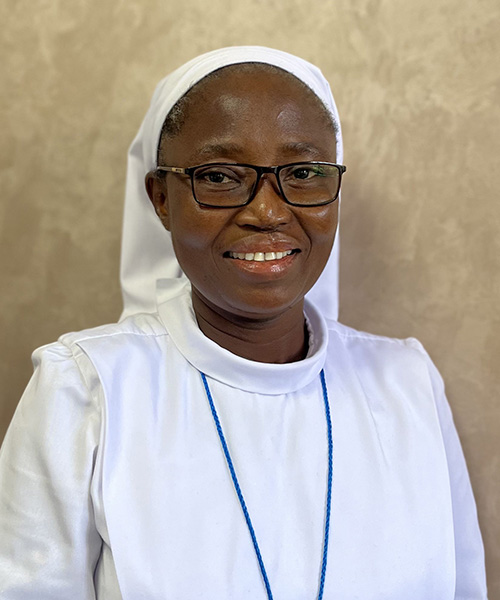
Background: Sister Stephany Ayomah is a member of Georgetown University’s Women Faith Leaders Fellowship 2025-2026 cohort. A member of the Sisters of Mary Immaculate in Ghana, she serves as the accountant of St. Joseph Clinic and Maternity Home in Chamba, Northern Region. Sr. Ayomah holds numerous leadership roles within her congregation and Catholic dioceses. She has partnered with the Conrad N. Hilton Foundation and Catholic Relief Services in projects focused on women’s empowerment and early child development in rural communities.
Sister Ayomah spoke with Luisa Banchoff via Zoom on June 18, 2026. In their conversation, she shared about her Catholic upbringing, her journey to becoming a sister, and her passion for rural development projects. She also discussed her capstone project, which supports and empowers teenage mothers in northern Ghana, reflecting upon the importance of sustainability in projects supporting rural communities.
Biography: Sister Stephany Ayomah is a member of the Sisters of Mary Immaculate in Ghana. She has an extensive background in accounting and rural development. Before her current role as accountant of St. Joseph Clinic and Maternity Home in Chamba, she worked as the bursar of the Dicosese of Wa and a hospital accountant. She serves on the finance council and development committee of the Diocese of Yendi and is the district superior of her congregation for the Tamale and Yendi dioceses. Sr. Ayomah earned a bachelor’s in accounting from the University of Cape Coast and a master’s in NGO Management and Rural Development from the University for Development Studies in Tamale.
To begin, can you tell me about where you’re from?
I’m from Ghana, from Busa District in the Upper East Region. I am the last born of my parents. I grew up in a Catholic family. My village parish is close to 100 years old now. My father was one of the first students at a school run by the Missionaries of Africa (White Fathers). He was baptized at the age of 11 or 12. At that time, if you made it to Standard 6 or 7 [US grades 6 and 7], the White Fathers sent you to their high school, and from there they sent you to seminary to become a priest. My father went to seminary, but he only studied there for two years because, as the firstborn son, he wanted to have a family. He got married to my mother and started teaching Latin at the seminary.
I grew up in a nuclear family, which was uncommon in our area; because my father became a teacher very early on, the school administrators built a cottage for him as the head teacher of the school. When other teachers joined the staff, he moved into his own house and gave the cottage to teachers who were posted from other parts of the village.
Can you speak about your journey to becoming a sister?
Because of my father’s background as a teacher, he translated the Bible from English into the local language. There was a congregation of missionary sisters living in a convent nearby, and every Saturday, the sisters would come to our house for our father to teach them the local language. Anytime they came, they would ask me and my cousins if we wanted to join their congregation. We didn’t like those questions, so anytime we saw their blue habits from afar, we’d run away.
When I went to junior secondary school, there was a sister who was a teacher and assistant chaplain for the chapter of Young Catholic Students. She got me interested in becoming a sister. I then studied secretarial and management studies in senior high school. When I got back to the village, there was a sister from the congregation I eventually joined. The sister needed somebody to type documents on a typewriter for her when she attended meetings. She would bring the typewriter to our house, and I would type for her. After a while, I told her she could leave the typewriter at the convent and I would come there to type. At one point, she told me that the congregation was hosting a “Come and See” event for aspirants in the Upper West Region and asked me to accompany her. I attended and I realized that I wanted to join the congregation. I attended a second “Come and See” event, and the sisters asked if I was ready to start formation.
At that point, my mother had died and my elder sister had come to stay with me and my father, who was over 80 years old. I told my father that the sisters would give me a job in the diocese, so if I go to the convent and don’t come back, it would be because I had gotten the job. My father said, “Okay, we hope to hear from you.” So I went, and that was it. I started formation. When my father heard from the sisters that I had started formation, he said he was happy because he had wanted to be a priest. I never had any resistance from my family about becoming a sister.
Can you tell me some more about your congregation, the Sisters of Mary Immaculate? What is your history, and what do you focus on in your ministry?
The Sisters of Mary Immaculate is a congregation of diocesan right. We were founded by a French-Canadian bishop called Oscar Morin. He belonged to the White Fathers. He was the first priest to come to the northern part of Ghana as a Catholic missionary; he came via Ouagadougou to Navrongo. Back then, there was no formal education, no health system, and no Christianity in the area. He began with home visitations, talking to local people about Christianity. Later he brought two religious brothers and priests from his congregation to join him. He realized that he would also need sisters for this work, so he invited some Missionary Sisters of Our Lady of Africa (White Sisters). At that time, there were many barriers because the sisters didn’t understand the local language and tradition.
When he became the Bishop of the Vicariate of Navrongo, Morin asked the sisters if it would be possible to start a congregation of local women who could teach and catechize local women and children. He founded the congregation of the Sisters of Mary Immaculate in Navrongo in the late 1920s and asked the White Sisters to be responsible for the formation of the new congregation. The first six girls who began formation all left. This continued until 1932: the girls would come for formation, but they would go away during the process. So Bishop Morin turned to the bishop of Ouagadougou, who also belonged to the White Fathers. He negotiated with him to bring some girls from Ghana to Ouagadougou so that they could be trained there and then be sent back to Ghana. The aspirants would go from Ghana to Ouagadougou, where they were trained by White Sisters and Missionary Sisters of the Immaculate Conception. The first group of girls went in the late 1930s.
By 1943, the number of sisters was growing. The bishop of Ouagadougou told Bishop Morin that accommodation and feeding were becoming a problem and asked that the sisters be brought back to Ghana. Bishop Morin agreed and brought the first group of sisters to Ghana in 1939/1940. Two settled in what is now the Upper West Region, and two of them came to Navrongo in the Upper East Region and opened a convent there. More girls started joining from communities in these regions. More girls were coming from the Upper West Region, so Bishop Morin agreed to move the formation house to there.
In 1946, we become a congregation of diocesan right. Our generalate was established in the Upper West Region. Back then, the White Sisters were still journeying with us. Our first superior general was a White Sister who was more or less a member of our congregation. The first indigenous sister became superior general in 1956, when the White Sisters withdrew and we took up the administration and formation for the congregation. By then, Bishop Morin had gone back to Canada because of ill health. The first bishop of the Diocese of Wa took up the mantle and supported the congregation as our sisters went into nursing, teaching, and pastoral work.
That brings me to the charism of our congregation. Bishop Morin initially founded us to help with catechism, formal and informal education, home visitation, health, and social work. In our constitution, we have a clause that states that we can start any other apostolate that is in line with our constitution. We later branched into hospitality. We currently run a guest house in Accra and hostels in Kumasi and Sunyani.
Can you speak some more about your educational background in accounting?
I studied business in secondary school. After my O-Levels, I went to the convent for my formation. Before joining the convent, my major academic interest had been in journalism. When I became a sister, my superior said the congregation would like me to study accounting. Initially, I didn’t want to. I consulted a cousin of mine who was a priest and is now a bishop, and he told me to go with an open mind. When I went to the Kumasi Polytechnic to do a higher diploma in accounting, I was surprised with my results. I developed an interest in working as an accountant. Up until now, I still find joy in doing that.
After receiving my higher diploma, I worked as the diocesan bursar of Wa Diocese for eight years. From there, I joined a newly founded community in Tamale to start a polyclinic for the Archdiocese of Tamale. I was the accountant for the clinic for four years. While I was there, I did my bachelor’s degree in accounting at the University of Cape Coast.
How did you become involved in rural development?
After four years at the polyclinic in the Archdiocese of Tamale, I was transferred to St. Joseph's Clinic in Chamba, Yendi Diocese, to work as an accountant. It was a new environment altogether because I hadn’t worked in a rural community before. People see things differently compared to communities where I had been.
While I was working in the clinic, a church-run secondary school nearby asked me to teach there temporarily while they looked for a female teacher, so I taught part-time for a year while also working at the clinic. As part of the school’s pastoral work, we began working with the women in the community. I realized that the women lacked knowledge in many things. Their main source of livelihood is farming, but they don't know the difference between commercial farming and farming for household consumption. They end up selling what they’ve harvested, and then they don't know how to earn a living once the farming season is over.
From this experience, I developed a project called the Odome Rural Women’s Empowerment Project. I started the project in 2014 I received a grant from the Conrad N. Hilton Foundation in 2016 to continue. We taught over 100 rural women in liquid soap production, which they can do in the farming off-season so that they don’t just sit at home. They make the soap and sell it for a profit. We also provided seed money for the women to buy Shea nuts. We put them in groups of three and, when the season came, each group would buy Shea nuts, store them, and sell them to companies. They earned a small profit on it, and that money is kept in the savings groups in case a member needs to borrow it.
When COVID came, it really affected the women. COVID meant we could not produce or buy anything. The lockdown lasted for almost a year, during which the market was very affected; people who used to order our products were not ordering anymore. It’s picking up again, but it's still not as it was before.
While I was doing this project, I realized there was a need to learn more about rural development, so I sought permission from my superiors to pursue a master’s degree, which they granted. I pursued a master’s in NGO Management and Rural Development at the University for Development Studies in Tamale. The course had a lot of components. For instance, project development: developing project ideas and working with rural women. It really opened my eyes and gave me a lot of motivation and creativity to develop projects.
How did the insights you gained in your master’s program shape your approach to rural development?
I advise men and women farmers alike to keep some of their produce for consumption. Even if someone has 100 acres, they should not sell everything. Rural women sell all their produce and use the money to buy household items. I tell them that they have enough: they are not running a hotel or guest house. They may buy a motorbike whether they need it or not. A short while later, they have no money to buy food. So I tell them not to sell all their produce immediately but rather store it until the prices go up. And when they do sell, they should not spend the money buying things. First they should ensure that their children have health insurance, that their house is repaired, that they have a mattress to sleep on, and that their children’s school fees are paid. In these communities, you have one man with three or four wives, and most of them don't take care of the children's education. I tell the women that if they are able to support a child to go to school, the child will take care of them in the future. I encourage them to pay their child’s school fees even if their husband is not paying.
I also encourage the women to join the local savings community group so that they can save a bit and borrow money. We organize these savings groups in such a way that we do the share-out of profits when the farming season is setting in so that they can access capital and get a tractor to plow their land. I'm happy that these groups are yielding results.
You are also involved in early child development interventions. Can you speak about that?
In 2022, CRS started a project on early childhood development and rural women with the conference of major superiors in Ghana, and our district was selected to participate. The project is called Strengthening the Capacity of Women Religious in Early Childhood Development (SCORE-ECD). The main focus of the project is to improve maternal and child health in the rural community and to build the skills of sisters regarding early childhood development.
The participating sisters worked as master trainers. We were asked to identify volunteers in the community to work alongside us in community sensitization and engagement. We trained them to become “lead mothers.” The lead mothers handled groups at the community level. From there, we formed groups of women who were either pregnant or had a child under two years old. We developed flipcharts that featured drawings related to different issues, including challenges with breastfeeding issues, pregnancy complications, and antenatal care. The flipcharts are designed so even women who are not able to read can understand. We also covered topics such as malaria prevention, WASH, and cleaning the environment. We ran cooking demonstrations so women can learn to produce nutritious meals for young children. We also trained the women in making toys for children using local materials. This improves the cognitive development of the child. The project also established savings and lending communities for rural women to borrow money among themselves without the need for collateral securities.
Through the project, I was able to build an early childhood development center in Chamba. It is the first of its kind in the area. CRS had encouraged the creation of such centers at health facilities for children. But in the clinic where I work, there was limited space: we didn’t even have space in the clinic for reproductive and child care. So I talked to my congregation and the parish and did some advocacy in the community, educating them to understand the importance of and early childhood development center and seeing how they could support us. The community told me that they didn’t have money, but if I sourced cement, community members would mold blocks, clear space, and dig. If I got masons, they would help them to build the center. The parish gave us a small piece of land in front of our convent for the center. The community helped in clearing the site and we built a shed. CRS visited and said it was very good for an early childhood development center. Unfortunately, a very serious storm brought the whole thing down soon after. We made a proposal to CRS and they supported us in building a bigger center. It can now contain over 60 children.
We also have German partners who have been supporting the Catholic private school and our clinic. They visited to see our projects and saw the center. They saw we were using mats for the children that we spread on the floor for them to sit, play, and learn. The German partners told us they would speak to early childhood development centers in Germany to collect furniture and play materials for us. They sent us a container with materials and furniture, not only for the center but for the school and the clinic. Now the children are able to sit at a table for learning. They also have puzzles, play blocks, toy cars, and bicycles donated from Germany.
Could you share a bit about your capstone project for the Women Faith Leaders Fellowship?
My capstone project is focused on empowering teenage mothers. I have worked with women in the Odome Rural Women Empowerment Project and SCORE-ECD project, but they were not necessarily teenagers: some were married, some were widows, some were young women.
What motivated me to take only teenage mothers for my capstone projects was a program we ran with midwives at the clinic. We realized most pregnant women would come for antenatal services at a late stage of pregnancy. We were doing research to understand the cause of this problem. I would help the midwives by taking the register, so I saw the age of the women who came in. I discovered a lot of them were between 16 and 19; one woman was only 14 years old. When the women were leaving the clinic, I would speak to them, asking if they were in school or had dropped out, if they were married, and if they lived with their husband or their parents. Most of them were living with their parents. Some of them didn't even know who the father of the child was.
I told the midwife in charge that the number of teenage mothers was above the target number for the district. I engaged opinion leaders on the issue as well; they said that the issue was beyond them. I said we can do something: we may not succeed, but something must be done. I spoke to the local assemblymen about the situation, letting them know that the teenage pregnancy rates are above average. We talked about it. They also raised their concerns.
This issue was in my mind when thinking about the capstone project. Once the project was approved, I began by engaging parents. I told them I wanted to train their daughters in skills such as in sewing, weaving, and hairdressing; provide mentoring; and host talks on reproductive health. I also plan to have cooking demonstrations, because from what I've learned from the CRS project, some young women cannot meet the health needs of the children after they’ve given birth. They feel that you must have plenty of money before you can eat good food, which shouldn't be the case.
I did a screening of potential participants in January. Over 60 teenage mothers came; some were pregnant still, some had given birth. We cannot accommodate so many people, so I chose to focus on teenage mothers with children between 0 and 5 years old, which reduced the number to 31 participants. I also will need to acquire supplies: a loom for weaving, sewing machines for sewing. It would be too costly to get teachers to teach all these skills, so my strategy was to contact professional seamstresses, tailors, hairdressers, and weavers. I’ve asked if I could bring five girls to each of them for training. They agreed, but on the condition that the girls bring their own equipment. Another challenge is that the capstone project is just for one year. But for somebody to be trained and be well-equipped to do work that can generate money, they need training for three years to receive a national certificate.
When I did the budget, it was far above the amount we receive from WFLF. So I spoke to the Bishop of Yendi and the development coordinator for the diocese. They had funded a project in 2025 that they were planning to run it again in that community. I asked them if it was possible to change the community, as I had done a feasibility study and already had participants selected. I submitted a proposal and they agreed to partner with me. They said they would provide some looms and sewing machines to support my capstone project.
In rural communities, when people hear that a sister is doing an intervention, everybody wants to be a part of it, but the resources are limited. Some of the interventions need to go beyond one year. If not, you won't achieve your goal and objectives. If the teenage mothers were to graduate from training after one year, they will not have learned much. It’s possible that some projects can last for just one year, depending on what the person is doing. But if there is room to support a project for more years, it would be good for consideration to be given to that.
It would also be good to be connected with donors we can submit proposals to in the future in order to ensure continuity and opportunities for expansion. For the capstone project, we are given mentors, and I'm happy my mentor is somebody who is also in development. She has told me so many things that I didn’t add to my capstone project initially, and through review and meetings, I've been able to rework on it and see things differently now. If I were to resubmit it for more funding in the future, it's possible that I will expand it beyond what I have submitted for now. It would be great to be connected with donors through the WFLF, to speak with them so they can see what we are doing and possibly support our project.
Thank you, Sister Stephany, for your feedback and for sharing your extensive experience in women’s empowerment and rural development. All the best in your capstone project and beyond.