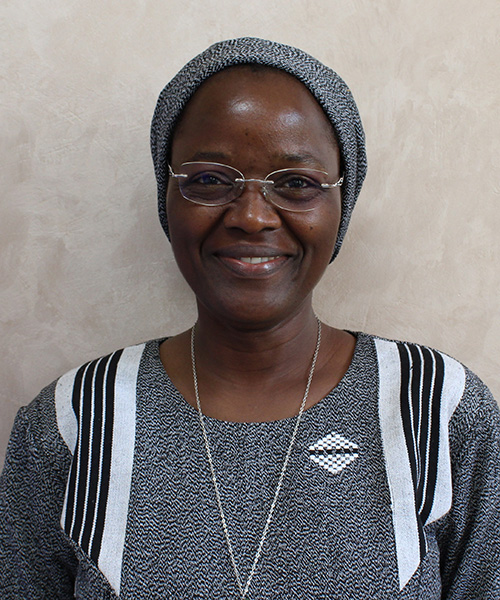
A Conversation with Sr. Blanche Dala, A Sister of the Missionary Workers of the Immaculate
With: Natoane Blanche Dala Berkley Center Profile
July 9, 2026
Background: Sister Natoane Blanche Dala is a member of the Women Faith Leaders Fellowship 2025-2026 cohort. She belongs to the Missionary Workers of the Immaculate and is based in Bobo-Dioulasso, Burkina Faso. Sr. Dala has extensive experience as a social worker, serving poor and Indigenous communities across five continents in her three decades as a Catholic sister. She currently runs the Domaine Saint-Joseph, a vocational training center in Bobo-Dioulasso that equips young women with skills to acquire economic independence and regain a sense of agency for themselves.
Sr. Dala spoke with Luisa Banchoff via Zoom on July 9, 2026. In their conversation, she spoke about her early sense of calling to serve others, the insights she has gained in her decades of work as a missionary, and the joys and challenges of running the Domaine Saint-Joseph in Bobo-Dioulasso. Sr. Blanche also reflected on the challenges facing displaced people in Burkina Faso, the importance of interreligious relationship-building, and her sense of a shared foundation of spirituality that unites people across cultural and religious lines.
Biography: Sister Natoane Blanche Dala is a member of the Missionary Workers of the Immaculate, affiliated with the Society of Donum Dei. Sr. Dala’s social work ministry has taken her to such places as New Caledonia, Peru, Morocco, and India, and the UK. She is currently based in her native Burkina Faso, where she runs the Domaine Saint-Joseph vocational training center for young women in Bobo-Dioulasso. She previously worked for the Apostolic Nunciature in Morocco, where she underwent training in intercultural leadership management. She studied in France, Italy, and the UK and holds degrees in theology and religious studies.
Thanks so much for speaking with me, Sister Blanche. Can you begin by sharing about yourself?
My name is Sister Blanche. I belong to a congregation called the Missionary Workers of the Immaculate. I have been a part of my congregation for 32 years now, and my mission has taken me all over the world. I got my degrees in France and Rome and then went to study and work in the UK, where I stayed for almost five years. After that, I went to New Caledonia, in the South Pacific; I worked with Indigenous women in the city of Nouméa. Then I went to Wallis and Futuna, also in the South Pacific. Next, I went to work as a secretary at the Apostolic Nunciature in Morocco for three years. After that, I went to Pondicherry in India, where my congregation works with disabled people and very poor families. We accompany them and work with local partners, including the Order of Malta.
About two years ago, I returned to Burkina Faso. In Bobo-Dioulasso, my congregation runs a training center called Domaine Saint-Joseph. We have 25 girls whom we train in vocational skills such as sewing, cooking, and farming. My focus at the moment is looking after these girls. Right now, there are displaced people fleeing other parts of the country due to terrorism. A lot of girls enter our center because they have no choice: they have to leave home and start over again. Sewing and cooking provide opportunities for them to get decent jobs.
Can you share about your family background? Did you grow up in a Catholic household?
I grew up in a Catholic family. My mom and dad are Catholics and so are all my brothers and sisters. One of my sisters is married to a Muslim man, but there is no problem related to religion in the family.
In Burkina Faso, we have three main religions: traditional believers, Muslims, and Christians. Among Christians, there are Catholics and Protestants. Often in the same family you find these three religions being practiced by different people. The relationships between the religions have been historically tolerant and peaceful, and we’re working to keep it that way. We are living through times in which people might accuse Muslims or Catholics for causing problems. But we can’t just blame religion for our problems, because even within families we can still have problems. I don’t see our problems as being caused by religion.
At our training center, we don’t only take Catholic girls. We train anyone who comes. We're open to giving opportunity to everyone because no one must be left behind. If you can't sew, we encourage you to try something else. We try to find something for any girl who comes to the center.
Can you share about your journey to becoming a sister? How did you decide to pursue this vocation?
My vocation came to me very young. When I first chose to become a sister, my parents thought that I wasn’t mature enough. They sent me to a boarding school run by nuns to see if this was really what I wanted to do. I have an aunt who is a sister; she used to come to our home and take me to visit the other sisters. The call of God came to me through my aunt, and joining a congregation became my answer to God’s call. I also had an uncle who was a priest and he accompanied my desire. He really wanted me to find my answer to the love of God. He helped me to choose to answer this call personally.
I entered the congregation very young, when I was 16 to 17. Since then, I have expressed my answer to God’s love through every person I can bring to that love in different ways. As long as God gives me the joy and the power to be able to do it, I want to do it, especially by helping girls and women.
Can you share about the history and charism of your congregation, the Missionary Workers of the Immaculate?
The Missionary Workers of the Immaculate were founded in France in 1950 by a priest. The first sisters who came to Burkina Faso in 1962 served as nurses and teachers. We take care of women and vulnerable children.
The sisters of the congregation do not wear a habit, which was the first thing I noticed about them. We dress like laypeople because our charism is to carry the love of God wherever we go. Our founder wanted us to be among the people and to bring the good news to them. It reminds me of the philosophy of Charles de Foucauld, the French monk who lived in Morocco and Algeria. He said he didn’t work as a missionary in order to give a speech to change the minds of people. Instead, he wanted people to notice the way he lived and say to themselves, “If this man is so good, I want to know his God.” It’s through our way of life – what we do, what we say, how we live – that we attract people. Sometimes we bring the good news without opening our mouths. We bring the good news through the way we approach people, respecting them, caring for them, encouraging them. It’s true that we need to do catechism and provide theological training, but it’s also true that our life has to be a testimony of the good news and the love of God. God has given me the grace to travel all over the world and meet amazing people in Pondicherry, Morocco, New Caledonia, Vanuatu, and many other places. Sometimes you don't need to say much: it’s your presence that says something about your God
You mentioned studying in France and Italy. Can you speak more about your educational formation?
Before taking vows, I studied in Rome at my congregation’s college. I studied theology and religious studies. The college has moved to France, but it used to be in Rome. While studying, we also put our studies into practice as missionaries by helping out in local parishes by caring for children, teaching catechism, and preparing children and youth for their first communion and confirmation. I did the same while I was in Lourdes, France and in Lima, Peru, where I was on a mission for two and a half years. In the UK, I worked with prisoners in Maidstone, in the south of England. We would listen and to them and accompany their families. All the missionary work relates to the formation training we received. When I was in the South Pacific, in New Caledonia and Wallace and Futuna, I was also teaching catechism and training adults.
Can you speak more about your training in intercultural leadership management?
I received training in intercultural and interreligious leadership management when I was in Morocco between 2019 to 2021, working at the Apostolic Nunciature. As part of it, we would meet women and girls in rural areas once a month. We would share our experience with them in order to foster tolerance and live together as Catholics and Muslims. We would essentially do social work with these women, who are facing a lot of difficulties. We accompanied them. We also worked with immigrants as well as local people. There is no division between Catholic and Muslim; rather, we are all human, all brothers and sisters. The calls of peace of both Jesus and Muhammad came together in our hearts.
Islam is a beautiful religion. A cardinal used to say that while we Christians are sleeping, the Muslims are already awake. You can listen to the Muslim call to prayer. There is a foundation of prayer to the Moroccan culture, and this creates openings for encounters with other religions.
Do you see similarities in the different countries and communities where you’ve served? What insights have you gained from working in so many different contexts?
Across the many places where I’ve lived and worked, there is a foundation of prayer to life. In Pondicherry, you find big trees wrapped with cloth as a sign of respect for nature. In Morocco, people wake early in the morning to pray. In Vanuatu, there are traditional religious practices. I like to say that humanity is full of gods. Some call it God, some call it Jesus, some call it Muhammad, some call it Buddha. We are all full of something beyond the physical. We are full of the desire to connect with the spiritual strength and power within us and connect to it within other people. We are united with one another despite differences in religion. I find that the whole world is so beautiful, for we are all one family.
Can you speak some more about your work in Burkina Faso?
I came back to Burkina Faso two years ago. I am based in Bobo-Dioulasso, the second city. The Domaine Saint-Joseph is a center for technical training. We have three people who are qualified to lead the training for the girls. Some of these girls are young mothers. They attend the center from Monday to Friday. The training is in sewing, cooking, and gardening. Those who are trained in cooking learn to cook traditional as well as international dishes. Two sisters provide training, and two extra people come twice a week to give specific training. The sewing training involves three years’ training. At the end of those three years, the girls must be able to start their own business so that they can live decently. The gardening training is for two years. Two men come and give lessons in gardening; we have a big garden and a small farm.
This is how the center works. But we don’t have all the equipment required. Not everyone has a sewing machine. Sometimes we have to wait for one student to finish in order for another one to start. If every student had a machine, it would be easier.
Education is the most beautiful thing you can give to someone, more than money or anything else. This is why we're trying to train girls here in Burkina Faso.
You mentioned the challenge of displaced people in Burkina Faso because of terrorism. Can you speak a bit more about that challenge?
Displaced people who come to our area are supported by families who welcome them. There are also some temporarily shelters that have been arranged for them by the government, where they can stay until the situation quiets down. It’s not easy for the displaced people because they are forced to leave everything they have behind. If you have a farm, you can’t travel with all your animals. You can only pick up what you are able and run for your life. Some of them have already returned home, but not all of them.
We have some displaced girls who stay with us, but we don’t have space for a lot. Some of them are staying with relatives nearby. It’s a fragile situation for girls to stay with people they don’t know; they are very much exposed. We really want them to be safe. Often, these girls surprise us with their cooking and sewing skills. They create, they innovate. They have skills that need to be developed to give them a chance for a better life.
How has your experience been in the Women Faith Leaders Fellowship? What are some of the insights you’ve gained through the fellowship so far?
When the Women Faith Leaders Fellowship gave me this opportunity, I experienced it as a blessing. It’s a blessing to be trained, to have one’s eyes opened to possibilities and opportunities. I am also grateful to my congregation, because through them I have been able to participate in this fellowship.
I’ve loved learning about networking. I like creating new contacts, talking to new people, and learning new things. At the beginning, I was shy; I didn’t want ask anyone for anything. But I learned that I need to speak on behalf of people. I’m not only speaking for myself. A lot of people are waiting for help that can come through me. That thought gives me strength. So I'm trying to build a network and gain the strength and courage to go forward. I thank God for the opportunity.
Can you tell me about your capstone project for the fellowship?
My capstone project is based on work I am already doing. It’s to further develop our center, the Domaine Saint-Joseph, to provide more opportunities for girls and women so that no one is left behind. I want anyone to be able to come to the center so that they can have an opportunity to develop skills through vocational training in order to make a living.
Is there anything you'd like to add?
Thank you very much for the opportunity to share my story. It’s been a privilege for me to speak about our center and to thank God for what he's doing through our work. I’m also grateful to the fellowship for the opportunities it’s given me to listen to the stories of the other sisters. They speak to my missionary heart. Through their stories, I have learned that you should never give up, because if God gives you inspiration, He will also give you the strength to carry on to the end.
Thank you, Sister Blanche. I wish you all the best with your capstone project and beyond!