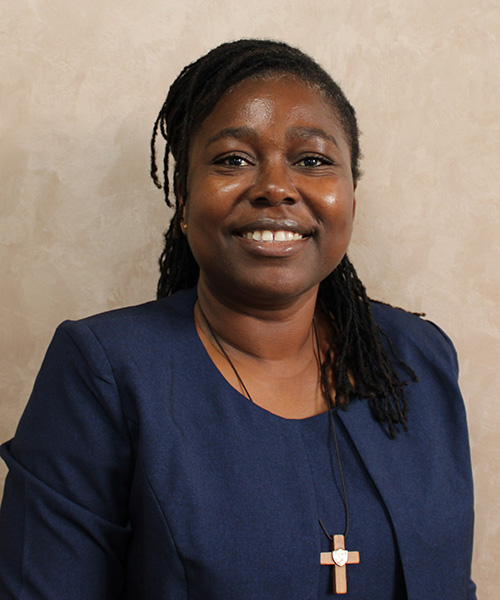
A Conversation with Sr. Callista Tetteh, A Sister of the Holy Cross
With: Callista Tetteh Berkley Center Profile
June 12, 2026
Background: Sister Callista Tetteh is a member of the Women Faith Leaders Fellowship 2025-2026 cohort. A Sister of the Holy Cross based in Ghana, she is a lawyer with decades of experience providing legal assistance to marginalized Ghanaians. Sister Tetteh is passionate about advocating for and raising awareness of human rights, including women’s rights, labor rights, and the right to a clean environment.
Sr. Tetteh spoke with Luisa Banchoff via Zoom on June 12, 2026. During the conversation, she spoke about early encounters with Catholic religious life, her decision to become a sister, and her extensive experience as a lawyer. She highlighted the importance of educating Ghanaians about their legal rights and providing legal assistance to the most marginalized. She further reflected upon how the Women Faith Leaders Fellowship has shaped her understanding of collaboration and mentorship and expanded her impact, including through her capstone project focused on girls’ empowerment.
Biography: Sister Callista Tetteh is a member of the Sisters of the Holy Cross, a congregation with roots in France and headquartered in the U.S. She holds bachelor’s degrees in political studies and law and is a member of the Ghana Bar Association. She is currently pursuing an LL.M. in human rights law and practice, with a focus on the intersection of environmental change and the protection of vulnerable populations. In addition, Sr. Tetteh serves as Area Treasurer for the Sisters of the Holy Cross in Africa and has a radio program focused on the intersection of faith and social justice.
To begin, can you tell me about your background? Where are you from?
My name is Sister Callista Tetteh. I’m the fourth of six children; I have one brother and four sisters. All of my siblings are or were married and have kids now. I was born in 1986, so this is my 40th year. I grew up in Cape Coast, in the central region, and went to school there.
I joined the Sisters of the Holy Cross’s initial formation program in 2010. I had my formation partly in the U.S. and partly in Ghana; my two-year novitiate was in the U.S. and my post-novitiate was in Ghana. I went to law school in Ghana and was called to the Ghana Bar Association in 2021.
Were you raised Catholic, or did you become a Catholic later in life?
My dad is Catholic. He actually attended seminary for a while. My mom is a Methodist. Most of my siblings are Catholics, but some are Protestants. Where I come from, it’s common to have mixed faith marriages, where one person is Catholic and the other belongs to another church. Families where both parents are Catholics are also common. I was baptized Catholic when I was 11 years old. My dad practiced the Catholic faith, but I wouldn’t say I came from the church-going type of home.
In the course of my childhood, I lived with my uncle in Cape Coast. He lived near a Catholic high school where a cousin of his was a Catholic priest. That was when I started becoming more active in the church. They had this group of kids who used to sing with the students. Anytime the students went on break, the staff and their children and those who lived nearby came together to form a church choir. We participated in church in that way. The Holy Cross brothers lived on the campus of the high school, where they worked as teachers and administrators. They used to have programs for kids during Christmas and Easter period. I got to know them, and that was where I really built my Catholic faith.
Tell me about your journey to becoming a Catholic sister.
The Brothers of the Holy Cross lived on the school campus close to where I grew up. That was my first introduction to any religious community. As I became older, I visited them from time to time and made friends with some of them.
When I went to college, I was close to one of the brothers. On one of my visits to their community, he told me that one of Holy Cross Sisters was going to visit the community on the day that I was there. I knew about the existence of sisters because there was a diocesan congregation, the Society of the Infant Jesus, near where I lived. . They were founded by the first indigenous Ghanaian archbishop. They wear the religious habit. Most of my knowledge of sisters came from them. But I didn’t know the Congregation of the Holy Cross also had women religious. When the sister visited, I was introduced to her. She was called Sister Esther. She was dressed normally, like any other woman. I asked more about it, and she explained to me that not all congregations of women religious wear the habit.
While I was at university, a brother of the Holy Cross became a mentor to me. Anytime I had questions related to faith or any other issue, I would call and ask him about it. Around 2006, the brother told me that he would be traveling. At the time, mobile phones were not very common, so it wouldn’t be easy to reach him. He told me that I should contact Sister Esther anytime I had questions. I got in contact with Sister Esther and asked her about religious life in general. I was around 21 or 22 years old. It was a time when I was searching and asking questions about life, what I wanted to do after school, and all that. I also had some plans of my own; I wanted to finish my first degree and possibly study law after working for some time.
As I was having conversations with Sister Esther, she invited me to visit her community. I visited them and got to know another sister who lived there. That was when my interest was piqued, particularly about their congregation. I liked their way of life. They would get up early, go to pray, and then each of them went to do their work. Then they would come back, pray together, share a meal and go to sleep. It felt very peaceful to me. You were not competing with anybody, you just did what you had to do,
I stayed with them for one week and then went back to school with that thought in my mind. That’s what community life is all about. It felt that simple to me at the time. When I graduated from school, I stayed in touch with Sister Esther for a while. She’d never asked me whether I was interested in joining and at the time, I didn’t have the courage to tell her that I’d developed some interest. It was later on that we talked about my interest.
In Ghana, after you complete college, you need to do a year of national service. Sister Esther asked me that I should go and do the year of national service and think about my interest. If, after completing national service, I still felt like this is what God was calling me to, then she would initiate the formation process. She also encouraged me to explore other congregations, because there are so many congregations in the Catholic Church that do different things. Their passions may be different, but it’s the same commitment they all make. I had searched and visited other congregations. But by that time, my mind was already made up to join the Holy Cross Sisters. When I completed my national service, I began formation. The rest is history.
Can you share the history and charism of your congregation, the Sisters of the Holy Cross?
The Sisters of the Holy Cross were founded in France by Blessed Basil Anthony Mary Moreau. He came from a small town in France called Le Mans, where he was a diocesan priest, during the aftermath of the French Revolution. At that time, faith was very diminished. In the education system, you couldn’t talk about God and people had to hide to preach the gospel.
In his quest to spread the gospel, Father Moreau brought together some of his priest friends. They started meeting and teaching in the surrounding villages. There were a group of lay religious men that had been formed by an older priest called Fr. Dujarie. He was weak, so he asked Father Moreau to be the leader of this group of brothers. Father Moreau combined the brothers and the priests and they became one congregation. The name Holy Cross came from the neighborhood where they lived in Le Mans, which was called Sainte-Croix. When the congregation took roots, they found spirituality in the name, as a symbol of a life anchored in the cross of Christ.
Father Moreau had this interest in the Holy Family. He saw them as a model in whatever he did. As the Holy Family was made up of Jesus, Joseph, and Mary, he felt the need to have women religious to complete the family. So he invited a group of four young women from his locality and began teaching them. Eventually, they came together as a congregation. At that time, and even now, the Church leadership in Rome did not approve of women and men belonging to the same congregation with the same leadership. They approved the men as Holy Cross brothers and priests. For the women, it took some time.
Father Moreau sent out sisters, brothers, and priests to the U.S. upon the invitation of the local bishops. The sisters went to Indiana while some stayed behind in France. Some sisters were also sent to Canada. While they were still waiting for official recognition, the women became three groups of women with separate leadership. The sisters who went to Indiana became the Sisters of the Holy Cross (Notre Dame, Indiana), the ones who went to Canada became the Sisters of Holy Cross (Montreal, Canada), and those that remained in France became the Marianites of the Holy Cross. My congregation is the one that went to Indiana. Though we all have one foundation, we are three separate congregations of women religious.
The Sisters of the Holy Cross from Indiana started out as educators. When they came to Indiana, there were some Native American girls the bishop wanted them to educate. There was also an orphanage that the bishop asked the sisters to help manage. That became the main apostolate of the sisters. But as the congregation grew, other needs emerged. During the civil war in the United States, some of the sisters went to serve as nurses and tend the wounds of the soldiers and civilians who were injured. That led to the creation of our health care apostolate. It became a big part of who we are. As the congregation grew, we had a health care system which has now been merged with others in the U.S. Later on, we created an apostolate around justice-related issues, such as the environment and women’s empowerment. Those kinds of issues also became part of our apostolate.
Our charism is to read the signs of the times and respond to the needs that emerge around us. That is how we develop our ministries and our apostolates. Our core values are prayer, community, and compassion. Whatever we do is informed by these core values.
How did your congregation arrive in Ghana?
The Sisters of the Holy Cross came to Ghana in 1983 upon the invitation of the Bishop of Sekondi-Takoradi. Before then, the priests brothers of the congregation were already in Ghana. The brothers came to Ghana first, in 1957. The first community of the Sisters of the Holy Cross in Ghana was built by students attending the technical skill training school run by the brothers. We’ve been in Ghana for 43 years. At present, we are 18 Ghanaian sisters.
You’re a lawyer by profession. What made you choose to pursue law?
I’ve always had an interest in law because I like to speak for people who don’t have a voice. I would say I’m a natural advocate. I like speaking up for somebody who is being treated unfairly. Growing up, I always had the desire to become a lawyer someday.
When I applied to college, it was for a bachelor’s in law. When I got my admission letter, I had been assigned a different major, a combination of English and political studies. I wasn’t happy about it, but I think God knew what He was doing at the time, because if I had studied law from my first degree, my path may have been different and I may not have become a sister. There’s something about the nature of studying law that, if you are not grounded, you’ll be more interested in making money than serving others.
I ended up majoring in political studies. Some of the courses I took were in law, such as constitutional law, so I knew a little bit about what law was all about. When I started developing interest in religious life, I thought that phase of my life was over. I didn’t believe I could be a sister and a lawyer at the same time. But when I went to the U.S. for my novitiate, I met some Holy Cross sisters there who were immigration lawyers. I was intrigued that somebody was a sister and a lawyer at the same time.
After I professed my first vows, I came back to Ghana. In my congregation, after professing first vows, you prepare a five-year plan toward making your perpetual profession. If all goes well, five years after your first vows, you make perpetual vows. The five-year plan includes ministry preparation, which includes further education, as well as formation preparation, where you learn deeply about your vows and prepare to make perpetual vows. I said that I wanted to go to school within the five years, but I didn’t specify law. I was open to whatever the needs of the congregation might be.
For the first two years after my profession of vows, I taught in a school in Ghana. I was becoming interested in teaching, but I still had an interest in law.
After the two years, I talked with the leadership of my congregation about education. They asked me what I wanted to study. Since I had met some Holy Cross sisters who were lawyers, I thought I’d bring my desire up and see if I’d get approval. My congregational leader in Africa said that the congregation actually needed someone with knowledge in law. They were growing and had property, and because civil issues could surface, having someone with a legal background could be of help.
I started by doing a post-first degree LL.B. for three years. After that, I had to go to the Ghana School of Law for professional training, which I did for two years. In 2021, I was called to the Ghana bar. I’m also currently pursuing a master’s degree in human rights law and practice.
Tell me about your interest and work related to human rights.
My main goal for studying law was to be able to help people, especially those without access to help. When I finished law school, I looked for avenues to do so. In Ghana, you have to do a pupilage year after law school; you work under a senior lawyer before you get your practicing license. I did my pupilage at the Legal Aid Commission, which provides legal assistance to the needy and vulnerable. When I worked there, I met a lot of people who were very vulnerable in a lot of ways. Sometimes somebody would come to the office with a lot of pain in their eyes. I could see that they were confused, and when they told me their story, I realized the answer to their problem was something very small. Listening to their stories, I realized many of these people had no knowledge of their basic rights. They didn’t even know they had rights. Many had been subjected to domestic abuse and violence. There were also property issues; a poor person would buy a plot of land, and then it would be taken away without any recourse. I heard these stories and realized I had taken a lot of things for granted. I thought that people actually knew there are legal remedies to these issues. That heightened my interest in human rights.
I’ve also worked on my congregation’s justice committee. One of the areas we focus on is environmental justice, advocating for integral ecology. When I was on the justice committee, we visited a place called Prestea. It is a gold mining town. We were researching the impact of the gold mines, especially the illegal mines, on the lives of the people. A lot of people are affected negatively by illegal gold mining operations, but they don’t even know they have a right to safe water and a safe environment. I found that there were connections among all these things, and that there are a lot of organizations working in this area. Sometimes these organizations look for someone on the ground with knowledge. With my background, it would be easier to work with some of these organizations and advocate for the right to safe water, a clean environment, and land. I thought that specializing in human rights could help me work in this area. That also shaped my interest in human rights law. I want to do more advocacy, work with organizations for systemic change, and maybe influence legislation. Having a background in human rights advocacy helps to work in these areas.
You mentioned how many people don’t know their rights. Do you do awareness raising work?
I was doing a radio program called Faith in Action. It was a weekly radio show I created with some of my sisters. The idea behind Faith in Action was to bring forward some of the issues I’ve mentioned, such as environmental justice and issues of social concern. I combine the legal and faith aspects of these issues. In Ghana, most people are religious: Christians, Muslims, and people who believe in traditional religion. So I decided to appeal to people’s good conscience by informing them about the issues and their religious obligations to address them. We shared with listeners that exercising faith is not just about praying and going to church, it is being concerned about what happens around us.
The radio program also educated people about their rights. I put the topics together and invited some of my colleagues who practice law to speak about the issue and tell listeners what their rights are. If listeners had questions, they would ask. That was one way we brought rights issues to the public. We ran the program for about six months. Right now, the program is on hold because we are restructuring it.
I sometimes do awareness raising at the parish level, especially when there is a program to speak about a particular issue of concern. I have worked with some widows’ groups. I also participated in a marriage class organized for young people who are preparing to get married. Some of them don’t know the legal implications of marriage. So I tell them about their legal rights as spouses. I love the opportunity to share what I know with people. It’s fulfilling for me.
You recently attended a human rights seminar at Harvard University. Can you tell me more about that experience?
The Harvard program is part of my human rights master’s program at the University of Ghana. It includes an international experience where students attend a seminar at either Harvard or Columbia. The clinic that organized the seminar at Harvard Law has been working with human rights organizations to bring some of the issues to the forefront. They’ve written briefs for cases brought before the U.S. Supreme Court.
The seminar focused on business and human rights. It was about addressing human rights abuses in corporations and the supply chain. We looked at how corporations have a responsibility to respect human rights and address human rights abuses in their supply chains. For example, companies do all they can to avoid liability, without caring about whether someone working on a cocoa farm is a victim of child labor or trafficking. Some of the stories we heard were horrible. The fact that the corporations involved were able to avoid the liability because of certain clauses in their contracts was horrible.
Getting to know about some of those issues was a real eye-opener for me. Particularly with environmental issues. Mining conglomerates don’t care about how their mining operations are affecting local people. I will have to write a research paper on human rights as part of the class. I’m thinking of researching rights violations that are taking place in mining areas and whether or not mining companies are taking responsibility.
How has your experience been in the Women Faith Leaders Fellowship?
The fellowship has really been helpful in expanding my horizon when it comes to working with others. It has given me the understanding that humanitarian work is not done in silos. You have to work together. And the more you let people see and understand what you’re doing, the more they are able to collaborate with you so that you can expand assistance to as many people as possible. There are a lot of organizations that are working at the highest levels, and they rely on people who are working on the ground to understand and appreciate the challenges and humanitarian needs that exist. This is an opportunity for me, because every time I wake up, I meet with someone who needs direct help. Others need to hear about those encounters, because there are people who want to do good work in the world but not all of them can meet the woman who has just been beaten or the girl who doesn’t have an idea of what her world could be. I feel like I have that opportunity to do that.
The fellowship also enabled me to learn from the other sisters about the work they do and the people they encounter each day. We have similar stories to share, and the people we encountered in Geneva are willing to help if they hear our stories. It’s all about sharing stories and understanding how the world works.
When we learned about working in the development world and collaborating with donors, it felt foreign to me and a bit overwhelming at first. I felt I could just be a lawyer, representing people and doing little things here and there to make an impact. It was an eye-opening experience for me and I learned that collaboration really helps to make a bigger impact.
I also learned about navigating the politics of the development world. It’s likely that when you’re working with development agencies and organizations, you will encounter challenges. Our work is not that simple; we have to be able to be open to others and let them in and work collaboratively with them. I’m a sister but also an expert. I really never looked at my ministry in that light. I just thought that we encounter people and find ways of helping. For me, it’s still about doing God’s work, but there is something different about having the expertise, not just in the area of law but in connected area, which I didn’t have before.
Tell me more about your capstone project for the WFLF? What do you hope to achieve with it?
My project is called “Voices of Dignity.” It’s an empowerment, mentorship, and rights education program for girls. The idea is to bring girls together and pair them up with women mentors. We will select 30 girls within the Sekondi-Takoradi area, with a focus on girls from vulnerable homes, and pair them up with mentors. The mentors I’m identifying are both religious sisters and non-sisters. Some of them are my colleagues in the legal practice.
I’ve always believed in mentorship. The Women Faith Leaders Fellowship really confirmed this for me. The fellowship’s focus on girls made me realize that girls need mentorship; they need to see themselves in someone. Role models are very essential. I have encountered girls whose ambition is so small; their world is very limited in terms of their aspirations because they haven’t really been around people who can inspire them. During the application process for the Women Faith Leaders Fellowship, most of the questions were about women’s and girls’ empowerment. And mentorship is part of empowerment. I wanted to teach teenage girls about their rights and help them to aspire to do a lot of things beyond just getting married.
I decided to build my capstone project around mentorship. I met a certain girl at a parish in Takoradi, a city in the Western region. The girl I talked with was in high school, around 16 years old. I asked her what she wanted to do with her life. The first thing she told me was to find a rich man to marry me. I was shocked. I said, “That’s all you want to do, have many children?” I thought it was kind of sad. Marriage is good and raising a family is good, but I don’t think that’s the only thing girls should aspire to. But that is still the mindset: you get told that if you are not married, you have not achieved much. You would think nowadays things would be different, but they’re not. Teenage years are a very critical time for girls. They need to be surrounded by people who have aimed beyond just getting married and raising kids, people who have made a difference around them. And when you put girls together, they will have conversations that go beyond just talking about boys and marriage.
The project will guide the girls to expand their horizon, looking beyond their immediate surroundings. The project will also include a four-day camp where we will have leadership training and sessions focused on empowerment, rights, education, and reproductive health. The girls will also have the opportunity to form groups and do creative work like painting and spoken word poetry. The idea is for them to have fun while learning at the same time. Afterwards, we will follow up with them.
When I presented the idea at the WFLF meeting in Geneva, somebody suggested I develop a toolkit to share with the girls at their camp. We will check in with them to see what progress they are making in order to measure the impact of the mentorship program on the girls. Hopefully we can replicate the project in the years ahead.
Would you like to add anything?
The Women Faith Leaders Fellowship is one of a kind. It’s been an opportunity to help us navigate the world around us. As sisters, we are no longer living in our convent walls. We work in the world, and the issues we learned about during the fellowship are real issues that we engage each day. It was a privilege to be a part of this year’s cohort. I hope that whatever I have learned will be beneficial to me and the people I encounter every day.
Thank you, Sr. Callista. I wish you success in implementing your capstone project and continuing to build partnerships to expand the impact of your important work.