Background: In his address to the first assembly of the International Association of Jesuit Universities (IAJU) in Bilbao, Spain, in 2018, Father Superior Arturo Sosa, S.J., emphasized the importance of “education for world citizenship.” Since 2022, the IAJU Global Citizenship Curriculum Project and the IAJU Global Citizenship Fellows Program have brought together thousands of students from the international network of Jesuit institutions to engage in dialogue and develop leadership skills as global citizens.
Project Manager Jane Fitzpatrick, who supports the IAJU global citizenship programs, connected with members of the Global Citizenship Alumni Ambassadors program during the fall 2026 semester to talk about their experiences with the programs and what it means to be global citizens as students at Jesuit universities across the world.
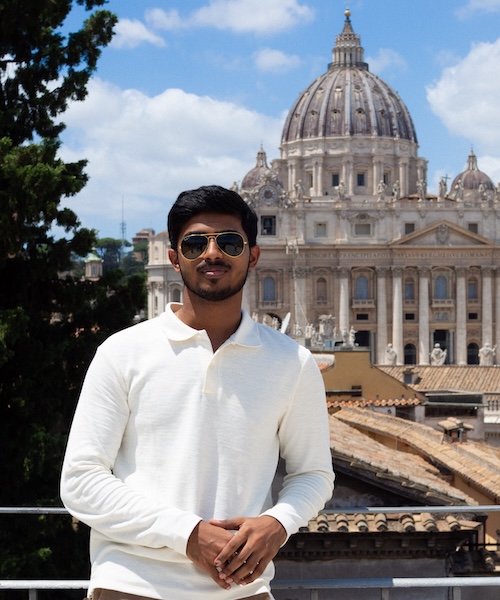
Biography: Timothy Ajay is a postgraduate student in international relations at Loyola College, Chennai in Tamil Nadu, India. He is a member of the IAJU Global Citizenship Fellows Program 2025-2026 cohort, and he serves as an alumni ambassador for the IAJU Global Citizenship Curriculum Project for fall 2026.
Please share a little about yourself: Where are you from? Where do you go to school, and what are you studying?
Hi, I’m Timothy Ajay from Tamil Nadu, India. I am currently doing my master’s in international relations at Loyola College, Chennai. Interestingly, the decision of pursuing international relations was heavily influenced by my participation in the fellows program, where I experienced how human agency matters a lot, and the significant role that dialogue has in diplomacy, especially in a precarious international system.
What was the name of the class you took that incorporated the global citizenship modules last year? Who was your professor, and how did the global citizenship curriculum support your coursework?
The class that incorporated the global citizenship modules was called Global Citizenship - Sociological Perspectives. The course was handled by Professor Theboral P., assistant professor in the Department of Sociology at Loyola College, Chennai.
Doing my undergraduate in history, I always felt my major was a bit monotonous. Studying political history and how it shaped modern society was crucial, but very dreary, nevertheless. But as I started this course, it unlocked the lens of how just as the world is intricately connected, it is alienated just as much. Studying not only the anthropocentric view of the world, but also how the environment matters, along with the condition of the contemporary societies, not only helped my deliberations, but also how I viewed my major.
What was it like participating in a Global Student Dialogue for that class? What did you take away from that experience?
It was a very new experience at the start because it was my first time interacting in a diverse setup such as the Global Student Dialogue… I was in the group with both people from my locality, my country, and participants from other countries, as well, making it a diverse discourse. One conversation which made a huge impact on my understanding of social issues was with a participant from Colombia who explained how there's social discrimination in the context of class and the way it impacts how the cities are structured. This was very interesting because even though India and Colombia are very far away, the social issues manifest themselves very similarly, with the Indian society having a caste system (classification of social hierarchy based on birth). I am a firm believer of the existence of multiple realities within a single locality, and the conversations with my compatriots along with the other participants helped me gain insight on the various social issues that are prevalent in their realities.
The Global Student Dialogue was very crucial in my early understanding of the role of dialogue in shaping one’s worldview because the need for context is essential in understanding and caring for someone or something, especially on a global scale. These contexts are only gained through these important conversations which educate, inspire, and empower, all while fostering empathy.
How have the global citizenship programs impacted your understanding of Jesuit values or the Jesuit network?
Jesuits and education are collocational, just like the famous combination of “salt and pepper.” Having been part of the Jesuit formation throughout my collegiate education, the curriculum project, as well as the fellows program were amazing opportunities, not just to deepen my understanding of the values that shaped me, but to also experience how it is being lived out in many aspects. Education and service are two cornerstones of the Jesuit mission, and having learned so much about the values and its applications, it was such a remarkable experience to see the amount of work that goes on at the Jesuit Curia [during the fellows program], especially having had key conversations which included topics such as higher education, the challenges and prospects of its evolution, the transition to new developments, hearing different lived experiences from students across the network and how it has enabled––as well as impacted––their progress was truly profound.
While this gave me a lot of insight, the experience at Centro Astalli (Jesuit Refugee Service) [during the fellows program] was something completely different. Experiencing something that translates from theory to practice is always enriching, just as how Centro Astalli embodies and institutionalizes the values of cura personalis and cares for and helps the refugees, especially with the unique conditions each situation presents. Having heard all of this, it was truly inspiring how being part of the same Jesuit network, I was able to experience the inspiring work that is conducted and how it fosters the hope to make the world a better place, despite the various limitations and difficulties it upholds, the same hope which the cohort learned how to foster, making this program truly holistic.
What role do the Jesuit values play in your life as a global citizen?
As a global citizen, I emphasize the importance of love, which is the base of all Jesuit values. This love helps propagate values such as Ad majorem Dei gloriam, magis, and cura personalis to be lived in each of our lives. Requiring context is important to gain familiarity, but familiarity is nothing without empathy. Empathy is enabled only through love.
Ad majorem Dei gloriam is a value very close to my heart, where I see service, especially as a global citizen, as doing things for the greater glory of God and through his providence. Similarly, magis is not just “more,” but doing more with what we have at hand, which is truly what being a global citizen is all about. Cura personalis––“care for the whole person”––helps my journey as a global citizen, especially during the fellows program where I experienced what the actual “care” was. These Jesuit values helped me understand that being a global citizen is not just about learning about the conditions of others but embodying the spirit of “men and women for others.”
Why did you decide to stay connected to the global citizenship programs by becoming an alumni ambassador?
Quite frankly, I wanted to stay connected with the project because I thought the fellows program was just the beginning. Just as how it taught me the importance of dialogue and how to implement it effectively, I wanted to continue being part of such enabling experiences and discourses, not only to impart my understanding, but to further enrich and deepen it. To be able to have access to platforms such as the Global Student Dialogue as well as the other programs, is, indeed, such a privilege. It helps us to constantly maintain the attitude of a global citizen, to also understand critically how each issue affects the world, and to foster the hope and empathy which serves as tools to make a positive impact.
Based on your experience in the programs, how would you now define global citizenship?
For me, global citizenship is not just being boundless and transcendent, but to make the conscious choice to listen, discourse, and to have the humility and readiness to serve, even when the world is filled with difficulties, all with a hope and courage to be present and work for a better tomorrow.
Do you have any advice or a message for students across the Jesuit university network interested in global citizenship?
One important message I would like to share is to "cherish the process" because it is not everyday that you get to take part in a process such as the curriculum project, which teaches the in-depth nuances of contemporary issues, and the tools to approach it, as well as the lens to understand it. Global citizenship is a process just like the curriculum project, which is constant and evolving. So, as you take part in the process and learn what global citizenship is, adopt a mindset of not only looking for solutions, but to ask the right questions, which is only possible through listening, and that is the ultimate tool a global citizen requires.
Thank you, Timothy!
I am very grateful to be able to continue my participation in the program, and sincere thanks to International Association of Jesuit Universities, Georgetown University, Loyola College Chennai, Berkley Center for Religion, Peace and World Affairs, and to the organizing team, Dr. Thomas Banchoff, Mr. Nick Scrimenti, Ms. Jane Fitzpatrick, and Rev. Dr. Julio Giulietti for their constant support and guidance. Looking forward to continuing assisting the team in building more global citizens!