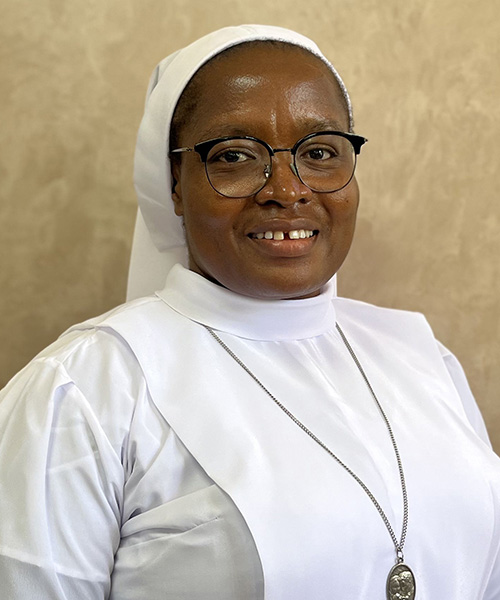
An Interview with Sister Philomena Wrehdi Jappah, A Sister of the Holy Family in Liberia
With: Philomena Wrehdi Jappah Berkley Center Profile
July 10, 2026
Background: Sister Philomena Wrehdi Jappah is a member of the Women Faith Leaders Fellowship 2025-2026 cohort and a Sister of the Holy Family in Liberia. Sr. Jappah has two decades of experience in the education sector, working as a teacher, school principal, and regional and national administrator. She currently serves as the Education Secretary of the Diocese of Cape Palmas, as well as the Coordinator of the National Catholic Education Secretariat. Her work focuses on strengthening the nation’s Catholic schools, with a focus on improving teacher training, promoting student-centered learning, and liaising with the Liberian government.
Sr. Jappah spoke with Luisa Banchoff via Zoom on July 10, 2026. In their conversation, she reflected on her early sense of calling to the religious life, her extensive experience as an educator and school administrator, and the challenges facing the education sector in Liberia today. She also shared her experience in the Women Faith Leaders Fellowship and plans for her capstone project, which will focus on improving the livelihoods of rural women farmers.
Biography: Sister Philomena Wrehdi Jappah is a member of the Sisters of the Holy Family, an indigenous congregation of women religious in Liberia. Sr. Jappah has served as Education Secretary for the Diocese of Cape Palmas since 2011, overseeing the diocese’s 15 Catholic schools. In 2025, she was appointed coordinator of the National Catholic Education Secretariat, which coordinates Catholic education across Liberia’s three dioceses. Sr. Jappah holds a bachelor’s degree in secondary education and a master’s degree in education and administration. She has also received training in pedagogy, school management, finance, and child protection.
Can you begin by sharing a bit about your early life?
My name is Sister Philomena Wrehdi Jappah. Wrehdi is my native name. I was born here in Liberia, in a city called Pleebo, but I grew up in a place called Grand Cess because my parents had to relocate for work. I’m the sixth of nine children. We grew up in Grand Cess as one big family: we shared meals together, we played together, we sang together, we prayed together.
Both my parents were educators and made sure we had the basic necessities and education. My mother was a kindergarten teacher; she would teach us at home before we officially entered formal school. My dad was also a teacher. He had a master’s degree in education. He worked in schools and universities as a lecturer. He also worked for the government; he was initially the district education officer and then became the county education officer for his home county.
I grew up a Catholic. My mother became a Catholic by marriage; she was an Episcopalian before she met my dad. From the onset, my upbringing was with a Catholic orientation. Our mother made sure we took part in church activities, joined choirs, and read in the church as lectors. Most of our social activities were based around the church. Our mother would always make sure we started our day with prayers. My upbringing has played a great role in who I am now.
I'm currently based in Maryland County, southeastern Liberia. Maryland County is the seat of the Diocese of Cape Palmas, which consists of Maryland, Grand Kru, Grand Gedeh, River Gee, and Sinoe Counties.
What is the religious landscape like in Liberia?
The county where I grew up is one of those places where the first Catholic missionaries settled when they came to Liberia. It is still predominantly Catholic, although there are other religions as well. A lot of Catholic priests and religious in Liberia today come from that part of the country. There were also missionaries’ religious priest and sisters whose lives were very inspiring. One way or another, they motivated me to become a sister because I admired their way of life of sacrifice and service.
Tell me more about your vocation. How did you decide you wanted to become a Catholic sister?
I was as young as nine years old when I first told my parents I wanted to become a religious. At the time, they thought I was too young, and I would probably change my mind as I grew up. But I didn't, and here I am today!
I attended a Catholic school run by the Precious Blood Sisters, who were missionaries from the U.S. Several sisters taught at my school, and after school they would run extracurricular activities such as crocheting and sewing for us young children. I had the opportunity to interact with them a lot, and I’m still in touch with one of them, Sister Zita, who is currently in Germany. I saw them, and I admired their way of life. From time to time, I’d ask them questions about being a religious. I told myself that if these people could leave the comfort of their homes, families, and country and come to Liberia to work with and for us, I could do the same.
Initially, I didn't know about differences in congregations, but I eventually learned that the Bishop Emeritus of Cape Palmas – the diocese where I grew up and am currently based – had started a congregation. It’s the only Indigenous congregation in Liberia. I was a teenager in high school when I found out about the congregation. I would visit the sisters in the convent, spend some time with them, and afterwards go home. I spoke to the bishop and told him I wanted to become a nun. He advised me to apply but told me that formation typically starts when you are out of high school.
My high school education was interrupted by the civil crisis. We fled to Nigeria for several years. I was still in touch with the sisters whose formation house had also relocated to Nigeria. I graduated from high school, and when I came back, I started formation. I entered the postulancy in 1998 and became a religious in 2002.
My now-deceased parents and my entire family had been very supportive of my vocation. Their love and support kept me going to a great extent. When I first told my parents, they thought I was too young, but by the time I had grown, they saw how serious I was about it, and they were very supportive. There was no rejection at all.
Tell me more about the history and charism of your congregation, the Sisters of the Holy Family.
Bishop Boniface Nyemah Dalieh founded the Sisters of the Holy Family in the year 1979. The whole idea behind starting a congregation was to help parishes work with local families. At the time, and to some extent still now, couples cohabit without having their union blessed by the church. In some households, the father and the mother have been together for more than 10 years, but if you ask them if they are married, they say no. They will say, “We are still studying each other.”
On visits to some European countries, Bishop Dalieh noticed that the parishes counted membership numbers by families, not individuals. Back in Liberia, parish membership was measured by individuals because most families did not have their unions blessed. So, Bishop Dalieh thought to start a congregation of women who would work with families and encourage them to bless their union and live as Christian families.
Our charism is “unity in diversity.” We engage in different apostolates: our sisters are trained in education, nursing, social work, home economics, and medicine. We are involved in most of the professions you can think of. But our overarching aim is to promote family life. Bishop Dalieh would tell us to meet families wherever we work. If we are working in a school, we are interacting with not only the children but their parents as well. We are also working with teachers who are family members. This is how we live our religious vocation and carry out our apostolates.
Your focus is on education. Can you speak more about your own educational background and how you became an educator?
I attended a government kindergarten school in Grand Cess; my mother was the principal at the time. After that, I was enrolled in St. Patrick’s Junior High School, a Catholic school. Then I enrolled in Fatima High School in Cape Palmas and later fled to Nigeria. When I graduated, I did my undergraduate degree in secondary education at Cuttington University in Liberia.
After graduating from university in 2007, I came back to my community to work. For two years, I served as principal of St. Francis Elementary School and taught biology at St. Francis High School next door. In 2009, I was recalled to the secretariat where I currently am. I served as the Assistant Education Secretary for Finance, Training, and Administration of the diocese. The Apostolic Administrator at the time had noticed there was some mismanagement of school funds and wanted someone to manage them properly. He spoke with my congregation’s Superior General, and she recommended me because I was good with accounts and funds. Because I had studied education, I went to Nairobi and did a course with CORAT Africa on financial management for non-finance officers. The course enabled me to build up my skills and do my work professionally.
I worked in the education office for some time. Then the education secretary resigned, and I was appointed to be the Education Secretary for the Diocese of Cape Palmas in 2011. In 2021, I went to Nairobi to do my master's in education and administration. After that, I returned and resumed my post as Education Secretary.
My work as Education Secretary entails a lot. We have 15 schools as of now. I supervise the schools to ensure that the teachers and school administrators follow the curriculum prescribed by the Ministry of Education. I carry out capacity-building workshops for teachers and administrators, helping them improve their teaching skills. I also make sure that the schools are supplied with the equipment they need for the school year and that the infrastructure is safe for students. When I’m visiting schools, I don’t only interact with school administrators and teachers. I also interact with students because everything we do is for them to get good results. Interacting with students matters a lot because it’s how I'm able to know how teachers are teaching. Supervising schools in the diocese is very tough because the distances are long and our roads are not the best. But I also have fun, so it doesn't stress me out so much.
Last year, I took on a leadership role for our National Catholic education body. Initially, the education offices in the dioceses worked individually. We thought to come together as one body. Now we have what we call NACES, the National Catholic Education Secretariat. In June of last year, when we celebrated 10 years as a body, I became head of the leadership.
Just yesterday, the NACES finished a national meeting that I hosted. We met and discussed matters concerning Catholic schools all across the country and how best we can work in unison to have Catholic schools run at the same high standards we have had up till now. Most people say that the standard of Catholic schools is higher than other schools. Everyone respects Catholic schools; the government appreciates the Catholic school system. So NACES has been working together as a team to ensure that even though times are difficult – funds are not as forthcoming and the economic situation is very hard – we do our best to keep the standards of our Catholic schools. Our quarterly meetings have helped to strengthen the system and share and incorporate policies as one body rather than as individual Catholic schools.
Can you speak more about the relationship between Catholic schools and the Liberian government?
Catholic schools can be found throughout the country. These schools charge small fees in order to operate the schools because we don't receive subsidies from the government. We run our schools independently, but our work complements government efforts. Some of our schools are located in places where there are practically no government schools. We want to make sure that Liberian children are educated and that they receive basic education.
Take, for instance, an elementary school in one of our villages. In the 2024-25 school year, we had just five students in the entire school. There were other children in the village, but they were not in school. This school year, we tried to figure out what we could do to bring these children to school. We decided to offer free uniforms, and the school that had previously had five students ended up enrolling 205 students. That’s just one illustration of how we seek the good of the community in our education work. We want education to be one of the top priorities in Liberia.
At the NACES meeting we just had, we discussed how best to engage the government to subsidize us. Some of our funding has been from donors, but now there is donor fatigue, and the funds are not forthcoming anymore. There is a lot we still need to do, but we can’t just do it from the little fees we raise; those are just for paying salaries and covering costs of maintenance and school supplies. So, it's been tough trying to keep up certain standards.
Beyond funding, what are some of the challenges facing the education sector in Liberia?
Training is a big issue. Some teachers are professionals in other fields, but not education. Some studied another subject at university. If someone studied economics and comes to the school to teach the subject, there’s a difference between how they teach and how a professional teacher teaches. That's why we run many capacity-building workshops. Next week, I'm going to host the administrators of the 15 schools in the diocese for two weeks. We will educate them with skills that will help them improve their administration while discussing practical matters concerning their schools, including how best to supervise teachers and help them make learning very practical and student-centered rather than teacher-centered, which our teachers get carried away with sometimes.
My entire month has been jam-packed with activities, and that's basically how the summer goes. The summer holidays are not a holiday for me; I’m working. By the time I'm done, school starts again, and I will start moving from one school to the other for supervision. I’ll attend meetings and run workshops with the teachers and meet with the students and a few parents. That’s my life around the clock.
Sometimes I take time off and visit my siblings, who all live in the U.S. now. I'm the only one here in Liberia because of the work I do. I visit them when I have a vacation. But with all the activities this year, I'm not sure I'm going to make it. We have funding for the trainings we're conducting this summer, and we have to carry out the activities and account for them within a certain timeframe. I’ll probably push visiting my family to next year when it will be a little less busy.
In your experience, what are the most important skills you have learned over the course of your career so far?
Let me give a shout-out to Georgetown University and the Women Faith Leaders Fellowship. The fellowship has helped me build on the skills I already have. For instance, I knew that leadership requires patience, because not everything will work the way you might want it to work and on the timeline you want it to work. Things come together gradually, so patience is important.
Dialogue and communication are also important, and so is tolerance. Sometimes it is tough because you want to implement new ideas but can’t because of resistance from someone else, for example, a teacher in the school who insists that the changes won’t work.
Most of all, prayer is important. As a religious sister, I will go to the chapel to pray before I make a decision. I offer it up to God and tell him, “This is what I’m thinking; if it is your will, help me to make it work.” I know God hears my prayers because he intervenes in His own way, which sometimes I don’t understand. Allowing Him to use me is something that has helped me a lot.
How has the Women Faith Leaders Fellowship been for you so far? What have you learned, and what experiences stand out to you?
I would say the exposure has been excellent. Meeting and interacting with sisters from different countries, different backgrounds, and different personalities was a lesson in its own way. Learning about a variety of topics has also made me a better person because my leadership skills have improved. At the same time, the travels and interactions, especially on our most recent trip to Geneva, have been enriching. We interacted with some big-name organizations we hear about all the time. Visiting these organizations and meeting representatives was an eye-opener for me as well.
One topic that was covered that I did not expect was self-care. Sometimes we work and work and work and forget about ourselves. It helped me realize that sometimes I can’t do it all. I have to take time to sit back and say, what can I do now for myself? Self-care is something I’ve been trying to do more of lately. I hope I can succeed. I want to be around for a long time, and exhaustion by itself is dangerous.
Can you share some facts about your capstone project?
As you know, my focus is on education, but I’ve also found time to visit parishes and outstations outside of where I’m based to work with women there. I've always had a passion to help women in rural areas, to help change their story just as this fellowship has changed my story. It was tough choosing a topic for my capstone project, but after consulting with representatives of the fellowship, I decided to focus on this passion to help women.
My project will work with women in rural areas to process cassava they grow on their farms. Cassava can be processed into many foodstuffs, such as fufu, gari, and attieke. It takes a lot of time to process these foods. For instance, a woman may harvest a 25- or 50-kilogram bag of cassava, but then she has to take time to peel and grate it manually. As a result, cassava and other crops sometimes go to waste. My capstone project is to help the women create a small station with equipment that can help them process the cassava into foodstuffs within a short span of time.
I've gone around and checked for simple machinery that the women can use to process the crops and reduce waste, and I’m going to work with them to help package the foodstuffs so that they can put them on the market. I’ve already bought some fufu or gari from a couple of them, and when I share it with family members in Monrovia, they are so impressed. The women’s products are good, so if they are able to make more in a short span of time, they can reach bigger markets and earn income to help improve their lives.
The initial phase of the project will be purchasing tools and machinery. I can only do that once I have set up a mini station and received funds from the fellowship. But I have started doing my homework. In fact, this morning, I was talking to one of the priests who celebrates Mass at an outstation in one of the rural areas. When I had spoken to my project mentor initially, I realized that the village I had earmarked for the project did not grow as much cassava as a nearby village. Running the project in that first village might cause it to stall, as they have less cassava. On Sunday, the priest and I will visit the other village where they grow more cassava on bigger farms. We will meet with the parishioners and discuss it with them, so that once we get the funds, we can start. So, the location may change, depending on where it is most suitable for the project.
Thank you very much for sharing your story and your aspirations for the future. Is there anything you’d like to add?
Thank you to the Women Faith Leaders Fellowship, which has added value to my life and work. My perspective on life as a religious sister has changed to a great extent. I still have the zeal to work for the church, to work for my people, to work for Liberia as a whole, and to help change the lives of many women out there.
That's a great concluding note. Thank you so much, Sister Philomena. Best of luck with your work in schools, your capstone project, and beyond.