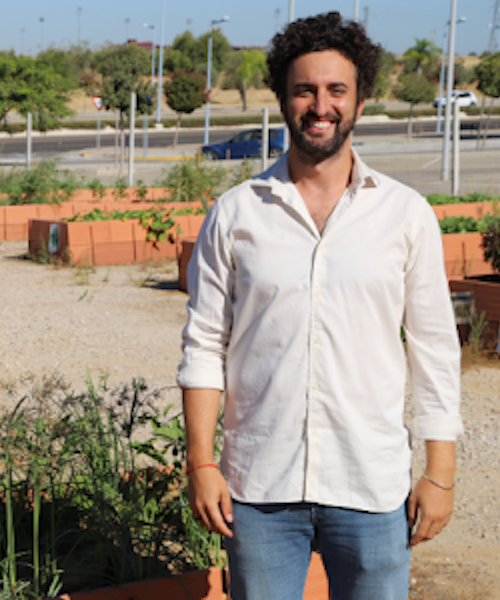
Background : As part of the Education and Social Justice Project, in June 2025, Cici Sprouse (C'26) interviewed Juan Romero González, who has coordinated Servicio de Evangelización y Diálogo (SED) volunteer and service-learning programs at Universidad Loyola Andalucía since 2016, first on the Córdoba campus and later in Seville. A chemical engineer by training, Juan’s path into this work was shaped by a long-term Jesuit volunteer placement in Ecuador and an earlier formative experience living in a rural Amazonian community in Bolivia. In this interview, Juan discusses how those experiences shaped his views on consumption, community, and social justice; his approach to interviewing and placing student volunteers with community organizations; and why he sees volunteering as fundamental to Loyola's mission.
Great. Can you tell me a little about how you started with SED? When did you begin this type of work? Why did you enter the position and all of that?
Well look, I started at Loyola University in… I think it was 2016, 2017. Because it was in November, I think. And at that moment, I had been unemployed for two months. My contract with the Hospital Order of St. John of God had ended. I came from working in a foundation in the third sector and I lived in Málaga, and they offered me a job in the Evangelization and Dialogue Service at Loyola University, on the Córdoba campus. So, I started working with a director who, at that time, well, that was the structure: the service director here in Seville, there was José María Valverde, and I was in Córdoba. That was the team. And I was giving technical support to what was done in the service.
So, at first, it’s true that my role was mainly support, a more auxiliary role. But I really liked it. I mean, I come from Jesuit education, since I was nine or eight years old, many years ago; I studied at a Jesuit school. And later, I also had an experience that marked me a lot—a long-term volunteer program in Ecuador that I also did with the Jesuits. I spent a couple of years there. That marked me, deeply.
So, working at a Jesuit university, in the pastoral service—service learning, volunteer programs—that appealed to me. It was like, maybe it wasn’t what I originally imagined, because I thought I’d work more directly with people. But I told myself, “Hey, maybe my volunteer experience is very valuable, and I can contribute a lot to organizing volunteer experiences.” And I really like working with young people; I’ve always worked with young people since I was 17, 18. So, that’s basically why I started.
With your experience in Ecuador, can you describe a bit about how it impacted you? What did you learn? And what specifically did you like about that program?
Well, let’s see, I came from other experiences. It’s true that for me, an experience that opened my mind a lot was one I had in school, in the first year of my bachelor's, the year before finishing, where I realized I was privileged, that I had a lot of luck in life, and that this privilege I had simply from being born in a certain context, with certain circumstances, came with a responsibility.
So, from then on, I began living with the mindset of giving back what I had received for free. That led me to join many NGOs while I was in university. In 2009, I had an experience in Bolivia, spending four months in a very rural community in the Amazon. That was my most foundational experience, realizing that there are different ways of living, different ways of relating, that I don’t need everything I’m told I need, and that I should aim for a simpler life, a more sober life in terms of needs.
And the importance of the person. That we are people, what we do, our environments, we create the cities, the relationships. So, that helped me realize the transformative power we have as people, in our surroundings and with one another—the power we have to create happiness, sadness, discord…
And of course, since 2009, I was still in university then. I studied a very technical degree, chemical engineering. And at university, I saw nothing about the person; it was all machines, artifacts, formulas. So, I got involved in Amnesty International, Human Rights Watch, human rights topics, but on my own, not through the university.
That later led me to hear about the long-term volunteer program. I finished my degree, worked for a year and a bit at an engineering company, decided to leave, and went to volunteer.
What impacted me most about international volunteering? Mainly, I took with me a sense of justice and a very strong awareness that we are all brothers and sisters, that we are all trying to live well, to live fulfilled. And for that, we need others—we need to live together.
That gave me a strong sense of community. I came back wanting to live not just with my nuclear family, but with a more extended, broader family. And then came the aspects of sustainability, caring for nature, the environment. I lived in a very rural area. Those concepts appeared in my life. That’s what I brought back.
Yes. So, how do you bring that into your life now? Are there daily, practical things where you carry that perspective?
Well, for example, in very practical ways. I hardly buy clothes. Before going to Bolivia, I lived consumption very much as identity–what I wore defined who I was, what I had, and so on. Once I came back, I only bought clothes when I needed them. I try to be much more conscious of what and how I consume. I understand my consumption as a political act. Everything we consume daily is political. If you buy a tomato in Seville in December, that’s a political act—you’re telling the system that you need tomatoes in December. But if you buy them in season, whether they come from a greenhouse or a local producer, if I can choose, of course I prefer local, but even if they come from a greenhouse, I’m signaling when I consume tomatoes. I’m contributing to demand when it should be produced. So, practically, I buy local products. And I realized in Ecuador from where I want to help—from where I want to work for others. I knew clearly I didn’t want to go back to Ecuador as a cooperator, or to Sierra Leone, or wherever. I don’t want to be a foreign aid worker in the Global South.
For me, the fundamental change has to happen here, in our mentality. Little by little, a cultural and structural shift must happen so that inclusive policies become possible. And at a practical level, I cannot forget the system I live in. I’m in a profoundly consumerist and capitalist system. So, from within that capitalism, from within that consumerism, is where I have to generate transformation. I can’t isolate myself and pretend I don’t know where I live.
Do you think you can teach that in your classes? How do you do that?
I think you have to let go of the idea, when you’re a professor or when you work with words, that your words will produce immediate transformation. That you will see it. That doesn’t generally happen. I may talk to you, and maybe, someday in your life, you’ll remember something I said, or something I said might help you. But immediately, in the classroom, producing direct transformation, if you work with that expectation, it will cause anxiety, discouragement. It's not healthy. For me, teaching is rooted in hope and love. Meaning—every person who walks in here is sacred ground. Like the Gospel says, Moses with the burning bush: “Remove your sandals, for the ground you are standing on is holy.” For me, that’s love, that deep respect.
I understand perfectly that an 18-year-old student might think in a completely different way than I do. They're in their process. They bring with them a society and culture that has shaped them. And our job is to accompany them. That’s what I mean by love—you have to love the people who come here. They are not to blame for thinking the way they think. They are a product of the society that has formed them. And then, hope. If I didn’t have hope, I couldn’t do this job. I want to believe that what Loyola offers students, because I consider myself part of Loyola, is something broader. If what I say in class is totally countercultural compared to the rest of their academic experience, then nothing happens. It has to be a collective effort; if we think we’re transforming students through one ethics class or one volunteer service, we’re not understanding the work.
How is your relationship with other professors in terms of the volunteer program? How do you share that goal with them? Do you have strong relationships with them?
Well, this is complicated. When you work in an institution like a university, you realize there are pyramid structures that can make things difficult. They’re necessary. Bureaucracy is needed so things are done properly. But if you only operate through bureaucracy, nothing moves forward. You need dialogue. That pyramid is complicated because it doesn’t allow fluid relationships. But there are also relationships formed day-to-day. You joke that I’m always having coffee, but for me, that is work. I need those relationships. I’m not an IT person locked in an office with a computer.
I need those hallway conversations—that’s where the humus forms that later bears fruit. Why? Because an email explaining an activity through a bureaucratic chain is often not understood. But if I invite you for coffee, speak one-on-one, explain why something is important, and make you part of the idea: “What do you think? Let’s add things, let’s work together.” That is powerful. And that’s considered “useless” in a business environment. But I defend the “useless,” because it’s actually the most useful part of our work. So, the professors I collaborate with most are those who, at some point, have connected with this department’s mission. I work with math professors, psychology professors, all types. Some resonate more with this work than others. At the pyramid level, everyone receives the same information; the deeper connection depends on who is open.
In terms of the students… I know you do an interview at the beginning when they start. What is your goal with those interviews?
When a student signs up for volunteer work, many of them don’t know what volunteering really is. They think it’s “helping.” But there are many ways to help. And you also have to know how to help. So, the interview is important because in our program, the focus is not on the student. The focus is on the community they will serve, and the organizations they will collaborate with. That’s where our attention should be. Before offering a volunteer opportunity to students, I’ve already met with the organization’s coordinators, visited the site, and designed an attractive program. I know what they need, what profiles they are looking for. So, in an interview, for example, if someone wants to volunteer with children in a marginalized neighborhood but they have very low energy or struggle socially, maybe that’s not the best fit. Maybe they’d work better with elderly people, or people with disabilities, or logistical tasks.
I might be wrong, but the interview is to collaborate with the organizations. And it’s the first time we treat students very like adults. The first thing I tell them is: “You are here because you want to be. No one made you come.” When they leave the room, they are the ones who contact the organization, not me. I don’t call the organization for them. It’s very adult. And some students don’t handle that well. They're often first-years, coming from highly structured environments, and suddenly, they’re treated like adults with responsibilities. This goes against our numbers: fewer students end up volunteering. That worries us, and we analyze it constantly.
Can you explain why you think that’s good? Why do you do it that way?
I do it because the sooner students understand they are responsible citizens, with rights and obligations, the better. I said earlier that I trust people. If I, Juan, create programs where I accompany the students everywhere, more people will come. But the transformation depends on me then, and that’s not the point. Volunteering is not about me. I do it this way because I deeply believe in justice and faith. If a student manages to volunteer under these conditions, their growth is exponential. They overcome fears, prejudices, accomplish something driven by their own convictions, connect with an organization that gives meaning to their desire to help. We trust processes. You are in a process when you arrive. I don’t have to be deeply involved in that process. I’m here to accompany you, but you walk the path.
What does that process usually look like? What do you notice most commonly in the transformation?
There’s a discovery.
Can you describe that more?
It’s the discovery that comes when you approach a reality. Volunteering is like a window—a ground-floor window. Not a skyscraper window where you can see but not touch. This one allows you to see and touch. And that creates the intention to cross the window: you go from observer to participant. You feel involved in others’ processes—their desire to live better, to pursue aspirations. And that encounter, seeing, reaching out, approaching that reality, is where transformation happens.
That pedagogy of encounter is very powerful. Much more powerful than the classroom. In class, transformation may happen, but it’s rarely as clear or strong. Imagine a student who believes immigrants steal jobs, are lazy, or come to cause trouble. When that student meets real immigrants face-to-face, hears their stories, those arguments collapse. They can’t sustain them anymore. That’s the power of volunteering. Many ask: “And where is faith in all this?”
Yes, that’s what I was going to ask–the connection with the religious office. How does being under a religion department affect the program?
It makes perfect sense. This is the most spiritual thing a person can do.
But what if the person isn’t religious?
It doesn’t matter. What we believe in this department is that every person is spiritual—not religious, but spiritual. Meaning everyone has the capacity to transcend a situation, imagine a better tomorrow, create concepts, picture a better world, imagine a different self. The capacity to help, to get involved. That’s the spirituality we’re talking about.