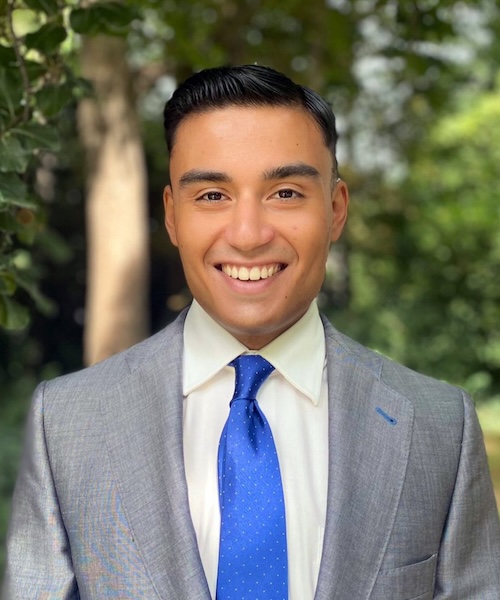
Background : As part of the Education and Social Justice Project, in June 2025, Cici Sprouse (C'26) interviewed Luis Párraga, a fourth-year international relations student from San Salvador, El Salvador, studying at Universidad Loyola Andalucía on a scholarship from the Government of El Salvador. Luis has participated in several Servicio de Evangelización y Diálogo (SED) initiatives during his time at Loyola, including ECOSED’s sustainable fashion program and, most recently, its eco garden project. In this interview, Luis discusses his volunteer experience in the eco garden, how it connects to his coursework and personal values around sustainability and consumption, and how it compares to his volunteer work with USF Ministry during a study abroad exchange at the University of San Francisco. This interview was conducted primarily in Spanish and translated to English by Cici Sprouse.
Well, could you tell me a bit about yourself? I already know a little, but just something about where you're from, your degree here, all of that.
Yes, I'm Luis Párraga, from San Salvador, El Salvador. I'm in my fourth year of the international relations degree here at Universidad Loyola Andalucía. And I came, thanks to a scholarship the government of El Salvador gave me to study here. And well, I'm about to finish.
Yes, congratulations.
Thank you. And during these years, I’ve participated several times in SED activities.
Yes? In which programs have you participated?
Mainly through ECOSED.
Okay, yes.
And I’ve been in one activity they carried out during the year, which was focused on sustainable fashion, though I only made it halfway through that, more or less. Then, I went on exchange for a year, and this year, I’ve gotten involved with them again. And now, I’m mainly in the eco garden.
So, mainly ECOSED, and now, the eco garden.
Yes, well…
With the clothing, those things?
Well, the clothing program was before. Now, it’s the eco garden. Those two fall under ECOSED.
Ah, I see, so, they're like two branches.
Yes. From what I understand, what they look for is that each year has a different theme. That’s why the concept changes.
Yes. How did you first find out about that program, at the beginning, when you started here?
Well, I think through the emails they send.
Did you know people participating before, or not?
I don’t think so, but I do remember speaking with Juan during my first year. I think, even on my very first day here at Loyola, I talked to him because he was at a welcome fair for new students.
And have you also participated in other SED programs, or only ECOSED? Because I know there are faith groups and those things, too.
Yes. I haven’t been very active, but I’ve occasionally participated in the faith groups that meet right here in the space where we are today. And I’ve been at some of the weekly meetings they have.
And how would you describe the work of ECOSED? Like, on a daily basis, what do you do? How many hours a week do you spend on it?
Well, normally, it would be about two hours a week that I dedicate to this. At least, this year, it’s been Fridays that I’ve devoted to ECOSED. That day, we go to the garden, and we’re occasionally joined by people from a foundation nearby called Asociación Inclusión Activa (ASAS) , and they bring people with mental disabilities who help us pick the produce from the garden. And in that process, we talk and get to know each other.
Has it ever been difficult to keep up with two hours every week, or do you find the time?
The main problem this year has been the weather, because many, many times we’ve had to cancel the activity because it was raining. It’s rained a lot in Seville this year.
Yes, I saw it on the news… all over Spain, I think.
Yes, so, because of that, I haven’t been able to feel as involved this year, since the conditions haven’t allowed us to meet as regularly.
Okay, I’m going to ask some things from my list.
Also, I should add that many times, my class activities have overlapped with ECOSED hours. For example, I’ve had meetings related to my thesis that conflicted with the garden schedule, so, for that reason, I wasn’t able to participate on some occasions, either.
Have you participated in any kind of volunteer work before coming to Loyola, or is this your first time?
Yes, I have done volunteer work in El Salvador.
What was it? What kind of work?
Well… at school, we had projects that were somewhat similar in the sense that we had gardens. We also had hydroponic lettuce crops. And, well, it reminded me a bit of what we’re doing now. We also had a plastic recycling program. And I was a co-founder with other students of a chapter, you could call it that, of something called Interact, which is the youth branch of Rotary Club in El Salvador. It was associated with the Maquilishuat Rotary Club, which is the name of the Rotary Club of San Salvador.
Rotario?
Yes, Rotary.
Ah, okay.
Yes, and they gave us support so that our school could start carrying out activities with them, mostly focused on collecting donations or fundraising for organizations.
So, mainly, it has been working in gardens, or work related to the environment?
Yes, in many cases, it was related.
So, you haven’t participated in programs with children? Well, now, yes, with the eco garden.
Well, they’re adults. With children, well, there was a small experience, honestly. In my school, in the afternoons a couple of times a week, we helped teach pre-K kids, before first grade, how to read.
Yes.
Yes, it didn’t last very long, but that was my involvement with children.
Mm. Here at Loyola, what do you most value about ECOSED? You can take a moment to think.
I think it’s the contact with nature. Because I’ve realized that the eco garden is the only moment in my whole week when I have a real connection with nature. And I hadn’t realized how far removed I could be from plants, from the earth, from trees, until we started this activity, and I realized how few moments I have to feel immersed in the nature around me.
Thinking about your degree, how has your work with ECOSED impacted your classes, if at all? You can take a moment.
First, I’ll mention that ECOSED is, in a way, a continuation of something I was already doing during my exchange in San Francisco. At the University of San Francisco, they have a farm outside campus that we visited a couple times. And what I learned from that experience and from the eco garden here is remembering the origin of the products we consume, the origin of food. Because, of course, when we buy food in the supermarket, it’s not obvious to us that those products went through a long process. And we often forget their origin, and the origin is in the earth, in the garden. That’s something I’ve taken from this experience.
As for a direct academic connection, I don’t know if international relations can be directly tied to this. We discussed this in classes like Principles of Sociology or, I think, Humanism or Basic Ethics. That idea of the alienation of people from the origin of the products they consume. And the dynamics of the capitalist system, understanding how that paradigm shapes our relationship with food and with the things we consume. We touched on those ideas in class, and the eco garden reminded me of them. And also, as you can see, it’s been something recurring—it’s come up in several parts of my studies.
Yes. Well, the two values of SED are the importance of social justice and care for the common good. Do you think ECOSED embodies these? And if it doesn’t, that’s okay, too.
Well, justice is present, first, in the sense that very different people can participate in this activity. I have many differences with the other volunteers. We have completely different backgrounds, different interests, same with the people from the ASAS foundation. But being in an activity that brings us together, that’s something just. And then… What was the other principle you said?
Care for the common good.
Yes, that’s even more present because it’s about appreciating what nature gives and giving it this extra attention so that it can bear fruit for people.
Do you think you’ve changed as a person because of these experiences? You’ve already mentioned how it connects to your classes and your thinking, but maybe in other parts of your personal life, such as your development or your goals for the future. It could also be that you haven’t.
Yes. Now I’ll talk about the previous ECOSED project, the clothing one. I already had a mindset that aligned with that initiative. Even before coming to Spain, I was known for having a somewhat particular way of dressing, like now.
Yes.
Usually, I wear very simple clothing, and I actually have very little clothing, because ever since I was a teenager, I liked going against trends and having a style that was more classic, refined, simple. Because typical clothing I saw, and still see, is disposable, it won’t last long. So, I wanted, through my example, to promote returning to a simpler style that was timeless. And also that was high quality, so it would last many years. These pants, for example, I think are from 2018 or 2019. If I had bought them at Zara, or Shein, or one of those brands, I’m sure they wouldn’t still be with me, now.
Like fast fashion?
Yes, fast fashion. So, I loved that ECOSED had that theme because it fit with my interests. And, well, maybe it didn’t bring anything completely new to my life, to my thinking, but it did reinforce that this inclination was something positive. And that there were other people interested in the same thing.
So, you’ve found a group of people here at Loyola?
Yes, yes. I’ve talked with classmates and realized I’m not the only one with this concern, and that many people also take similar steps in terms of how they dress.
Do you get the sense that most people at Loyola are involved in some kind of volunteer work, or not?
I’d say my perception is that most are not.
Why do you think that?
Because, for example, in ECOSED, very few students participate. I think there are, like, two or three of us who are actually present most of the time. So, considering it’s a university, I think, with about 4,000 people, that’s very little involvement.
What’s the reason for that, if you had to identify a few?
Well, you could say that schedules make it hard to get involved. And maybe, the academic workload, too. We have several long group projects and writing assignments, at least in my degree, that take a lot of time and energy. And then, maybe, there’s also a lack of incentives from ECOSED itself. It doesn’t even have to be a material incentive, in my opinion, but something that could be done more is reinforcing the understanding of the “why”—why we’re doing this. Many times after activities, we don’t have time to sit and discuss what we did. Last time, when we watched the documentary about Pope Francis, I loved that Juan added a discussion at the end. Some very interesting topics came up. But after our regular eco garden meetings, something like that doesn’t usually happen.
So, you would like to incorporate that?
I think it would be good. At least, for me, it motivates me and stimulates me, if something like that is created. And also, well, something material isn’t bad either, like an invitation to eat together, for example. I know those things have happened but not very often.
Do you think, for example, that the reason most students don’t participate in these kinds of programs is… I don’t know, is it related to the classes? Like, in your classes, have professors mentioned SED, or not?
Before I answer that, can I add something to the previous point?
Yes, of course. You can always go back to any part of the conversation.
I think a greater level of formalization would also help. And how could that happen? Well, I think, from the beginning, they could publish a formal schedule of what will be done each week, what the learning objectives will be each week. And also, they could tell you from the beginning some goal to achieve at the end of the program. This is also bringing up other ideas as I say this. Maybe, at the end of the program, they could issue a formal certificate mentioning your participation. I don’t think they do that, because I’ve never received anything like that from ECOSED. And that would already generate greater commitment from people. Many students sign up for ECOSED or SED activities at the beginning of the year and then never show up. So, having that extra formality would create more commitment from volunteers. Okay, now, could you please repeat the next question?
Why do you think most students aren't involved in this type of work? I’m thinking about whether classes or other university spaces mention these programs or not.
Well, I mentioned the Humanism and Basic Ethics class. In that class, we had a service-learning experience where we did volunteer work. It wasn’t with ECOSED; it was outside the university, with Jesuit Refugee Service. So, even though it wasn’t directly with SED, the principles are similar. But that’s the only class where, I think, they mentioned SED. I’m not sure…
And, in that class, how was the experience?
Well, we went weekly to the center. And we had lessons on topics like interculturality and the experience of migrants. That connected well with what we saw in class. And it also made me realize that maybe, SED is missing a stronger theoretical component—something that could be incorporated, like I mentioned, because in the end, there’s a lack of theoretical and intellectual grounding behind what we’re doing. For me, it’s obvious, but maybe not for everyone. And discussing it would make it clearer. And that would also make it easier for classes to connect with SED.
Yes. For example, in that class, was this part of the curriculum from the beginning?
Yes, yes.
So, the students in that class knew from the start?
Yes, we knew from the beginning that there was the option of doing that service experience or doing a written assignment. Most of us chose to do volunteer work.
And how was the reaction or participation of your classmates?
I think, for everyone, it was interesting. Maybe, because the lessons were related to our degree. So, if they talked about migration, migration routes, then we met migrants, which tied directly to what we saw in class. And that, maybe, helped people feel interested. So, now that I think of it, SED and ECOSED could design activities that directly connect with certain content from each degree. Maybe not a whole program per degree, but the occasional meeting or talk.
Jumping to another topic…After graduating, what are you thinking of doing?
Well, I want to do a master’s [degree].
A master’s in what?
I’m between two. One is in European studies, for which I already have an admission letter. And the other is in global studies. Actually, that’s the one I’ve been most interested in, lately, but I still don’t know if I’ve been accepted.
Global studies…can you explain what that would be?
It’s mainly about globalization and its relation to foreign policy, to day-to-day life in the international system. Also, related to globalization, it connects partly with what I’ve learned through SED, too. As I was saying, the eco garden reminds us how global processes have distanced us from the origins of the products we consume. I might not even be aware, but maybe, the fruits I eat, the vegetables I eat aren’t produced in Europe. They may have gone through a long journey across continents. Thinking about that is interesting to me. I find it fascinating. That’s partly why I like global studies, and why I like that ECOSED made me think about these things.
Based on this topic, is there a course like that at Loyola that you’ve taken or seen?
Yes, in Humanism and Basic Ethics, we talked about that. In Sociology too, in that specific class. And in international relations, in economics courses. Maybe, they aren’t dedicated to that topic. I don’t know if Loyola has courses that focus so directly and critically on that. During my exchange, I did take a class that clearly followed a critical theoretical framework from the start.
Yes. I wanted to ask about your exchange experience because I’d also like to hear about the differences between volunteering there versus here.
Yes. Well, I went to San Francisco through the Magis Exchange program, which is run by the International Association of Jesuit Universities. And as part of the exchange, you had to do at least one volunteer program. In the end, I did two: one short and one longer. The main one was with the equivalent of SED at the University of San Francisco. What was it called…? USF Ministry. And I loved it, because for many of their activities, the approach wasn’t strictly Christian. They invited people to participate, even if they weren’t believers. And that was made clear from the beginning.
Of course, a Jesuit Catholic university should have Christian programs, and that’s not something lacking here. Those options exist with the weekly faith groups. But since I personally am agnostic, I’m not sure if I’m a believer, and I didn’t grow up very religious, I’ve chosen, on my own, to get closer to the Jesuits because I find it interesting, and I’ve learned a lot of respect for religion, but I’ve never been deeply inside it. So, I loved having the opportunity at USF to join activities that, even if they had a spiritual focus, weren’t directly Catholic. That allowed me to see spirituality from another perspective.
So, I participated in these activities and also helped a bit, carrying boxes, taking notes, taking attendance. They weren’t huge tasks, but those were the things I noticed and liked. Also, financial resources matter for the type of activities you can do, and it was clear that there, they had many more resources. For example, the ministry had international immersion experiences every year that students could sign up for trips to Asia or Latin America, I think. I’m not sure if they were volunteer programs, but they included spiritual reflection, and they were covered financially for students by the ministry itself. Something like that doesn’t exist here, as far as I know. The university hasn’t provided resources for something like that for students.
I wanted to ask…In San Francisco, was the emphasis on Christianity less? Did you feel a stronger emphasis here on religion in your participation, or not?
Yes.
In what sense? How would you describe that connection to religion?
I feel that, here, the activities organized by SED, not so much ECOSED, but SED, in general, are more directed toward people who are already Christian or Catholic. And if you’re not, it’s, maybe, not very clear that people outside that group are also welcome. I do sense that everyone is welcome, but that message isn’t very explicit.
How do you think that message is conveyed?
At USF, they directly stated that everyone, regardless of beliefs, was welcome in the activity. It was said literally. You didn’t have to guess; you could see it in their communications. Then, of course, there are local factors that influence this perception. San Francisco has its “San Francisco values.” It’s extremely progressive. So, the university adapts to its city. A conservative Christian style wouldn’t generate much enthusiasm there. And here, in Seville, it’s the capital of Holy Week. So, it also makes sense that activities lean more directly into religion. So, I wouldn’t expect something completely different from either place. The local sociopolitical and geographic context plays a role. But yes, I’m sure that, in both places, the target audience is different, yet both places could work to make the non-target audience feel more welcome in their activities.
How would you do that, do you think?
[In English] You know what? Taking more Loyola-style activities to USF, and more USF-style activities to Loyola. And I don’t even know why I found this easier to explain in English.
We can also do part of the interview in English if that’s easier. We can combine languages.
Yes. We can do it mixed if necessary; I can switch.
Could you give an example of that, like a program from here or from there?
Yes. One really nice activity in San Francisco was a visit to a park where we did meditations. And they were general spiritual meditations––not tied to any specific religious practice. And there was lunch too; we shared food and had a discussion afterwards. At Loyola, for example, these weekly faith group meetings also are held. I like that you always reflect on a biblical text; for example, the priest has been accompanying the group from the beginning. I really liked and still like that type of activity because his presence provides the necessary perspective to help with interpretation. In fact, I would like the faith groups to have even more of that... I don't know if I should call it... a theological focus. Again, it's something I find intellectually stimulating, fascinating. So, each place can learn a little from the other.
Do any members of your family participate in this kind of volunteer work, or are you the only one?
I would say I'm the only one. However, my mother has dedicated decades of her life to work with a strong social focus. Not as a volunteer, but she's a physician. She first worked in rural communities in El Salvador, and then, she spent 25 years working with the Supreme Court of Justice in El Salvador as a forensic psychiatrist. She handled many cases involving injustice through her collaboration with the judicial system. So, that definitely gave her a perspective on social justice, an understanding of the struggles faced by different sectors of society. That has influenced me, even though her work wasn't technically volunteer work.
So, would you say that social commitment is your motivation for participating? If you had to identify one source of your motivation, where does it come from?
From a sense of justice that comes, first, from observing my mother's behavior. Second, from observing my own surroundings. And third, from observing the history of El Salvador and its current conditions. Regarding my personal context, I always attended a private bilingual school in El Salvador, which was already a tremendous privilege. I grew up with that privilege. However, I was surrounded by people who were even more privileged than I was, especially financially. Many of them had both parents at home, whereas I was raised by my mother. Their parents were business owners or highly paid professionals.
What I noticed in many cases was that my classmates didn't realize the privilege they had been born into. There was a significant disconnect between the way they saw life and the reality outside their own world. I'm not trying to present myself as morally superior, but, perhaps, because I didn't grow up with as much wealth or privilege, and because I always saw how hard my mother worked to give me those opportunities, that created social awareness in me.
Then, there's the historical context of El Salvador. It has always been an extremely unequal country, and that hasn't changed. There's a stark contrast between the wealthy business and political class, who have abundant economic resources, and the vast majority of Salvadorans, who earn incredibly low wages and live in difficult conditions.
That's part of what led me to the Jesuits. In El Salvador, they have enormous respect, prestige, and an important place in history because, especially after the founding of the Central American University, they have consistently fought to highlight these inequalities, analyze them within society, and implement plans to reduce them, whether through education, professional formation, or the charitable works of the Church.
You mentioned again the idea of reflecting and analyzing. How do you do that now? Is it mainly through your classes?
I would say, yes, it happens in class.
And with ECOSED, how do you personally engage in that reflection?
Personally? Well, first, I do it in class. During the first two years of my degree, most of the courses were designed to encourage this kind of reflection. Those years included more philosophy and humanities courses. During the last two years, those themes aren't as present, but they've left a lifelong mark on me through courses like Humanism and Contemporary Political Ideas, which also dealt a lot with globalization.
Beyond that, I'm honestly always thinking. I think I'm naturally inclined toward reflection. Conversations are another important way of reflecting. This interview is one example, but when I call my mother, these subjects always come up. I like telling her about my thoughts on the reality of El Salvador, international politics, or ideas that occur to me. I also have these conversations with friends who share similar concerns.
Writing might be the best way to explore these ideas in depth, although I don't usually spend my free time writing essays about them.
Do you think the other students you work with in ECOSED or the eco garden also reflect in this way? It's difficult to know, but what's your impression?
I think they probably do, because someone who isn't reflective or empathetic probably wouldn't get involved in this kind of work. I can't say for certain because I haven't really gotten to know my classmates well enough during these activities.
What do you mean?
I haven't gotten to know my classmates well enough during these activities.
Could you define "empathy" for me? Take your time.
Empathy is caring enough to understand what another person is feeling.
Has your volunteer experience influenced that definition?
Before participating in the eco garden activity with the clients from ASAS, I had never interacted with people with disabilities. That experience opened my eyes. I realized that they are fully capable of participating in activities requiring physical coordination, like the work we do there. Socially, in many ways, they are just like us. Talking with them, trying to understand what they're thinking and how they're feeling during the activity, helped me put myself in their shoes.
When I said I hadn't gotten to know my classmates well enough, I was mainly referring to my Loyola classmates. During the activities, we naturally focus on our guests. So, afterward, I don't really leave with a clear idea of what my classmates think because we haven't interacted enough.
Is that because you don't have opportunities to reflect together?
Yes, that's probably it.
How has your experience at Loyola been? Was it your first time in Spain?
Yes. My first time in Europe. But, from the very beginning, I felt at home. I've always felt warmly welcomed here. I was amazed to discover how many connections Loyola has with El Salvador. Many professors have not only researched El Salvador but have actually lived and taught there. That made me feel very comfortable because I appreciated their genuine interest, and I think I also sparked their interest. It's been a very rewarding relationship.
Would you say it was very different from San Francisco?
For me, San Francisco was also an incredibly positive experience. I felt very loved there. I also had family near San Francisco, so when I first arrived in California, I stayed with them.
Beyond that, before I even arrived at the university, I had already made a friend through the university's housing website. Although we didn't end up living together, we became close friends, and he welcomed me from my very first day at the University of San Francisco. He's a lifelong friend. In fact, yesterday a gift he mailed me arrived at my home in El Salvador. At the university, I always felt that people genuinely cared about me, perhaps even more than here, although that may simply have been because the environment was more personal. The professors were always very welcoming. I became especially close with one professor who taught Latin American politics and researched crime. Knowing where I came from, she often invited me to contribute my perspective in class, and I really appreciated that.
At Loyola, it's a little harder to build those kinds of relationships because the classes are much larger—sometimes 50 or 60 students. At the University of San Francisco, there were never more than 10 students in a class, so it was much easier to become close to professors. Even so, I can say that I'm now friends with several of my former Loyola professors, and that's something not many students can say. I'll always carry their teachings with me.
Do you think you'll return to El Salvador, or will you stay here? At least, while you complete your master's?
If you mean in the long term, right now, my personal preference would be not to return permanently. The lifestyle in El Salvador isn't one that I enjoy. It's very stressful and chaotic. People are expected to work constantly, drive from home to work and back, and that's about it. There aren't many cultural or recreational opportunities. It's not an easy place to simply go for a walk, and there's a lot of pollution.
At the same time, all of those experiences leave me with a sense of responsibility to work toward improving those conditions. I don't know whether I'll do that directly from within El Salvador, but my career will begin by working for my country. In fact, that's my plan.
After I finish my master's degree, I hope to be hired by El Salvador's Ministry of Foreign Affairs so that I can work in one of the country's diplomatic missions abroad. That way, I can contribute to my country by helping create opportunities for improvement from outside. At least, for now, that's how I envision the beginning of my professional career.
I understand.
One result of these experiences is that they have strengthened my sense of duty and my desire to pursue greater justice, not only for my own country, but for the world.
Well, that's everything I had. Is there anything we've talked about that you'd like to return to or add?
I don't think so. Thank you very much for the interview.