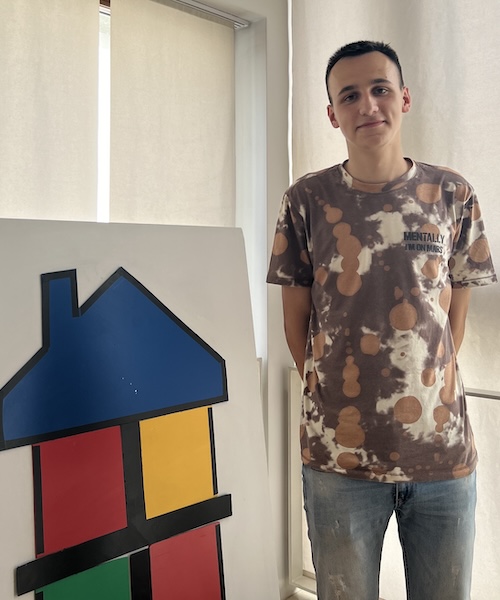
Background: As part of the Education and Social Justice Project, undergraduate student Julianne Meneses (C’25) interviewed Manuel, a high school student and participant in the Vision is Decision Project on June 21, 2024 at the John Paul II Youth Pastoral Center in Sarajevo, Bosnia and Herzegovina.
Okay, to start, can you just please tell me a little bit about yourself and your background?
I’m Manuel. I’m from about 45 minutes away, from Sarajevo. I'm 18 years old. I am interested in politics, democracy, and stuff like that. That's what I want to do in my life. That’s one of the main reasons why I signed up for this project. I can say that, and the fact that no one else wanted to go. But, I’m really glad no one wanted.
Okay, thank you. So, I mean, you touched upon this already, but how would you describe your connection to Vision is Decision? So, like, how you first heard about the project. What made you interested in participating in it?
My school is part of this project, so they invited students to come here to the center to be part of the project. They showed us what we would be doing—like the activities and everything—and I’m going to say it was interesting to me because, as I said, I’m interested in that.
But I’m a real introvert, so I was like, “It’s not for me. I’m not going to go.” But, my friend signed up, and since no one else wanted to go, I was like, “If no one else wants to go, I will go.” And then, I came here and made friends the first night. During those three days, I made friends that I’m still friends with to this day. We chat every day; we go on calls, video calls, and you know, stuff like that. And I’m really glad I came here.
And I only say this because I don’t think of myself as that big of an introvert anymore. Now, I can come up to anyone, introduce myself, start speaking like with you right now. I mean, last year I wouldn’t even think about speaking to anyone, so it’s kind of all new to me. But, I’m really glad this happened. I came out of my comfort zone, and I’m really glad I did.
Would you say that the center and the program has helped you build those skills? Like social skills?
Yeah.
Like, especially public speaking—speaking with someone—I didn’t like that. But, the first meeting we had, it was like a weekend, three days: Friday, Saturday, Sunday. I only started building those skills then, and now I’m completely...
Let’s say, I mean, it’s not a problem for me to come in front of people and start speaking, saying something about something that I know or something like that. It’s completely normal now.
That’s why everyone always says, “You’re going to speak, you’re going to speak, you’re going to speak.”
That's really great to hear, how you build more confidence in your public speaking skills and abilities. That's great, and that the center was very supportive.
I mean, one of the examples is Zaklina—she was our coordinator, the project coordinator. She saw potential in me and said, “I’m going to sign you up to be a peer educator here at the project.” So, I’m really—I really hope I will be. And, as I said, this is my second home. I love coming to the center. Mm-hmm. And when I have to go home, I’m really sad. Like, I want to cry when I’m leaving this place because I really love it.
Oh, that's great to hear about the community that you're able to build here and, like, build those relationships. Kind of shifting more towards the project prior to coming here, how would you have defined democracy? Or, what did democracy mean for you?
Well, how would I describe it? It is a system where everyone has the right to express their opinions. And I kind of—let’s say—I don’t think this new concept of democracy is what I really consider democracy to be. I believe that democracy should be about every individual seeing what they want or what they don’t want. So, like, let’s say...
You say that in English—consensus? I don’t know how to say that—referendum?
Yes, yes, yes.
You know, like, I think democracy should use referendums to vote for everything. Like, for example, Switzerland is using that, and I really...
Take your time. No worries.
Well, I really think democracy is the true option to lead the country where everyone has rights. Because we say we are a free country, and here, everyone has the right to an opinion. And the best way to show your opinion is to have the right to vote for your opinion: to say what you think is right, what you think is not right.
The ability to say whatever you want without the fear of being, I don’t know, arrested for saying or speaking against the president, against the prime minister, or someone like that is really what every country should aim for to have democracy. That’s my opinion.
Okay, so, it seems like you had a pretty good foundation about what democracy means to you. How has the center and Vision is Decision aided you in creating this definition for yourself?
It helped me in a lot of ways. First of all, I learned a lot of new things about democracy here in our country, in Bosnia. We also learned about democracy, the definitions of democracy, how it should be, the things that we don’t have in Bosnia that are not used here. I mean, they are used, but it’s not really a perfect country to show democracy, and the center motivated us to go to elections, to vote, to be part of the community, because only we can make this country a better place to live. And that’s what the center tells me, and I believe, I hope, it tells other people, too. And really, I believe the center was the biggest motivation for me to start exploring democracy more—not just democracy but politics, politics, politics, in general, and I’m really thankful I got a chance to be part of this project.
I met all of those amazing people here, and really… I’m going to say, democracy, now, is my entire life, like, all around me is democracy, now. Before the center, I just knew about democracy. I was not so much interested in it. I was interested, but not on this level. And then, through the center, through workshops and everything, I started to love democracy more, and really, now, I decided to go for that in my life.
And what differences would you say you see in how you learn about democracy here at the center compared to how you learn democracy in school?
Well, this is a great question because I have democracy in school, but it’s a problem. My professor is... she’s kind of like… Enters the classroom, of course, and she just takes your paper and just reads, reads, reads, reads. And it’s like, one lesson is—I’m not kidding—two big pages, and you have to learn that word for word. You just need to do that. And that’s something I really hate because I think you can’t learn anything like that.
Here, in the center, we do everything through interesting workshops, interesting visits. We went to the archive in Bosnia and Herzegovina. We learned a lot of things there, went to Parliament, learned... I mean, I learned a lot of interesting stuff in Parliament that I am learning in school, but I will never remember it from school because it’s just—I read it. I go, I do my exam, and I forget it. And that’s it. I mean, you can ask me, but I don’t know what I said. I mean, I have an A, but don’t ask me anything. But, through the center, I really learned a lot of things through those trips to some higher… Like Parliament, the buildings like that, I don’t know how to say that. I’m sorry.
Yeah, yeah, yeah. Well, no worries. No worries.
And this way of working—this non-formal education center—is something we should actually do more in schools. I believe more because this way, students can learn more things in school.
I’m an example; I learned so many things here in the center that I would never get a chance to learn in my school. And it’s kind of sad that our educational system is like that, does not work on this level as this center is working. They’re doing a better job than the buildings or… Yeah. Buildings that are supposed to do that job.
So, from my understanding, it seems that when you learn about democracy in school, it’s mostly just memorization, just to know the basic definitions. And that’s really just for testing purposes. Whereas, you see at the center, you’re more engaged with the material, and you are able to connect with it rather than just have that passive memorization.
If I can give you an example.
Yeah, of course.
I don’t know if you know about the Council of Ministers.
Yes.
Yeah, like, I had to learn all nine of those ministers—their names, their purpose, and everything. I mean, I really don’t need that in my life. I need to know why they exist and what their purpose is, not to know each one of their names, and that’s truly not necessary. Especially since they will change eventually. So, you need to know how this country works and how you can make democracy improve, to make this country a better place. That’s what the center taught me, not what school taught me, and that’s why I really started to love this place, and why I’m coming here more and more every chance I have.
Thank you for that. What do you think are some of the common misconceptions about the political system here in Bosnia and Herzegovina?
Yeah, yeah, I can elaborate. So, you were talking about how in school you're expected to memorize the Council of Ministers, all nine of them, their names and such, but not really why they exist or their purpose in serving the government. So, not knowing that, what do you think are some common misconceptions or misunderstandings about the government here that people have?
Well, first of all, I don’t know. Wait a minute.
No, take your time. If you want me to explain in a different way…
Let’s see. Well, many people here just give up on democracy, and what I really, really hate is when—for example, we have elections, and many people don’t go to elections, don’t go to vote, and then, when someone is elected, they start to say they’re not happy with the person or something like that, but they don’t do anything to make change in this country. Because if everyone would go to elections and vote for better, this would be a better place. But, no one wants to go. Everyone is just sitting at home and waiting for some miracle. And that’s what people think. People think that politics can change themselves, but they can’t. We have to be part of it. I mean, it’s…
I don’t know how to say this, it’s...
Take your time. Go ahead. Yeah, yeah, yeah, go ahead.
Okay, I know the word—definitely social science. It’s social science and it’s meant to help influence humankind. And, I mean, if you don’t do anything, of course nothing will get better. Of course, it will stay the same, but this center really motivated me and I hope my friends and everyone who was part of the project to actually go to elections. And make some changes, to make some projects in their communities, to make—I mean to make some change, to make a difference in this country, because if we don’t do anything, as I said, nothing will change.
Hmm. Yeah. And why do you think people are unwilling to participate in political processes like elections and voting?
Well, I believe the reason is, in my opinion, of course, we only have a couple of those big political—I don’t know how to say. Similar to you in America, you have Democrats and—Yeah, political parties. Like, we have just a couple of them, like you have [names political party]. Those big ones are just a few of them, and people are bored because none of them is good. So, I think we need more political parties, that’s what I’m involved in.
That means it takes more people involved in politics to make change, because when you’re involved in politics, you can make your own political party or be part of some other political party, but make some difference in it. And this way, that’s my opinion, why people are staying away and not going to elections and similar things, because they’re just getting bored of the same faces, seeing them year after year after year, and them just promising, promising, promising and not doing anything. Mm-hmm. So, I think we need more political parties and more people involved in politics to motivate others to make this country a better place.
Mhm. And in your opinion, what role does education have in encouraging people to be politically involved?
A big, big role. But our education is really—I'm ashamed of our education because it’s really bad. Elementary schools, high schools, universities. It’s really, really bad. For example, we have language in elementary school and you will learn nothing there, like in the first grade. We’re just like in kindergarten. It’s not—it doesn’t have any purpose. In high schools, even though many schools do have politics and democracy as a subject, my school too, but for my example, it’s not working well. In many schools in Sarajevo, well, I heard from students that they don’t learn anything new, just theory, and definitions, and something like that.
And I think we need to do that—that things have to be changed to have more—more projects in high schools about politics, about democracy, just to bring those people, us, the youth. We need to be, you know, involved, somehow, in politics. We need someone to guide us because we’re new to this. For example, I had the center to guide me, but many people don’t have this, the center—don’t go here, are basically just on their own, because the school is not doing their job properly. And I believe that with a better educational system, we could make politics come closer. Democracy come closer to students, to people. Maybe someone can find out that they’re actually interested in that. But they don’t know because it’s just definition.
I mean, yeah, if it was just what I learned in school, I would never consider myself going to political studies to learn about this. But through the center, through some workshops and everything I’ve been to, I really have a big motivation to continue this path in my life.
Well, it’s really great to hear that the center has, like, sparked this interest in you and has helped guide you.
Yes.
You made a comment saying, like, you had the center to guide you. What role do you think religious institutions, like, here, have in promoting democracy?
Well, let’s say this institution, I consider it unique, for example, because even though it is—mostly like a Catholic organization, everyone is welcome. Like, it doesn’t matter to them if you’re a Muslim, if you’re Orthodox, if you’re Jew, if you’re an atheist—I’m saying that right?
Uh, atheist. Atheist. Uh-huh.
It really doesn’t matter here, and that’s what I think is the most important. Now, when it comes to religion, I am religious, but I’m kind of different religious because I really think that church—and, I mean, I’m going to talk to you about church because I don’t really know about Islam and Orthodox—I’m going to talk about Catholic Church. It’s really bad thing back. Because they’re still going through some things that were popular back then but are not popular now. For example, you can’t have the same things in church that you had, I don’t know, 100 years ago and now. And many churches still go by the same logic, by the same, you know, logic. And I think it has to change. It has to change. And many churches want you to believe what they want. And, as I said, I’m kind of different because I don’t really believe in church that much because I have really bad interactions with church in my history.
So, I’m a believer. I’m praying to God when I can, but my church—my church, for example, my church is really bad. My pastor is basically a thief—like just money, money, money. That’s all he’s interested in. Umm, and I had, unfortunately, a chance to meet a lot of pastors like that. Not all of them are like that, thank God. And that’s what made me go away from church. But, I’m still a believer. I believe in God and all that. So, I think that we need firstly to change the purpose of church itself, to make it closer to new ages because we know new things are coming here, that it’s not the same like it was back then, and that, I mean, everything has to change. Everything has to evolve. So, the church itself has to make the church closer to young people and to the new age.
You mentioned the corruption that you see in your own church talking about your pastor and basically his greed. What connections do you see between politics and religion in the country?
Well, even though we are not a religious country—I mean, that’s on paper—I believe we are a very, very religious country because church, mosque, and all those institutions are really connected and really influencing the country itself. I mean, there’s nothing wrong if leaders are religious, and it’s normal, but they are letting that education—can I say education?—that they got from the religious institution lead the country. And, as I said, I’m a believer, but you can’t lead the country the same way you lead a church or some other religious institution because it’s really different. It’s not the same, and the country should be completely separated from other religious institutions, like church, and mosque, and similar things. I mean, that’s my opinion. Of course, someone can disagree with me, but that’s what I think.
I think that, really, the influence from church and other religious institutions can be bad to the country because, as we know, like for example—Like, if all those things that you do in church were criminal, I mean, we would all be in prisons. So, that’s why we need to separate religion and leading the country. I mean, church, of course, everyone has the right to be whatever they want, whatever religion, to have a chance to go to church, to go to mosques, to go to synagogue. But, I don’t think that those institutions should be involved in making laws and just life in one country, one community at all.
And from what you’re saying, and from my understanding, you see the problems where policymakers or decision-makers are being negatively influenced by their own religious institutions when creating these laws that apply to the country. Kind of shifting a bit—why do you think the Vision is Decision program was created here at the center?
Well, I believe it was created to motivate young people to not escape from politics, like many elders do now. As I said already, I think it was made purposely to bring us closer to politics, to democracy, to systems—how to lead the country and how to actually make good leaders. That’s, like, my opinion, why this project was created in the first place.
And I noticed you mentioned young people specifically. Do you see any generational differences between your generation or your parents’ generation when it comes to conversations about politics and democracy?
Well, I do, especially because of the war that happened in the ‘90s. That’s really a big influence on older generations, and many of them are still in some fear or anger caused by that war. And, of course—they are going to be more—let’s say, more away from politics now because they don’t like it. Especially here in Bosnia, we have three different nations, three presidents, and everything. Sometimes Serbs are not happy with Croatian or Bosniak leaders; Bosniaks are not happy with Croatian and Serbian leaders. And I believe that’s the biggest problem because people are still in those times of war. They’re still afraid; they’re still somehow angry. But, newer generations, I mean, we don’t remember the war.
We were not even born. And we know the war happened. We know all about it. But, for me, it happened, and it should be...it should stay in the past. Of course, we should remember it. It happened. All the people died. But, it shouldn't be the thing that defines how we do our things, how we live our lives. War shouldn’t influence the things we do in our life. We should just, you know, know about the war that happened to remember it, to keep memory of our lost ones, but not to make the war have so much influence over us and our lives. Because then, of course, we'll start hating every other nation here and everyone, and that's just not right at all.
Can you think of any ways for those older generations to get out of that fear mindset that you talked about?
Well, I can. I mean, it's easier in some cities where there's a lot of different cultures, like here in Sarajevo, but not specifically. There's a lot of Bosniaks, Croatians, and Serbs and they go kind of like...
I'm sorry, no, take your time.
But for example, in my city people are still very divided for some reason. They live, like, Muslims live in one part of the city, Croatians live in another part, and they just don't want to meet each other. I don't know why. I mean, I get it. They are still afraid. They're angry because of war, as I've already said. But yeah, I don't know how to motivate them to go out, to meet other people, to see that not everyone is the same because there are bad people in all nationalities in the world. That's the fact.
But, you can’t judge the whole group of people by someone. Many of our older ones are like, "No, like, he's Bosnian. I don't want to go with him. I don't like him. He’s Croatian, he’s Serb, I don’t like them," and stuff like that. And it's really hard to motivate them to go, especially if I go and see them, they will be like, "You're young. You don't know what happened. You were not alive when the war happened. You don't know what we went through." And that's the biggest problem. They're ignorant, very ignorant. And they just don't want to give a chance to other people that are not the same people. They don't want to give a chance to other people just because they think bad about some other people from that specific group of people. And that's the biggest problem here.
You mentioned that in your own home experiences, where you come from a pretty divided area. Have you had any similar experiences of division here at the center with the program?
No, never. Actually, I mean, it really doesn't matter to me. For example, one of our coordinators is Muslim, another is Orthodox, I’m Catholic, and I really see them as humans. I see them as good persons. I really don't care about their religion or anything like that. Yeah, mostly religion and nationality—I really don't care about that. You can be whatever you want; just be a good person, and that's what matters to me.
Why do you think the program is able to get past those mindsets that you’ve seen in your hometown and look past religion and nationality?
I’m sorry, can you maybe, like—?
Why do you think the program is successful in creating an inclusive environment where people don't discriminate against each other on the basis of religion, nationality, or ethnicity?
Does that help?
Just from what you’ve said right now, you haven’t had any experiences where people are discriminatory towards each other because of their religion within the program, yes? So, my question relates specifically to the program. It's a different community than what you see in your hometown, where people are divided. So, what specifically about the center here makes it so people are welcoming and inclusive?
Well, I think it's the mentality, mostly. People in my town have a very different mentality. I mean, people here are so much more down to earth. They understand that we are all the same, and there's no difference between us. We're just like—if you're Muslim or Christian, it's basically, you’re just human, of course. Our religions are different, but that doesn’t make us less human. I mean, religion is a very important part of our lives, but I think the more important part is if you're good or bad. Bad people…
And, I mean, that's the most important part. If you're Muslim and you're an awful person, of course, no one is going to love you just because you're Muslim. For example, I have a lot of people I don’t love who are Croatians and Catholics, just like me, just because they’re not really good people and they do very bad stuff.
I can’t defend or protect you just because you're Croatian and the same nationality. I don’t have to. If you’re a bad person, I will not protect you. But, I will protect a good Muslim or a good Serb Orthodox because they’re good people. And that’s like my opinion. Here in the center, people are really down to earth, normal. They’re not looking at you because of your name, your nationality, or your religion. They look at whether you’re a good or bad person, and that’s what this center is all about.
And even though it is a Catholic institution, they really don’t care if you’re Catholic or not. There are a lot of workers here who are not Catholics. For example, Amina, our coordinator, she’s Muslim; Zaklina is Orthodox, and it really doesn’t matter what religion you are. It really shows that the only thing that matters is how you live and your qualifications. Here, in the center, that’s the difference. In my town, even if you have the qualifications for a job, if the owner is Muslim and you’re Croatian Catholic, there’s a really low chance for you to get the job, and vice versa.
Yeah. So, here, you really see, you’re able to separate who a person is from their religion and not judge them solely based on religion.
For example, I know Zelco from, like, March maybe, and, just now, I learned that he’s Orthodox. I mean, I didn’t know before, but I didn’t really care what his religion is. I just know that he’s a good person, and that was the only thing that mattered to me.
Okay, that’s great to hear. And you mentioned this before, how the center is really open to anyone no matter their religious background. How are different opinions and perspectives incorporated into the workshops of Vision is Decision?
Can you repeat it?
Yeah, it just seems that here, at the center, it prides itself on being a very diverse community. Specifically for Vision is Decision, how are these diverse opinions and perspectives incorporated into the workshops and programming?
I mean, we really didn’t have that many workshops about religion. It was mostly about democracy, about politics, about being a leader. So, I don’t think we had something like—So, like, close to religious, they were mostly focusing on democracy and, as I said, being leaders. And that project was interreligious. Most people I met—one of my now really good friends—is Muslim. I mean, we were never talking about religion that much. We were only talking about politics—this in Bosnia, about politics in general in the world, about democracy here in Bosnia, and everything like democracy. Religion was really not that much included in workshops.
Uh-huh. Okay. And for political differences and political opinions, how has the program navigated those or incorporated those different perspectives in terms of politics?
Well, I mean, the program gave us a chance for everyone to give their opinions on what they think is right to do in politics, what they think is wrong. And we always talked about differences. Of course, we were never talking to each other like, for example, if I’m not agreeing with you on something, then we will talk about it—see why I think this is right, why you think that is right—and we were never yelling at each other or arguing or something like that.
Yeah, we had debates, for example, to see how the system should work—like I’m seeing the facts about one thing, you’re seeing the facts about other things, and then we have debates to see who wins, who people vote for more, and things like that. And really learn how to deal with people that don’t have the same political ideology as us, and that’s really, I mean, great. Because now, I can go and speak to someone who doesn’t think the same thing I think, like, I think one thing and they think something completely different. I can talk to them, I can see why they think that is right, and then, I will say why I think this is right, and, I mean, we will find some compromise and basically just stop talking about that if we can’t agree on it.
Because I don’t want to ruin a friendship or be in bad relationships with someone just because I don’t agree with their opinion that much. I don’t want to be the one to go around and say, “I think this is right; you have to think the same as I do.” I’m just like, “That’s what I think. Just don’t pressure me. Don’t make me believe what you believe, and I won’t try to make you believe what I believe.” You have the right to believe whatever you want.
And I have the right to believe whatever I want, no matter if it’s religion, political ideologies, favorite food, or something like that. Everyone has the right to support what they think is right.
Yeah. So, from my understanding, here, at the center, they really just encourage everyone to speak freely and also, at the same time, be respectful of differing opinions. So, you aren’t creating those divisions; you’re able to have these civil debates about various topics. Would you say that you see a similar environment in the current political systems in Bosnia here today amongst politicians?
Unfortunately not, because many politicians tend to argue and yell at each other. And just because they really—I mean, it’s hard to say—but they hate each other. And that’s the fact. We have three presidents; they can’t stand each other, and when they go to some public meetings where they’re on television, they yell at each other. There are no civil debates, no democratic environment. Those things don’t exist, unfortunately, like they should, and this center is—I mean, this center taught us what real democracy is and what real democracy should look like. And this democracy that we have is not right. The center also told us that this country is really a mess and that this is not how it should be.
It kind of gives motivation to change this, to change the political system in this country, to go out into the streets, to make some projects, to go to other people and present our projects. I mean, we had that as one workshop—to go to our school to present our project to other people, to bring them closer to the center, to democracy—the real democracy itself. And, I don’t know, since I’ve been coming here to the center, I really love to say that real democracy is different from democracy here in our country.
And in many other countries, actually. I mean, the corruption here is really high, and that way you can see all those things that shouldn’t exist in a democratic environment, a democratic society, but exist here. And I think our democracy in Bosnia really needs a big change to make it real democracy, to make this country a better place for all of us by making it a real democratic society.
You mentioned how one of the projects here at the program is that you go to your own school and present your own campaign. Have there been other instances where you’ve applied what you’ve learned from the program in your real life?
Well, I mean, yes, I kind of used the knowledge I got here in different ways. I did some presentations for my class from some other subjects. I used some knowledge I got here, especially in history, because we went to those institutions, so I could talk about those institutions when doing some projects for history.
Also, I met a lot of different people from this project, so I learned about other cities, about other parts of Bosnia, so I could use that knowledge, too. In normal life, I could actually use what I learned here to tell other people what I learned, what I know now, some definitions, some things I know.
And I’m really thankful for the center for giving me the opportunity to come here, to learn all those things, and to actually have some use of them in my daily life.
Yeah, yeah, it’s great that you’re able to apply what you’ve learned here. I know you mentioned that you want to pursue politics as a career, but you’re also able to use the knowledge you gained here even just in small ways in your life, which is really great. Can you tell me about your favorite experience from the program?
Definitely. The Democratic Academy was in January, I believe, for six days, and that’s when we went to Parliament, to the country’s archive, and so many institutions. That’s how you say that? Institutions—we went to so many high institutions in Bosnia. And that was one of my favorite experiences because I actually got to see those rooms where politicians are, the Council of Ministers, and to experience all of that. And to see all those political books, old, 100 years old, I believe. They were really old books from Austria-Hungary and everything. I really liked this project.
That was the favorite part of this project because we saw so many things that we maybe know about or maybe don’t. It depends. And, definitely, I can say that the academy was the best experience I had with that project. I say democracy is my favorite project in this center, and I will always, always miss democracy. I can’t wait to become a peer educator next year to be here for democracy once again with new generations of students.
So, I mean, you mentioned so many things like your favorite things about the democracy program, but it’s interesting that you said this is your favorite project here even after participating in the other programs. Can you maybe give me a few reasons why, specifically, the democracy project stands out to you?
It’s a project that has more meetings. We have three weekend meetings and one academy. You meet someone new, and then you get to know that person. It’s the same people all the time—the coordinators are the same—and you build friendships. Every time you come, you’re just so happy because you’re going to see someone, your friend, whom you haven’t seen in two months maybe, so you can be like, “Oh my God, they’re going to be here!”
I really built a special relationship, not just with my peers, but with professors from other schools, with Zaklina, my coordinator. She’s like my—actually, she is—my guide in this center. For any of those projects I went to here, she helped me apply. I was like, “Hey, are there any projects?” She was like, “Yes, there are.” A few days ago, she came to my school to do a presentation. Then, we went for coffee, and she told me she wants me to become a peer educator next year. She told me about all those different projects, and I’m really happy I got this opportunity. Through democracy, I came to this center, and, as I said, this project is one of a kind because it’s not just one meeting; it’s many meetings throughout the entire year. You get to know those people, and, every time, you become better friends. That’s really what I love.
There are a lot of people here from democracy, and I consider them my very, very dear friends. Some people who will be at our focus group tonight are now among my best friends because democracy brought us together. We know each other because of democracy, specifically democracy—not just the center, but democracy itself. That’s why it’s my favorite project, and it will always be my favorite project. I also love the educators I had there—my favorite educators. I don’t know if you know [name of educator].
No.
She was here yesterday. She’s my favorite educator, definitely. She’s been here from the beginning of democracy. She really shows how this works. I mean, we were talking about democracy. She told me she’s been here from the very first democracy until now—we are the fifth generation—and she always enjoys it. She told me about many experiences she went through in democracy. It’s really amazing how many people you can meet just because you decided to go to one meeting, then every other one.
So, it really seems like you guys have such a strong community with the democracy project—not just amongst the participants, but on all levels: educators, professors who come to lecture, coordinators—you’re all in communication with each other, which is really amazing to hear about.
Yeah, that’s amazing. That’s why I love this project so much.
Yeah, yeah. Can you tell me a little bit more about the transition to becoming a peer educator?
Well, I believe in September or October there’s a weekend training called “training for trainers.” I’m not exactly sure how it looks, but you learn skills like public speaking—how to make people listen to you. Because as an educator, you need to manage the group: when it needs to be calm, you need people to stay calm and not be loud or disruptive. I’m not very experienced with this yet, but I know it will be amazing next year, so I can’t wait.
Yeah, so, it sounds like it’s really about building the right skills and tools to be a good peer educator—interacting respectfully with participants and encouraging them to engage in the program. It’s great to see you so involved. What are your hopes or your vision for the future of Vision is Decision?
Well, I really hope more people will join. At the beginning, I believe there were about 50 of us. But in the last few meetings, there were only around 25 to 30, and many people lost interest. I don’t know why. I really hope that changes and more young people come to this center, specifically to the democracy program.
Because democracy depends on us, the young people. We’re going to be the next leaders, the next people in charge, and we need to educate ourselves the right way. I think the center is doing exactly that—educating us properly, so we can become good leaders and work within the political system of our country.
Do you have any suggestions on how the program could reach a larger audience?
Well, maybe more advertisements would help. I don’t know, maybe holding some conferences for journalists or something like that, so the program could be aired on national television. It’s kind of hard because we have three national TV stations here, but maybe getting coverage in magazines that people read could help. That way, more people would learn about the center, about democracy, and other projects here.
Specifically, for democracy, to get more people involved, to help prepare them to build a better country—to lead it the right way, not like it’s being led now. Like I said, maybe some events or conferences for journalists. And then to be in daily magazines and some stuff like that. Of course, to cooperate with more schools, so to make more schools be part of this project. And, maybe, because the center has other offices in other parts of Bosnia, to, maybe, make the same democracy in those offices, because not everyone can come here. I mean, it’s not really nice for someone from, I don’t know, very far south of Herzegovina to come to Sarajevo. I mean, it’s a big trouble. It’s a big trip. Maybe, that’s why people don’t want to come here. So, maybe, have democracy there, in those offices, so everyone could be included. And then, maybe, once a year, to make us all come together from the project and to have some big workshop together. That would be like one of the great things, yeah.
Yeah, yeah, because I know you mentioned before that one of your favorite things from, not even just the democracy project, but at the center, is that you’re able to talk to so many people from different parts of Bosnia. So, if the center was able to institute the same programs in different places outside of Sarajevo, it could reach even more people.
Yes, it could, definitely.
What other types of projects do you think should be implemented to build on the success of Vision is Decision and its goal of promoting democracy?
Can you, maybe?
Yeah, I can break it down. Do you have any other ideas for projects that could also contribute to building what you would say real democracy in Bosnia?
Well, yes, definitely, yes. Like some projects that will, like, teach you about democracy and politics, especially in Bosnia, because democracy—Vision is Decision—is focused on the whole world, democracy itself, not just Bosnia, like democracy in general. But, like, some projects similar to that but specific to Bosnia. Could be like, every workshop you have is about Bosnian politics, Bosnian democracy, because really improve a lot our political system, I believe.
So, maybe, some project like that could motivate more young people to make democracy better here in Bosnia. Yeah, like, if we were specifically to be taught about democracy and the political system in this country.
Yeah. Would you say there’s a lot of confusion about how your government runs here?
Well, we have about 15 governments. Yeah, of course. It’s really confusing. There’s three ministers, three presidents, that unofficial prime minister, and all of that. So, of course, I mean, it’s confusing for everyone. Because we are really, really confusing country and—I don’t know. Maybe. Yeah, people are really confused. Especially someone like you who is not from here, like it’s confusing for me. And I can’t imagine how you feel. Like, when I tell you we have 15 governments, and we have three presidents, and all of that, and like watching me, and saying, "Are you normal?" Because really, this country is complicated, and, for example, we had a research, Bosnia has about 250 ministers. Wow. Wow.
Hmm. Mhm. Yeah. So, it just seems like students aren’t actually gaining knowledge—useful knowledge—that would be helpful for them in their life. But, in comparison to the center, where they really do engage the participants and really create that interest in them so that they want to continue learning and really put the information they learn here in a meaningful way in their lives…Like you said, here was improving public speaking skills, having historical political knowledge that helps you with presentations at schools, even your future political career.
The center seems like it has guided you a lot. You also noted the differences between the generations in terms of political involvement. A lot of people seem to be unhappy with how things are run here, but are unwilling to take the steps to correct that, to improve the country. And this is where the center kind of steps in to motivate the youth, motivate the youth to be the change that they want to see. Yeah, and I know we touched upon religion a little bit and talking about the divisions that creates in society and in government. But, here at the program, it doesn’t seem like it takes that much of a role.
I really don’t like to talk about religion that much because, as I said, it’s kind of different in my situation.
Yeah, yeah, yeah. But, yeah, really, Vision is Decision is focused on teaching you guys what democracy should look like and how it should function within a society. And yeah, it just seems like it provides you a lot of hands-on experiences. You talked about visiting the archives, Parliament, and really understanding how your government functions here. But, yeah, is there anything that you think that I’m missing that is of key importance or anything?
I’m just going to say we had very interesting workshops. For example, if I can say one example, we had the Federal Republic of Fakistan.
We were divided into four groups, and it has to imagine that Bosnia—so, four different republics—want to be part of this big country called Fakistan. So, we had about three hours to, like, we had the entire story of the country and all of that, to make the country have peace and live together. And it was like, to this day, it’s one of my favorite workshops we ever had because it really shows how the political system should work. It really showed us how it really is looking like: you need now to...you have this one country, one part of the country, you have us, and now we have to help find some compromise.
And there also the educators were being like the journalists, being some fake news and everything. Like, we were like, “So, they hate us? Do they hate us or is this someone, like, making fun of us or like, what’s going on?” And, it’s really… It was amazing. It really, I think, showed us how to run a country in general, because you really need to pay attention to all of those three points, all of these little parts. To make a country be stable, to make it, like, work, function—and that’s something that’s missing in this country, like, really, a lot.
Yeah. So, you’re able to kind of role play like the government that you wish to see in Bosnia?
[Manuel nods]
Okay. Well, thank you so much for taking the time to talk with me. I know you just completed the first focus group.
Thank you. I could do it one more.
Yeah, yeah, I like it. I can also say this for [my fellow student researcher], but we really appreciate your eagerness to talk to us. It’s really helpful for our research. But yeah, before we end this interview, is there anything else that you’d like to add or share?
No, nothing. I mean, I’m glad I could help you. Yeah. And I’m really glad, as I said, I never got a chance to speak with other volunteers as now. So, I’m really thankful to speak to someone in English and something that has purpose and…I’m sorry for my English, if it’s bad.
No, no, no, no. No. Yeah, no, I understood you completely.
I know my accent is kind of mixed because I watch Americans.
No, no, no. You’re so—no, don’t worry about that. Yeah, no, this was a great conversation. Really helpful for my research. So, thank you.
Thank you for inviting me to come with you privately, to speak with you privately. I really enjoyed this.
Yeah, of course, yeah.