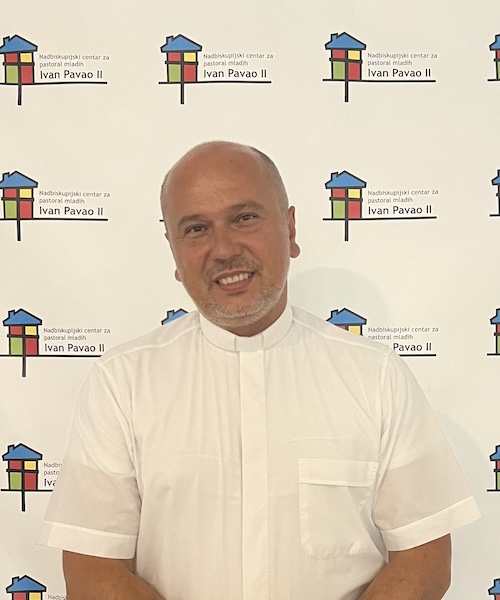
Background: As part of the Education and Social Justice Project, undergraduate student Julianne Meneses (C’25) interviewed Reverend Šimo Maršić, head of the John Paul II Youth Center in Sarajevo, Bosnia and Herzegovina on June 22, 2024.
Can you tell me a little bit about yourself and your background?
OK, I am Šimo Marśić and the head of this youth center. I started with this idea 20 years ago, and I am also teaching practical theology at our Faculty of Theology at the University of Sarajevo. At the same time, I am, on the level of our archdiocese, responsible for the youth ministry, youth work, and here with the cooperators. We are developing different programs and projects for young people because we want, with this house, with this building, to emphasize that young people are the future of this country and of the [Catholic] Church. We want to be with them and to accompany them in their life, to become responsible persons in their families, in their communities, and in their village.
Can you tell me a little bit more about the process of the creation of Vision is Decision?
OK, we started it, I think, already 6–7 years ago, like that. I remember we were at the seminar together with the young people and with the leaders of the youth ministry in Germany, in one of our partner dioceses, which is close to Frankfurt in Germany, and we spoke about different challenges that we have for the young people. And then, we somehow agreed that there is a need that we work, that we give our contribution. I would say that in the developing of democracy—as well here as also in Germany—there is also a tendency in all of Europe now that the young people are not going to vote and not going to be part of the political system. And so, because they don't believe in it, or they don't see it as very effective, and so on.
At the same time, here in our country, we are in the transition process still, because maybe that transition process from the communist regime to the democratic government should have finished before. But we had a war, and the war really, somehow, took our energy and took a lot of lives. You know that, also. But, and we—I would think that we still need to go through this transition from one system, the communist system, to the democratic system. And what is with the young generations is that they have their parents who do not sometimes believe in the system because they were living in the communist system.
And we now have to, I think, give our contribution to encourage young people to be part of the political system, of the democracy, and to believe that it is possible—that we can really, each of us, give our contribution to a better future. And that's the process. It's not something that is coming easily because we are still in this transition period. Still, there are some politicians who are coming from this period of the communist era who are running different things, and they’re running, sometimes, in the same way they were running during the communist regime. And now, we need the young people to enter into this system and change it from inside.
And we are giving our contribution, in that sense, through our project, and that's something that you are speaking with Zaklina about. And we are learning some processes and young people who are really encouraged to be part of the change.
In your own words, what does democracy mean to you?
When I say "democracy," that means that the people of our country have the chance to make a better future. That's the simplest way I would describe it. There is a system—a democratic system—that can allow, or is allowing, the people to feel like a part of what is happening in the country. With their vote, with different actions they are doing, and so on. And I think that that's the process we still have to work on, because the people still do not believe that it is possible.
I know you mentioned before that the parents of these children, some of them are still stuck in, like, the communist regime and era. What other generational differences do you see in regards to attitudes and beliefs in democracy?
I think that the older people do not—what I said—do not believe that the change is possible because they were witnessing throughout the communist era that there is no change, and that it is not possible. And we have to encourage the young people that they can be this change. And we are giving our contribution with this project, this program that we have. It's not big, you know, it's small, but I do believe in small steps in changing the mentality. You know, the mentality of the young, of the people here in our country—or, I would say, in all former communist countries—is still a mentality that was built up throughout the era of communism, in the sense that somebody else had to bring us a better future. Because during the communist era, there was always this idea of a government who is going to take care of us.
We have to reverse this mentality. It's not the government, it's not the politicians who are going to save us or bring us a better future, but we are those who can do it. So, this transition is a process.
And what role do religious institutions, such as the center here, play in that transition that you're talking about?
I think the education—that's what we can give. That's what we can give, together with the experts, with the professionals on the political side and professional side. I can say that now, what I’m saying, and I think that we as a faith organization, we have to go and find in our religion the foundation for it. Because why would we do that? Because we want to give our contribution, so that people feel free, and that they feel the freedom—they can express themselves, they can be part of the political system. And that we encourage them to be self-confident, that they can do the change. That they are the change.
So, I think that with that, we are encouraging in them also something that is good—that they can find strength in their belief in doing so. And I know that it is not a big thing that we can do, but as I said already, with the small steps, with this education in the new generations, I know that some of those young people who went through our programs are politically active already—very active—and they found the strength here to enter into this world, you know, of, really, political life. Which is not something that we would now say to young people: "Go to this political party." That’s something we are not interested in. We are only interested in encouraging the young people to be the change they want to see.
Yeah. So, instilling them, instilling in them, like, to take initiative in their lives. How would you say the education provided here differs from education provided in the traditional school systems here?
I don't know really what the education there is, but it's our contribution to it, I will say. And I think that, for our people here—when I say our people, I mean all the young people here in this country—once they see that the religious institutions are doing this, they still have a big trust in the religious institutions. If the religious institution is encouraging them to do something that is good for them and for society, maybe they are going to be a little bit more encouraged by it. You know, they would find more strength to do their own initiatives, because they believe in religious institutions.
There are some statistics that say people here in our country still have trust in religious leaders. And if religious leaders are doing something like that, maybe they are going to find the strength to really go in that direction.
So, it really is just kind of setting a good example for the children to follow.
Yeah, yeah, it's not really that we are here in this institution, and we have only this project. It's one initiative in the youth center, and I think it's very important at this point in time. Maybe in the future, it's not going to be important, but right now, we want, as the Catholic Church, to give this contribution to this society—to the society.
What are the connections between Catholic values and democracy?
All. I think is that the Christian—Christian belief—is in accordance, or that democracy is in accordance with what we as Christians are promoting: that everyone has the freedom to express themselves and to be part of the political system, and so on. I think that's something that is reflected in our Christian belief.
So, they go hand in hand. Can you tell me what is your favorite thing about the center?
About the center? My favorite thing is when I see the young people who are happy here, who have a good experience of the time spent here, who want to come back and then share the stories from what they experienced here. That’s something that always—when I see their faces, see they are smiling, they’re, you know, happy—that’s what we are trying always to do: to have those kinds of programs where they can really have a good experience, which is going to help them in their life, in the sense of becoming responsible persons, whatever they’re doing, wherever they go.
And during the time, I saw so many young people who, thanks to the experience in the youth center, really grew into very, very self-confident persons and who are really happy, or who are really thankful for this experience—writing me letters or sending me emails about how the time here really helped them in their growth, in their, you know, taking responsibilities, and so on.
Do you have a specific example of a past participant or student?
Yes, probably. Just recently I saw one lady—she's already married—and I hadn’t seen her for the last 10 years. She was studying here in Sarajevo, where she finished her studies, got married, and now has a good job. She said that time flies really fast and that she hadn’t been coming here, but she always remembers, and it really helped her—with her studies and with her life. That experience she had here meant everything.
So, I remember when I saw her that I had had a lot of talks with her personally, and that she was very active in our different programs here. And then, all of a sudden, she disappeared. And now, she came back—10 years later—and she said that this period of time was very important for her and that she is very thankful for the time she could spend here.
Yeah, it seems like the experiences that people have—you really last a lifetime and stay with them.
Yeah, yeah. And we don’t know. I strongly believe that once we create the space—where, I would say, as a Catholic place—where the young people are feeling accepted, where they are feeling love, where they feel at home, where we create—in theological language, if I would say that—in theological language, where there is the Holy Spirit working among us, or where we have a good atmosphere, that’s something that is secular language.
Yeah. Then, I think, if they are open also to learn something, to have the experience, I strongly believe that God is working in those persons. And that doesn’t mean that God is not working in other persons. But if they are opening themselves to the good in themselves, then the good is flourishing—they are living fully. And that’s what I wish for all the young people who are coming here: to live their life fully and to be really happy.
Because I strongly believe that this is what God is wishing for them, also, and we have to provide them the experience that can support them to really make something beautiful of their life and to become the best version of themselves. That’s something that, recently—and that’s what we are trying to do—to encourage them, to develop their talents and abilities, and to be the best version of themselves. Because we know that with our choices, we go in this direction or that direction. We have to carry them to go in the direction where they have a really beautiful life.
Yeah. Yeah, and that belief in seeing the potential in everyone, it really reflects the community here, especially people coming from not even just, like, a Catholic background, but Muslim, Christian, Orthodox. Yeah. So, really uplifting that good in them.
Yeah, and that’s what I said. Now, it doesn’t matter what religion they are. Sometimes, they don’t even know that I’m a Catholic priest at all. They discover that when they see me at Mass. But that’s not really important. I think what’s important is to have a place where they can have this experience, that uplifts their spirit and helps them really become the best versions of themselves.
What are your hopes or vision for the future of Vision is Decision here at the program?
I hope that we can really contribute with this program, with the small steps, to build democracy in our country. That’s it—that we can give this contribution to this program so that the young people are really encouraged to be part of the change and to be the change they want to see in our society.
What other types of projects do you want to see implemented in contributing to those small steps to democracy like you said before?
I think that, I know that through this program we also have some connections with politicians—maybe a little bit more at the government level, with different levels. We do have something already, but maybe a little bit more. But not in the sense that we are promoting one party or another. And that’s very difficult in our country. So, if you ask this person, they would say, “Oh.” I think that’s something I would like to see—a little bit more connection with the local government.
OK, well, thank you so much. Yeah, we’re right at about 20 minutes—I don’t want to keep you too long. I’m just going to do a quick summary of some key points I picked up. Feel free to add whatever you think I should focus on.
But really, from my understanding of our conversation, Vision is Decision is contributing to the transition to democracy here in Bosnia and Herzegovina—where it’s the people who make the changes and lead, rather than the government or politicians speaking for them.
The program really wants to instill confidence and the ability to take initiative among the youth here. And really, the role of the center, with all its programs, is education—so that the young people who leave the program or the center afterward feel prepared to take on whatever career path or life direction they choose, in a prepared manner.
And, really, it’s about building a supportive environment for the youth to participate in. Does that sound right?
Very good, very good summary. Yeah. I would give you the best note as a professor.