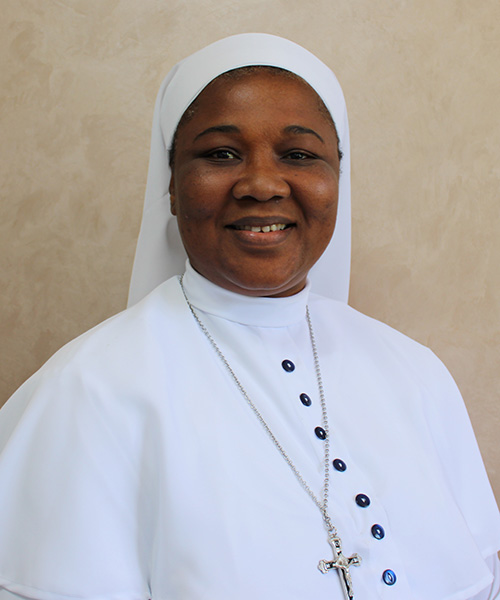
Interview with Sister Denisia Ijeoma Okonkwo, DMMM
With: Denisia Ijeoma Okonkwo Berkley Center Profile
October 5, 2026
Background: Sister Denisia joined her religious order straight out of secondary school and has spent almost 28 years as a Catholic nun. Her assignments have ranged from running a primary school in a remote part of Kogi State to serving as matron at her own former school, while she steadily earned academic qualifications. That mix of experience led her to the Cardinal Onaiyekan Foundation for Peace. She sees the Foundation’s fellowship, in which she herself took part, as one of many efforts to ease Nigeria’s serious tensions. Those efforts, she says, are like the hummingbird in the story who carried drops of water to a burning forest despite the other animals’ mockery. Only the faithful, combined small efforts of many can put out the fires of violence.
Biography: Rev. Sister Denisia Ijeoma Okonkwo, DMMM, is a member of the Daughters of Mary Mother of Mercy Congregation in Nigeria. She holds degrees in communication studies and international relations. She is a Peace Ambassador with the Cardinal Onaiyekan Foundation for Peace, where she serves as personnel officer, and she is secretary to her congregation’s Communication Department. She is committed to women’s empowerment and access to education, and is a member of the Women Faith Leaders Fellowship 2025-2026 cohort.
Tell me how you came to be where you are now: where you were born, your family, why you became a sister.
I was born in Owerri, the capital of Imo State, but I grew up in Umuahia, in Abia State. My late father was a policeman, and civil servants are subject to transfer, so the family moved. I did my primary education at St. Stephen’s Primary School in Umuahia, from primary one to six. The school had originally belonged to the Anglican church, but the Abia State Government had taken it over before I enrolled.
I am the fourth child but the first daughter, with three brothers ahead of me. So you can imagine what it was like growing up under three boys!
My mother is a dedicated Catholic and a businesswoman. She is very religious.
What do you mean by “very religious”?
She is devoted to church activities and moral life. Most of her children attended public schools for primary education, but she sent all three of her daughters to mission boarding schools for secondary.
In 1991 she enrolled me at Our Saviour Girls’ Secondary School in Elele, Rivers State, owned by Rev. Fr. Prof. Emmanuel Edeh, a man known for his good works and his simplicity. But the fees were high, and after my junior WAEC my mother could no longer afford them. She moved me back to Abia State, to another private mission school, run by the sisters of the very congregation I later joined. You see the connection?
Yes! Can you clarify the different kinds of Catholic schools?
There are Catholic secondary schools that admit non-Catholics, but a juniorate is different. It is a school where young girls who may want to become sisters are formed, and it admits only Catholic girls. The late Bishop Anthony Nwedo founded it to help train girls who might want to become religious sisters. The school my mother moved me to was the Bishop Anthony Nwedo Juniorate. I started in SS1 and completed my SSCE there in 1996.
Because the sisters ran the school, I saw them every day: how they lived, how they came to chapel to pray, how they taught us, and how they disciplined us when we went astray. I watched, and I said to myself, “I would like to be a reverend sister.” Their lives and their commitment inspired me.
I joined the convent in 1997, straight after my WAEC. I was very young. The first stage of formation is called aspirancy, and then I went on to the novitiate. In 2000, I made my first religious profession with the other sisters of my set, publicly taking the vows of obedience, chastity, and poverty.
One interesting thing: of all my classmates who entered the congregation with me, I am the only one who remains.
What did you do next?
My first assignment, as a very young sister, was to Sheria, a remote rural community in Kogi State. There were no flights, no paved roads, many bad roads, no electricity, and no power poles. Two newly professed sisters were sent there, and a senior sister accompanied us all the way from Umuahia. I thought, “Wow!” The congregation ran a primary school there, and I was sent as the bursar, in charge of finances: collecting school fees, buying supplies, paying teachers, and so on. I had only my WAEC, and I was still young.
The new headmistress was supposed to arrive and take over from the outgoing one, but she was delayed, and the outgoing headmistress had to leave for her new post. The Mother General instructed her to hand the school over to me, a newly professed sister with only a WAEC! I had to take a breath and say yes. I could do it because my mother had raised us to be independent, strong, and confident.
So I became headmistress for a term, while also serving as bursar. With a little pride, I can say I did it well. Nobody was there to guide or assist me. We expected the new headmistress in two or three weeks, but she did not arrive until late December. I simply had to do it, and I did, for a full term. Then I went back to being bursar, and stayed for three years.
I was then transferred to the juniorate where I had been a student, this time as matron. I thought, “What? My alma mater?” And the sister who had been my principal was still the principal. How was I going to blend in? I would be living in the same house, eating at the same table, and praying in the same chapel as my old principal. The sister who had taught me food and nutrition was also in the community. I wondered whether they would still see me as a student. I had many doubts, but there was no going back. That is missionary life: you obey.
When I arrived, the hostel, refectory, and classrooms were all the same. In the students I saw myself. Having been a student there only helped, though. As matron, I was in charge of every aspect of the students’ lives: making sure they were in chapel, in the refectory for breakfast, lunch, and supper, in class for reading and prep, and at assembly on time. I reported to the principal, who did not interact directly with the students. I knew what students get up to, the mischief and the lies. (Not that I ever lied as a student, I smile.) And I knew how the sisters used to catch us!
It was the most difficult assignment of my religious life. It was tedious, and sometimes I was afraid or uncomfortable, still seeing myself as a student whenever I met the principal. I couldn’t rely fully on the prefects, who sometimes behaved like the other students, so I had to check everything myself. I ate breakfast at 10:00 or 11:00, lunch between 3:00 and 4:00, and supper at 9:00 or 10:00 at night. I developed a serious ulcer and became very ill. I kept snacks in my office to eat now and then before going to the convent, which helped a little. But with courage and confidence, I managed to do my best.
What happened after the juniorate?
I had many assignments in primary and secondary schools, mostly as bursar. In my congregation the bursar is in charge of everything to do with finance, and I have served in that role in most of our schools.
And your own education?
In 2011, I was admitted to study for my degree. In my congregation you wait your turn. You cannot jump the line, but when the time comes, the congregation trains you. I studied Mass Communication at the Catholic Institute of West Africa in Port Harcourt from 2011 to 2016. Afterward I was posted back to our schools as bursar and primary school teacher.
Later I was admitted for a master’s in International Relations at Godfrey Okoye University in Enugu State. At the time I was assigned to Kotonkarfe, a rural Muslim community in Kogi State, as bursar. When the admission came, the Mother General told me there was no money for my fees, because many young sisters were waiting for their degrees and the congregation had to pay for them first. Godfrey Okoye is a private university, and private universities in Nigeria are expensive. I asked whether I could go if I found a sponsor, and she agreed. I found one, but the congregation requires that a sponsor support two sisters, not just one, so that sisters without a sponsor are not left behind. I understood the reason, but you cannot set conditions on someone’s charitable gift, and my sponsor said he could not support two sisters.
I had to find another way, and I did. I graduated in 2022 with a master’s in International Relations. I went to our headquarters in Umuahia to report to the Mother General, as we do after graduating, so that we can be posted somewhere suitable. That was a challenge, because most of the congregation’s work is in schools, hospitals, orphanages, homes for the destitute, and pastoral work. My field, international relations, was different. I asked the Mother General for permission to look for work outside the congregation, and she approved.
How did you go about that?
While at Godfrey Okoye I had applied to the Cardinal Onaiyekan Foundation fellowship and was accepted. I attended both sessions, one of them in Abuja. When I began looking for a job, I spread my CV everywhere: universities, government, anywhere. Two sisters were working at the Foundation then, and Sister Agatha advised me to approach Veritas University, the Catholic university in Abuja. I met the Vice-Chancellor, Rev. Fr. Prof. Hyacinth Ichoku, and told him I was looking for work. He told me to get a PhD. I answered that I couldn’t do that without income, which teaching would provide. But Veritas hired only people with PhDs.
I lost my zeal and just kept praying, looking to God. Then one day Sister Agatha Chikelue, the Executive Director of the Cardinal Onaiyekan Foundation for Peace, called and asked me to bring my CV. I didn’t know that the sister working with her had been transferred. I replaced her as personnel officer in 2022, though the Mother General may relocate me at any time.
Can you tell me about your congregation?
The Daughters of Mary, Mother of Mercy was founded in 1961 by an indigenous bishop, the Right Reverend Dr. Anthony Gogo Nwedo, CSSp, who died in 2000. Our charism is bearing witness to the mercy of God. Our founder believed that “catching them young” would make a difference, so we have more than 100 schools in Nigeria, primary and secondary. We also have 50 to 60 hospitals, and many of our sisters are doctors and nurses. We run pastoral ministries, teaching catechism in parishes, and sacramental bookshops selling rosaries, Bibles, and other religious items. We have bakeries producing communion hosts in Abuja (at Nyanya, managed by one of our sisters), Calabar, Ibadan, and Abia State. We have over 900 sisters, serving in Nigeria and also in the US, Germany, Italy, Canada, Ghana, Belgium, and elsewhere. Our headquarters is in Umuahia, Abia State, where I grew up.
Is it one of the largest congregations in Nigeria?
Yes, yes, yes. Our late Mother Mary Paul Ofia professed many sisters at once, sometimes 60 or 100. In Africa we are not very good at family planning, so many young girls came to us! In the past six years the numbers have fallen, and we now profess five, three, six, seven, rarely ten.
What is your role at the Foundation?
The Foundation has just marked 15 years. For years we rented space, but with rising rents we decided to have our own building, and we moved into it this past June. If you visit our small office and see how few staff we have, you will wonder whether these are really the people doing work seen all over the world. With a handful of staff, we carry out inter-religious work everywhere. The Foundation is large in its structure, its scholarship, and its work: inter-religious dialogue, conflict transformation, and mediation.
Our founder, His Eminence John Cardinal Onaiyekan, has long been committed to peace. Nigeria has endured a great deal of tragedy, even before he founded the Foundation, and he has always worked for dialogue between Christians and Muslims. You only have to search his name to see that. After he retired as Archbishop, he established the Foundation as a registered organization.
It is big because it has gone international, and people from outside Nigeria now apply to our programs. But in the modern world you have to raise grants, and funding is shaky now. So far, so good.
As personnel officer I serve as the human resources person. I coordinate the staff, look after their wellbeing, and act as the link between staff and management, including raising matters like salary increases. Good relationships between staff and management matter a great deal. I also advertise vacancies. I don’t work in isolation, so I need to understand what is going on in each area, and colleagues help me with that. Our management insists that staff work as a community, not in silos. If I knew only personnel work, I would have no idea what the monitoring and evaluation officer or the program officer does. Knowing how an NGO works also helps staff grow, so that if they move on to another organization they are not timid. I know that I will leave one day, too.
How are you involved in the Foundation’s work beyond personnel management?
Our work is mediation and conflict transformation. We meet Muslims and Christians every day, and the interactions are far from easy. You need to be mature and well equipped. Even in our fellowship, we have to understand each other better, because there are sometimes small, healthy misunderstandings, even among people who have come to learn about peace. You have to be wise and mature and understand where these attitudes come from. It isn’t easy to bring the two religions together. I have been here close to four years, and we are building common ground, but it takes time and effort. We are also into empowerment, because every fellow will have work to do after graduating.
What do the fellows do?
We work for sustainable peace for development. Fellows, who include Christians, Muslims, and sisters, receive a seed grant for a project. Every project must have both Christians and Muslims as beneficiaries, because the Foundation is about inter-religious dialogue and peace. That is essential to building on common ground.
None of this is easy. There are still problems and still killings. We cannot accept that, and we work for change, though some of it is small. We are just a hummingbird, doing what we can. If you open the news, you hear of killings in Nigeria. But we live here, and we cannot give up. We know we are making a difference. If every organization can be a hummingbird, bringing a little water to quench the fires, we will see results. Muslim NGOs can talk to their imams. Tell them, “Please, we are one; there should be no killing.” The people who kill have imams, and they go to mosques and have leaders. Sometimes it seems you should give up and say, “What is the point? Why am I going to the office every day, writing grant proposals for fellowships, when there is still killing in the North?”
But at the Cardinal Onaiyekan Foundation, we are the hummingbirds, doing small things, going to the river for water to quench the fire. In the story, the other animals laughed at the little bird: “What can you do with a pinch of water?” The bird replied: “Instead of laughing at me, bring your own pan. If I bring water, and you bring water, we can quench this fire.” As far as I’m concerned, we are one of the hummingbirds in Nigeria, doing our best to bring peace.
How many fellows are there? Your hummingbirds!
More than 200 have graduated. We now also have fellows from outside Nigeria: Ghana, Cameroon, Niger, Ethiopia, Uganda, the Central African Republic, Somalia, Côte d’Ivoire, and others. The current cohort has finished its first segment, and the second runs from late November into December.
Tell me about your capstone project under the Women Faith Leaders Fellowship. How is it going, and what do you hope to achieve?
It is going well. The project is called “Building Skills for a Brighter Future through Empowerment.” In Kabusa, a rural community here in Abuja, I am working with young girls who have finished secondary school but cannot afford university. I came from a family that struggled. I know how hard my mother worked to take care of us after my father died. She was a businesswoman, and she worked especially hard for us girls, knowing that if you don’t educate a girl child, anything can happen to her.
Breaking the cycle of poverty takes one person at a time. If a girl is not educated or equipped with a skill, a reasonably well-off man will not come to marry her. A poor man will marry a poor woman, and nobody breaks the cycle. But if a young woman is equipped, through academics or skills, and is independent, a man of average means will say, “Wow, I’ll marry this woman, and she won’t be a liability.” That is how you help break the cycle of poverty in a family and a community.
The girls are still in training. Some are learning to sew, others to bake pastries. I have visited five or six times to monitor their progress, and I don’t announce my visits. If they aren’t at their shop, I ask their mothers or others. I want the training to be thorough before we buy equipment, so that it isn’t wasted. Training takes time. Then we will buy sewing machines for some, so that people can bring their own material to be sewn, and equipment for the bakers to make cakes, pastries, and wedding and birthday cakes. When they are paid, they can take care of themselves.
Most of these girls had been doing harsh work, like cleaning, for 20,000 naira, which in Nigeria is almost nothing, not even enough to do your hair. A girl has to look good. Some have lost their fathers, and their mothers cannot support them. If they aren’t careful, they can fall victim to bad men, or their mothers may give them into early marriage out of hardship, perhaps to a poor man who cannot support them, and the cycle of poverty continues. But when these girls are equipped, they are independent and self-confident and can do things without asking a man for help. Many men are not sincere: before they give you anything, they want to take advantage of you, which leads to disease or unwanted pregnancy.
The girls are doing their best. Recently they sent me pictures of cakes and other things they made themselves, and I was impressed.
Thank you, so much, and best wishes, for the program and the Foundation!