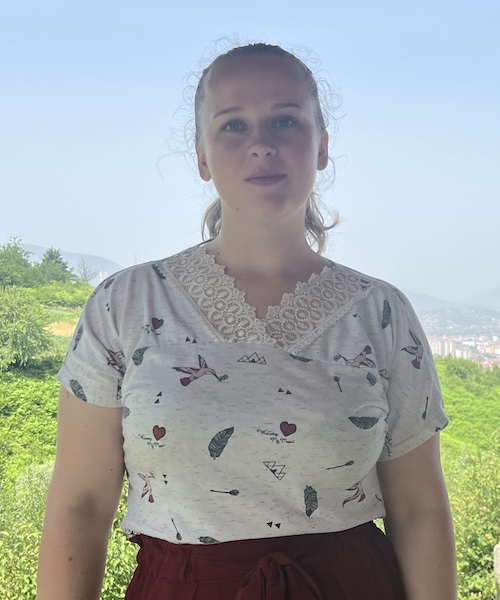
As part of the Education and Social Justice Project, undergraduate student Julianne Meneses (C’25) interviewed Zaklina Brnadić, project coordinator for the Vision is Decision Project on June 19, 2024 at the John Paul II Youth Pastoral Center in Sarajevo, Bosnia and Herzegovina.
So, to start, can you just tell me a little bit about yourself and your background?
So, my name is Žaklina Brnadić, and I am working here in Youth Center John Paul II for the last one-and-a-half years. Before that, during my university, I was a volunteer here and a peer educator. Before my work here, I was working in the Council of Ministry of Bosnia and Herzegovina, and I finished social work. And, that's it, basically.
And how would you describe your connection to the Vision is Decision program, specifically?
First of all, I finished social work at the Faculty of Political Science, University of Sarajevo, and then, after that, after I finished my university, I started to work in government, for government. Okay, so, when I finished my university, I started to work for government, and I spent two-and-a-half years working there.
So, during my studying, and because of my work there, because of my job, I had to learn a lot about this country, about government and how this country works. So, basically, when I quit there and started working here, that project was beautiful for me because I could implement my knowledge in this program, in this project. So, basically, it was useful for me to have that knowledge because I found some connections between this program, between government, and you know, it was easier for me to adapt to that program, to approach all those people who work in government. It was easier for me to find time to visit them with kids and youth, and it was easier for me to work on that project because of my work before.
So, what made it, specifically, what made it easier for you to work on the project compared to your work in government?
Because I didn't need some kind of preparation, learning about the government and this country, how elections go and stuff like that. So, it was really useful for me because I didn't need to spend that much time learning about projects. Yeah, so, it was easier for me to continue work.
And how did you first learn about the project here?
Youth and democracy. So, when I was a student, I was part of this project. I was a member of public forums because through that project, we had five public forums during one academic year, and teachers on that forum are mostly professors from the Faculty of Political Science or Catholic faculty. So, yeah. And those topics are connected with democracy, with religion. And yeah, somehow all those topics are connected with religion and democracy—so, how one Catholic, one believer, fits in this world now, in democratic society, and things like that. So, it was really interesting for me. First of all, I was a student there. And those topics are connected with me as a social worker as well, not just as a student at the Faculty of Political Science, but as a social worker, because all those topics are...
I don't know how to say it in English very well, but all those topics are connected with today and with people who live today. So, you can see how that topic represents in real life. You know, like it's easier to understand because we live now in this society. So, yeah, I liked that during my university, when I was a student. So, basically, it was easier for me. I knew about this project from before, and yeah, somehow my work experience—everything—everything is like a puzzle for me.
So, now I have a bigger picture to work on this. And because I know the situation in Bosnia and Herzegovina, during my work there, I needed to, you know, every day I needed to check what is going on in the country, who said what, and, you know, their relationships, and stuff like that. So, it's easier for me to understand them and how they think. And somehow, I developed that critical opinion. I don't trust them. They say something, you know, I can use some filters when you speak about news and what they're saying. So, it's easier for me because I have that knowledge from before. And now, it's not just that I was sitting and learning, learning about this country and government. I was there, and I could tell how they actually work.
Yeah. So, your experience as a student and then your work experience through social work has really prepared you to take on this project.
Yes.
Okay, perfect. So, in your own words, how would you describe democracy?
Yes, for this project. Like, democracy.
Democracy?
Yeah. Like, what does democracy mean to you?
Yeah. For me, democracy means freedom. Freedom of speech, freedom of fact, freedom of life. Freedom to travel, freedom to—like, really freedom. But at the same moment, I'm a bit afraid of democracy because democracy is not freedom for everyone. Like, we have—if you are coming from—for example, my freedom and freedom of Bosniaks here in Bosnia are not the same. We have the same rights, human rights, but I have more opportunities because I have double citizenship. I have Croatian passport and Russian passport, so I can travel freely.
So, we can do the same stuff, we can travel, but for some stuff, they need visas and things. So, basically, from my point of view, democracy is actually freedom to choose and to be chosen. And here in Bosnia, you already learn that if you are coming from Republika Srpska, you cannot be chosen in the federation. Yeah, so yeah, somehow, we are a democratic society here, but still, somehow we are breaking human rights from that point of view.
And when I was in Marseille, we spoke about those things, and I met many other people from other countries—from Syria, from Egypt. Before that, my opinion about Bosnia was that we are a terrible country, but when I heard those stories, I realized, "Okay, we are like that, but still, we manage those things, and we still live together." So, yes, and when they asked me how it all works, I mentioned that ethnicity is a problem, not religion. But then, I realized that we are breaking—I'm breaking—human rights, because Romas and majority ethnical groups here in Bosnia don’t have any rights. Even if they have Bosnian passport, and they are citizens of Bosnia and Herzegovina, they cannot be chosen for president and things like that.
So, lately, I think more about that, yeah, because I have all rights here, yeah, but my neighbor doesn't. Mm-hmm. So, yeah, I see that as maybe, maybe a topic to work on—yeah, to try to change. I find that really interesting and important.
So, it must be a difficult thing to handle, then, when you yourself feel that freedom that you're talking about, that you see connected with democracy, but not see it in other people's lived experiences in Bosnia.
We have freedom, but until one moment. For example, this I already mentioned—you cannot be chosen to be president, even if you have a great background. You are the best person in this world. Like, yeah. It doesn't matter because you are not the right person. You are not Croatian, Bosniak, or Serbian, so...
Hmm, yeah. Yeah, there's still barriers in the way.
Yeah, but I believe that, somehow, deeply in my heart, I'm not connected with—I don't feel deeply connected with any of those groups like Croatians, Bosniaks, or Serbians. But I feel that, from my point of view, I just need—I need one president. One president is enough for me, and I can trust this person, you know. He’s paid to do good things for me. You know, I believe that a Bosniak can lead. I believe that a Serbian can lead this country as good as a Croatian can. So, from my point of view, who is president doesn't matter. What matters for me is peace and human rights. So, yeah.
Yeah. So, from my understanding, it's not so much about their background, just what they can do for the people, yeah.
Yes, how they can lead us and how we can represent ourselves globally. Because when we say that we have three presidents—like, what? It's confusing. But then, you have to explain that the only way to bring peace in this country was that Dayton Agreement. And in that Dayton Agreement, there is mentioned that "blah, blah, blah, blah." You can read all about those things. But still, still, I'm not sure that any of our presidents knows.
You know, like, when they speak about law and rules, I don't know—I don't know how one person can know all about that, because we are so divided. Municipalities, cantons, and, you know, federation, top government—we are so divided. So, I'm not sure who can explain everything.
Yeah, you're talking about how complicated the systems are here. What are, like, the common misconceptions about politics, government, democracy here in Bosnia?
Can you explain more?
What are some—in general society—like, what do you think are some common misunderstandings of how the government functions in the country?
You're asking me how those three groups see how government works or—
Yeah. Yeah, just...Like, what do you think are like common misconceptions?
OK. Yeah, I'm not sure, but every time when we have one topic to work on, there is always one side who doesn't agree about that. Yeah. Last thing was the resolution about genocide. So, you know, like...
So, last thing was that resolution about genocide and—it's a big deal. Because of course, one side doesn't want to hear about that. Even if in that resolution it's never written that they call—I will try to translate—but they call that [in local language]. It means genocide nation. That is not written in that resolution, but they call—Serbians call themselves, like, "we are not genocide nation." And, you know, like, when you hear that for yourself, if you are part of a group, you will feel terrible. But it's not written anywhere. I read that resolution, and it's like—it's not. It is about Srebrenica, but it doesn't mention Serbians in that bad way, you know? Like, they blame individual person, not group.
Mm-hmm. Yeah, yeah.
But you know, like, politicians and things manipulate with that. So, they try to have more influence on people. So, not just Serbians that they manipulate with that—even Bosniaks and Croatians manipulate with that. So, one of the primary groups who represent that resolution are Croatians. So, like, they vote first for that resolution, and second is—you know, like, Bosniaks are there. But also Bosniaks use that resolution to manipulate Bosniaks. You see, "We are victims here; now we have rights," and things like that. There is no place for peace during that—even if that resolution is a good thing.
Yeah, so it's really good to know that genocide—now we have, like, globally, International Genocide Day for Srebrenica and things like that. We need to respect all victims. It doesn't matter which side that victim belongs to. But you know, it's hard to be smart. And to—you need to... I don't know. Be patient. Mm-hmm. And read a lot. Learn a lot. Yeah. If you read just title or in newspaper, you will hate someone, but if you actually read the resolution, you will get a bigger picture.
But I'm not sure how many people in Bosnia and Herzegovina actually read. So, yeah, that's the problem. We need to research and read about those things. It's just one example—and many of them.
[light laughter]
So that patience that you're talking about—rather than finding your own news articles or sources to form your own opinions—a lot of people rely on politicians within their own party to guide their opinions.
It's easier to say, "Yeah, he said that. He is God. He is..." I don't know. Some people here in Bosnia and Herzegovina see their leaders as gods, idols, and things like that. And because of war and everything, they see that politician as a leader. And I'm not sure what, but I'm not sure how many of them actually read anything else—how many of them try to see the bigger picture and try to understand the other side.
Because I can mention one example from Serbia during that bringing of the resolution, with Aleksandar Vučić, president of Serbia. Where—in, I don't know which city, maybe New York? I'm not sure. Don't—I'm not sure. And they made one interview on the street, and one old man said that Aleksandar Vučić is fighting for their rights.
Like, what is right there? Like, if you are right, then all those people who died are not right. So, what is true?
Yeah.
It's okay. I see Germany after World Second War, they said, "Okay, we did it. You can blame us." They paid a huge amount of money to other countries, and look where Germany is now. Germany is a really powerful country. Yeah. So, imagine what we could be. Maybe, we won't be as powerful as Germany, but if we put all cards on the table... I think the problem is bigger because we still have some traumas from World Second War. And if you go deeper and deeper, you still have traumas from the Ottoman Empire.
It's just like one circle of violence, of wars. And you have people here who are born in—I don't know—one country, and died in another country. You know, like, mostly, if you see a person older than 35 here, it means that person was born in a country that now doesn't exist. Yeah. So, yeah, you have—yeah, many cultures are here, and yeah, many, many things. So, it's hard, especially to understand, if you don't have one history. And now, right now, you have three of them.
Which side is right? So, we should find one middle way. And when you compare our books from primary school, high school—history books—you will see that they don't tell the same things. Like, you are a kid, you are—I don't know—fifth grade, you have history, and kids from your school, who belong to another ethnic group, have a different book of history, and you two are learning the same thing, but totally different.
Yeah, yeah.
And it's like—what is going on? Who said that that history is right? So, yeah, that's also democracy.
Yeah. Yeah. So, there's just a lot of places in society where divisions are created. Yeah.
Yeah, and many, many persons here actually, who don't want to hate, who want to live freely in freedom—they think that Tito and communism are the best way to live on. So, yeah, you still have some kind of idea of Yugoslavia, even between youths. Which is strange—they aren't born in that period of time, but that idea about united Yugoslavia and people here, deeply in some hearts, is still alive.
Yeah, yeah. Hmm. Yeah.
So, you mentioned a lot of challenges of a unification within the country—whether that be political propaganda from politicians or differences in education. What other biggest challenge do you see to creating full democracy?
Challenges. So, yeah, we mentioned politicians, and yeah—corruption is deeply connected with politicians. So, if you see that there is some kind of scandal, in my opinion, I think that behind that is something bigger. But not bigger like terrible for us—it's bigger for them. That they can—you know—that they can take a huge amount of money for themselves.
Because now, we are fighting about—that resolution. So, maybe, maybe, you know—we are fighting about that resolution, so our mind and our eyes are all on that resolution. But from other side, there is some other topic written with small letters in the news, like it doesn't exist. That maybe MMF [IMF] gave us some money, or, you know, like, we can use that situation to get some money from the side.
Yeah, so yeah—corruption is a huge problem. And I see that if you want to be part of the European Union, we need to adjust our laws and stuff, you know, to be good, to be right. And what happened in Croatia after that—maybe I mentioned to you or not—but after they started that process of becoming a member of European Union, [Ivo] Sanader, who was like—I don't know how to translate, but he was like top head in Parliament—yeah, he ended up in jail.
Yeah. And so, basically, we want to be part of European Union, but still, if we become members, that means directly that many of them will end up in jail. Yeah. So, I see that as the best thing ever that can happen here. But they're trying to sabotage, yeah—and things like that.
And we have huge influence of Russia and other countries—Russia, Turkey, Germany, I don't know, European Union, I can say it like that—America as well, European Union. And you’ll see that three powerful—I don't know, can I say, countries for European Union and America, too—they are fighting for us through us, even if they have nothing from us. You know, if the European Union let us go, it means that Russia will have bigger influence here, and we’ll be under—not under Russia or Turkey—but they will have more influence here, yeah. Which is not good.
And if you see through history, every war, every—I don't know who—if he wants to go to Europe, he goes to Bosnia. Every empire goes through Bosnia. Yeah, so we are—I don't know—geography, our position, our geographical position of us is like that. You know, everyone who wants to go in Europe should go.
Now, we have problem with immigration, with immigrants who want to go to Europe, and they all end up here in Bosnia. So, it was also a big problem for us. Now we have less of them, but still we have a huge amount of immigrants here. They don't want to stay here in Bosnia—they want to leave, to go to London, Germany, Canada—I'm not sure—anywhere else, except Bosnia. So, yeah.
And problem about democracy is school—education. We have different systems. Me, in my high school, I learned on—like—we had, we still have, but we had Croatian system. And yeah, I didn't learn that much about Bosnia. Like real Bosnia. About this country, I know many facts about Croatia—so because it's Croatian system.
So, yeah, it was—when I grew up, I realized that I know nothing about this country. So, you know, like, I didn't know the name of the highest mountain point in Bosnia. But, I know it in Croatia. And it's the same for each.
Yeah. And, also, I can mention that older people are a problem because I think after war they didn't get the right—how to say—you know, they've been in war and after that, we are done. And I think that they needed some kind of therapy, psychotherapy, to process everything—what they saw, what they heard. Many of them lost some members of family. And I think maybe, maybe some other country gave us money, and maybe, they sent some specialists in that area. But it wasn't enough to help everyone, I think. Or maybe, someone stole that money and, you know...
But, I see that there is huge drama beyond them, and yeah, because of that, I think they are afraid that it will happen again, and they are ready to fight again. It's hard to... yeah.
And, also, there are many, many other things, because we mentioned that, we spoke about that, that many young people—they want to leave Bosnia. Or they did. After they finish high school, first thing what they do is applying for a visa. Mostly it's Germany, then Sweden. Sweden—I don't know, any other European country except Bosnia. Yeah. So, now, we are dealing with one huge problem. For me, as a social worker, I can see that we live—we have—like, it's different in America, but we have—I don't know—when we want to get retired, during our working life, every month we give some amount of money for our retirement.
And earlier, like five persons worked for one—how to say—that amount of money when you get when you are retired?
I think what you're talking about—like younger generations support the older generations, yeah.
Yes, yes. It's solidarity—like principle of solidarity, we call it like that. But how you say it in English?
Yeah.
When you are retired, yeah, that amount of money. What you...
Pension fund, yeah.
Pension. Pension, like every month you get—we call [in local language]—yeah, every month, we get like salary but for retired. OK. So, now, like, predictions are that 10 persons have to work for one. Yeah. And we have huge amount—a lot of older people—than youngsters who will work for that. I think, in future, we will deal with big problems. We have to find some solution. But still, I can see that as a social worker, as someone who sees deeply, who learned how to see things deeply. But what about the rest of them?
Yeah, I don't think that our politicians have this kind of education. And that's the biggest problem. I think they don't have education—correct education. For example, you can be minister of civil rights, if you are an engineer. It doesn't matter what you finished and what is your background. If you are in party, and if you are a good person for that party, they will put you in that position. It doesn't matter if you have no idea what they are doing.
It's stupidity. It's insane, yeah, that someone who has no idea about that topic can be minister of that ministry. But it's our real life. Yeah. So, we have some expectation. But in reality, how—that it's okay? That that person cannot do that. He or she doesn't have knowledge about those topics. And, you know, when you are in position—who cares? You are like boss. Yeah. Yeah. So, yeah, that's also a problem.
You're mentioning the problems with government, with people lacking the proper qualifications to be experts, leaders in their own respective field, and also just in general, corruption throughout the country through politics. What do you see as the role of religious institutions such as the center play in politics and promoting democracy?
We did one research here in the Youth Center, and we asked youth what they think—what is the position of religious communities in peacebuilding. And they said—more than 50 of them voted that religious institutions can have an effect on society, on political people and things. So, basically, we have youth who think that we have to say something. And yeah, I think this is one way how we are reacting to their needs.
And yeah, nobody wants to say something bad to religious communities because if you do, then you’re seen as not a good person. And the second thing is that all those politicians are connected with churches or with the Islamic community—it depends which group they belong to. And they need us. So, if they need us, we need them. So, if we can have influence on them, that could be good.
But, I don't understand one thing. Every religion, if you go deeply, has some rules. It means don't steal, don't lie—I don't know—like, we have rules. And those persons are here coming into the youth center, coming into church, and they are corrupted. They’re still telling something.
I think the most terrifying thing—and I feel pity for them—is when they have some public speech and they use quotes from the Bible or Quran. It’s, like, devastating for me. That’s not a democratic society. We live in a secular country, so, there is no space for religion during your public speech.
It’s not communism. Under communism, you could choose—they wanted you to be either a member of the party or a member of a religious institution. And if you chose the religious institution, that meant you could not be a member of the party, and vice versa. But now, you have that thing that you can be a member of the church and of the party at the same time. And imagine—if you are not well educated, if you are deeply religious, and you see that that terrible person who represents you goes every Sunday to holy Mass, you think: "Okay, he’s good, he’s going to church." But it means nothing. It means, really, nothing.
You will see them—if we are celebrating, I don’t know, Saint Anthony Day or if it’s Easter or Christmas—you will see them in the biggest church, the cathedral, in the first row for the first time in your life. But on that special day, when journalists are there, they will sit in the first row. And you know, like, why I don’t like that? They’re manipulating.
But, what we are doing here is we are trying to teach youth and kids how to think critically. If that person is in charge, it means nothing. If that person tells you something, it still means nothing. If that person leads you in the direction you want to go—on the path you want to follow—it means something. You know, if your idea is the European Union, and you see that that politician actually really works for that thing, then you should vote for him—if he shares your idea.
But, still, I'm not sure. I'm not sure. You know, the problem is that it depends on where you are. Here in Sarajevo, you'll see that we are pretty much united. You see that every day during your walk through the city—you will see many differences between us, but still we are here together. But if you go into some rural area, you will see that there is still a problem, even if only one ethnicity lives there. Yeah, they think differently than me.
Yeah. And also, we work in that field—we are trying to reach those youth, and we're trying to bring them here, or we are going there. We are going with—I don’t know—we have our peer educators. And they are not all Christians—they're also Muslims and Orthodox, not just Catholics.
[interview gets interrupted]
No, no, it’s OK. I understand this is a busy time, especially with the program going.
Yeah. No, basically, yeah, we’re trying to reach them, and we’re trying to teach them. So, for example, if we are going into some rural area where only—I don’t know—Croatian people live, we’ll go with some Serbian educator or someone like that who is the same as them but different, you know, so they can see that that person is a person. Actually, we have one experience with two Serbian boys.
We connect ethnicity and religion. Yeah, two Serbian boys—they went to a rural place, and they realized that kids there had never met any Serbian. Yeah, it was a big deal for the kids because they didn’t introduce themselves. They did a workshop and the kids were surprised. It’s exciting, you know, like, everything is good—until they said their names.
Yeah, so it’s good for the kids that they saw they’re good. Yeah, they have maybe now a good example of Serbians. They’re not all bad, or something? Yeah, it’s breaking those prejudices and—like, yeah, their parents probably teach them that Serbians are bad. Yeah, yeah.
So, you kind of touched upon this before, but can you just expand more about why the Vision is Decision program was created?
It’s created for youth to develop critical opinions, to learn how to manage this world we live in. And also, it’s created because of the church. This church lives now in democracy—a democratic society. So, where is the place of the church in this society? Yeah. To answer all those questions, that’s the main reason we have it. Like, professors from the Catholic faculty come, you know, to teach students that being a member of a political party and being Catholic can go together.
Yeah.
It’s not something absurd, but if you live your religion, it means that you have to translate that into your political life. You know, every religion has rules and those rules. Moral rules, more or less, you know, like don’t kill—if you kill someone, you go to jail. Like, it’s law. Yeah, government law and religious law. But if you are a real Catholic, a real believer, if you live that way, and you are a similar politician, it means that you can, maybe, probably do—I don’t know, you can save your cheek. We say "cheek" when you mean dignity. And you are not willing to sell yourself for money, and you—I don’t know—put your people in desperation, or sadness, or steal from your people. You know, if you are a real believer, you won’t do that. You will fight against corruption. You know, it can be really successful. But our main, main point—main goal—is to teach them not to trust everyone. Yeah, and if—there is one research they did here in Bosnia, not just Bosnia, Croatia and Serbia as well—and the result, the result is the same: they don’t leave because of money, they leave because of the political situation.
So, basically—what we are talking about—this country is good to live in now. We have a lot of empty workplaces, and we don’t have someone who will work there. And now, in Croatia, you have—it’s not a problem, but it’s strange and unusual that they have workers from Nepal coming to Croatia to work seasonal jobs and stuff like that. It’s strange. It’s not usual. They’re still trying to adapt to that; they come from a different culture and they don’t know the language, but we’re used to that. We don’t have Asian people here, you know. We all can speak the same language. It doesn’t matter if you are from Serbia, Bosnia, or Croatia. We speak the same language at the end of the day. And it’s strange, but I’ve been there in Zagreb and I saw them working and stuff. They’re so nice, polite, and cool. But, it’s new.
To go back on your point about translating religious moral values to politics, why do you think religious groups are an easy group to manipulate through a politician’s perspective?
It depends. Maybe, some priests—or I will say priests—share that idea about a special topic with that politician.
Even if that’s not right, they will say during their preach some bad things, even if that is forbidden in the Catholic Church. You cannot go on the altar and preach things like that.
Yeah.
But, you will find that it can be manipulated. Yeah, they can use their position to share some ideas. Mostly, you have that in the Orthodox Church. Less in Catholic Church and Islamic communities because they are the majority, and, of course, if you have majority, then it means that you have a lot of people there, so you will easier find someone who will do that.
So, Orthodox Church and politicians in Orthodox Church have huge influence. In Catholic Church, less, but still, yeah. And, of course, if I need to leave, and if I need to change, I don't know, roof on church or something, I will sell my vote for that occasion. You will give me money. I will say something good for you. Yeah, like, you know. Yeah. In Republika Srpska, they sell votes. You know, like for 50 marks or something like that. Votes.
They sell what? Oh, oh, oh, oh, wow.
Elections. Oh, yes, if you take picture that you make circle on me, I will give you 50 marks. Wow. But if you are poor, what it means for you to vote for that person? He will give you 50 marks. Nobody else will.
Yeah. Oh.
Yeah. So, we fight against those things, but still, we are better than Serbia. Don't tell them. No, in Serbia you have huge manipulation with elections, and it's huge scandal, and, somehow, I don't know, we should be worser than them, but we are not better than them. Don't think from that way. But in Serbia, on last election, it was huge scandal. Huge. Like they changing votes if they, you know, like how to say when you do like, this like… make not valid. Yes, yes, yes. And things like that. And they have proofs.
Ohh, like they faked the votes. Ohh, Okay. Uh-huh.
That happened, but still nothing happened. Same thing can happen here in Bosnia, but mostly in Republika Srpska, not that federation is better, but it's more connected with Republika Srpska. And when we have election, there is always this problem with Republika Srpska.
Yeah, somehow. For example, last elections, president of Bosniaks is not from that Bosniak political party, which is the most powerful. We choose the person who we want. So, it's like we have some democracy here in federation, even if that person is not powerful, powerful. How you say it in English, "dark horse," like when you don't expect someone will win, and at the end, that person win. That happened in federation. So, yeah.
Oh yes. Yes, yes, yes. Yeah, yeah. Uh-huh.
That person is a Begovich. He didn't actually win. He is a leader of the most powerful Bosniak political party, and he didn't win. Yeah. So, you can see that we have democracy and we can lead that society but still have problems.
Yeah. What would you say voter participation is like in Bosnia?
We are not interested in voting, so, I don't know percents. And that's also the thing—we want to teach them to go on election because if you don't go, then it means that they can manipulate with your vote. And just go there, and, I don't know, do whatever you want. Draw heart on that paper or whatever you want. It doesn't need to vote at all. Just go there, and do something. Don't let them space to use your vote.
Hmm.
We also trying to teach them that, so it's good thing, and we're trying to teach them how to make research about concrete person. And you know what they should look when they use Google to find. It's not just that person is famous. I want to see his politic, what he want to do through that four years. I want to know what he, what is his idea for Bosnia for next four years. So, this is different than what we used to.
"OK, that person sounds nice. Cool." I don't know. "Let's vote for that person." "No, it's not. Let's see what that person can do for me."
Yeah.
Because he is there for me. Not I'm not here for him. So, just just to change opinion.
Yeah.
Yeah, I know you mentioned before that it's common for people to view politicians as like a sort of God. And so, it is just to break through that facade. What do you think is the importance of focusing on youth in this program?
Focusing on youth, they don't have any kind of knowledge. At first, some of them have democracy in high schools. I didn't. So, I'm not the only one. Some schools have it, some school doesn't have it, so I didn't have any kind of knowledge about democracy.
Yeah, yeah.
And human rights. They didn't give me space in my high school program to learn about that, so still, we have some kids and youth who doesn't know anything about that, and it's really important because we live in that society. And when you ask them, they doesn't care about politicians, they doesn't care about parties, they doesn't care. They just want to hang around. That's fine. And somehow, we put accent on that, that they are here together, making new friendships. And that's true. Yeah. But at the same moment, they learn something. They doesn't know that they're learning. Yeah. So, we bring some external educators, professors to teach them how to make research, how to find what is true, what is not, like experts in those kinds of areas. And it's cool for them. Every time after that kind of workshop, they're so excited. They didn't know about those websites, those websites cool, they're not famous. The most famous news website is Click Symbols in Herzegovina, and if you go through comments, you will see, like, I don't know how comment area is allowed. No, a lot of hatred and I know about couple of cases where police was included.
Yeah, yeah, yeah, yeah.
Because of websites, imagine, so to some journalists they get some messages and stuff like that. It depends, but it's like pro-Bosniak webs. And also, I read every day and you know, like, it's stupid website. You have everything short. They doesn't do any kind of analysis, and it doesn't matter for them if serves of that news is like writers and...
It's just there. Yeah. It's just there. Yeah.
"That person said that." And yeah, but mostly, if you want to see if something happened, just if you see that you are standing in line, in your car, in line, huge line, something happened, you probably go on that website and see immediately what happened there, car accident or something.
So, yes, we are trying our best to give them some tools, so they can use, and no matter where they are, just to think different.
Yeah.
To try to understand that this country is not that bad, okay, we live like we live.
Mm-hmm. Live, but still.
We have some good aspects. We have potential to be better, and I can imagine Bosnia and Herzegovina as normal country. We are normal, but more normal. [light laughter] Yeah, it's not... We have huge potential. Yeah, like, really we do.
Yeah.
And just, I would... Just to change political structure.
Yeah, yeah, just taking the proper steps to get to that for it. Yeah.
Yeah. For example, Milorad Dodik. We mentioned how they all change positions—now president of that, now president. Yeah. So, Dodik is a big of, which two of, which their presidents since war stopped.
So, like, for three decades? Yeah, yeah.
And what new can I hear from them? Nothing. Yeah. So, okay, your time is gone. Go, go, go somewhere. Probably, they will go in jail one day.
What specific elements about the program do you think makes it so successful?
I think that different kind of approach. First, this program is open for everyone. It doesn't matter if you are Muslim, Catholic, or Orthodox. Still, we have Sunday holy Mass and every night, we have prayer. But they can come or not, you know, like, and kids, if they are Muslim and Orthodox, they are willing to join on holy Mass. They are interested. They have interests to see how it looks, how it works. They have questions, and it's good for us, actually because...
Yeah, yeah.
We give them opportunity to know us, and we will be more accepted here. If they know us, it means that they accept us. Yeah, we have opportunity to give them good picture of us, of Catholics.
Yeah.
And yeah, sometimes I have more Muslims than Catholics. It's strange, but it's true. And I don't know. They have space here. So, through this project, they can create some activities in their schools—activities like they want to do, you know, like they can create. They can plan that activity, and we give them our knowledge. We are helping them to do that project. Small project became reality. So, we include also professors, their professors from their high school, because without professors they cannot do that.
Yeah.
So, basically, we have some humanitarian actions. We have, like, they spend one day with headmaster of school. You know, like, they can do whatever they want. We just give them free space to think and create some activities. Yeah. So, it's new for them. Strange for them. And this kind of program is not usual. Because only political parties give something like this to youth and not religious parties. So, I think we are exception, if we speak about religious institution. Mm-hmm. I don't know that Islam community or Orthodox Church have something like this. If they have, probably, we will work together. But I don't think so—that they have. And yeah, we have more from this program than they have from.
Yeah, like, sometimes, I think that we get more from this program because they are young, and it's cool between them to say that, "Okay, I was in Catholic Church. You know, like. Yeah, cool."
Yeah.
"And I remember when I was young, I was in mosque. You didn't."
Yeah, I'm experiencing something that you haven't before, yeah.
Yes, and they share that experience amongst others, and they are our ambassadors in their schools. Imagine we have five of them. You will meet them, five of them in one school from Sarajevo, and once, one boy from that group came to me crying, and I asked, "Okay, what is wrong?" And he said, "I've been in many organizations, I do many education programs and stuff. But nobody did something like this for us."
And only thing, what I did is, one of them celebrated birthday, and we bring cake.
He must have felt really, like, seen, and like...
Yeah, that's okay. But, but this is normal for us. We are here to celebrate every day together, like, okay, I stopped whole program. It doesn't matter. We, we created pop quiz. For night, we have many funny activities. It's not just about learning, learning, learning. Okay, you have school for that. But, here you are. You have free will to be, and we need to be creative to make you want to stay here. So, and we bring cake, and they all sing. Imagine group of 50 people. "Happy birthday." Just for you, yeah. Yeah, it's cool. Really cool. And they remember those moments. And I was so surprised because, you know, I thought, "Is something wrong?"
But it was a good cry.
It was a good cry, yeah.
Oh, that's really sweet.
Yeah, like they are our ambassadors in their schools. We have benefit from that. They share this experience, and sometimes, I meet someone, and when I mention where I work, that person will say, "Oh, I know where it was. I've been there once in your sports hall. My brother was there, you know, like...?"
They know about us, and also, the government is starting to recognize us. And yeah, we can apply for many, many grants and stuff like that. Our projects are big, and yeah. And maybe, one more thing is really good:
Because on this project we have some kind of routine. So, every generation, 50 of them, go through education, you know, like three weekend meetings. Yes, three weekend meetings in Democracy Academy.
So, they have enough time to know each other better and to… It's like episodes of a whole series, you know, like, for example, on one weekend meeting, the accent is on media, on another, it’s on political systems. You need to be creative to bring political systems so that it is interesting, you know. So, we create, for example, fake votes, so we make elections.
Yeah, to connect with them, yeah.
Like we say, it goes like this, this, this, this.
OK, spend half an hour listening to me, and now, we are voting. You have time to prepare your campaign. Now, you have time to share your campaign with the citizens.
One part of the group is citizens and, you know, like…
Yeah, yeah.
And we practice that, and one of the boys—you met him—he's elected for president and he's president of this generation.
Yeah.
We are trying our best to make that interesting.
To bring those topics to them, yeah, yeah.
I really see the connection you mentioned before between the balance of education and fun. Yeah. So, you're engaging with them in a meaningful way that they are interested in the topic. Yeah.
So, through that way, they actually learned.
But they don't know that they're learning.
Yes, at the end, of course, we always explain after we finish an activity. We explain for them, you did that, that, and that, and it means this and that.
Yeah, yeah, yeah, yeah.
You know.
But through all that process, they have fun.
Yeah.
Yeah, and it's really important and interesting. We also enjoy that, you know. They are fighting debates, and you, know, like, we teach them how to find some facts, how to be opposite, even if they share that idea, you know, like...Yeah, it's interesting.
I don't not enjoy this project. It’s not tough for me.
Yeah, yeah, yeah. I really enjoy it. Yeah. And I join those workshops sometimes as a participant if they need someone, if it's a working group. If I see that one group is, I don't know, shy, sometimes I join them to help them to reach their opinion and stuff like that.
Yeah, yeah.
So, yes, they always have some of us to help them, but mostly, they work alone. And yeah, we use those kinds of fun programs for them to learn.
Yeah, you shared a lot of stories with me already, but is there a particular experience that stands out to you, like maybe your favorite experience?
Can you repeat?
Do you have, like, a favorite experience from the program?
Oh, I don’t know. I don’t know which one I can choose, but…
Yeah, I don’t know. Every generation is different. This is my second generation, actually, but I don’t know, maybe I can.
Yeah, when we went to Germany for, yeah, for youth exchange because of that program project.
We went there, and that group was a group of 10, and all of them are from the same generation, and all of them are the best students in that program. Their schools chose them because of their grades and, you know, like, they’re good kids. Yeah. And after that experience, we spent seven days in Germany together. We went to Europa Park. We visited the European Parliament. We visited the European Central Bank in Frankfurt.
Mhm.
And we traveled a lot.
And after that, after we came back, I saw one picture. One girl from that group shared it. They all are together, but not with the youth center. They went on some mountain for skiing, but they were together, and they are from different cities.
So, they organized this themselves, not through the center, but... Oh. Yeah, that's really nice.
So, and I don’t know, it’s not something special.
But I’m so happy when I see that they’re still together. And you know, sometimes they send me messages: "Do you have something new at the center we can apply to, we can participate in?" So, basically, if we need participants for any kind of program, we can reach out to those groups and, you know, they are always willing to hang together. And I see that. I’m proud of that. I feel proud because we didn’t have that goal.
But now, we have that goal. They are together, and it’s really good, especially if they are not all Catholics.
I think it speaks to the strong community-building and really building, like, those lasting relationships that...Yeah.
Yeah, it's really good to see. And you see that, actually, you are the reason why they are together.
This youth center is the reason, because one girl is from Kramnik, another boy is from Zenica, a third boy is from Sarajevo. They are from different cities — when will they meet?
No, it's okay. Yeah, because, like, otherwise, if not for the center, they wouldn't have met or known each other. So, it's really special—not only did they meet each other, but enjoy each other’s company and were able to build those friendships and extend it past just from this place.
Yeah. And they joined some other programs in the religious program and, you know, like voluntary actions and other programs. So, you can see that they have initiative to work in the community and for the community. It’s not all about politics and democracy—it’s deeper. Like, okay, we are now here because of democracy. We gave you tools. And now, you want to do more.
Yeah, that’s it.
Yeah.
I know you mentioned before, like, that community-building, that relationship aspect—it was not an original goal or intention of the community, but it turned out to be something that you guys prize and love to build on. Do you have any other hopes, visions for the future of the program in the center?
Yes, I would like to have more meetings with them. No, I really like, and I really enjoy this program, and I would like to have more weekend meetings. I would like to visit more institutions with them. I would like to travel more with them. I don’t know. I would like to give them T-shirts—“Youth and Democracy”—I have that in my budget. But I would like, like, you know, I would like many things.
I would like to change something, as well: those public forums. Maybe, it’s time to change them. But maybe, it’s time to give more tools for high school students. They’re more interested in those topics than students, so maybe, we can. You know, like, I’m not alone in this project, and we have to sit, and the problem is when you have a project you have an agenda—what you have to do. And, in reality, sometimes, some things don’t work, but you have to do it.
And now, we can see that some things are working, some things less.
Yeah, but I would like to continue with this program in the future. I really would like to, and I’m willing to do my best for that occasion.
I don’t know. Every time, I learn something new.
And this last generation, they have great ideas—they want to go to the cinema.
Yeah. One group of them was from one village. They had never been to the cinema.
And why don’t we, you know? Yeah, let’s go to the cinema. We can watch some movie which is connected with democracy. Yeah, yeah. Yes. And they’re happy, they’re in the cinema, but also, they learn something.
And one girl said that she wanted to visit the archive.
And yeah, I managed that. "Okay, you want to go? Let’s go."
Yeah, you see that they want to do something, and it’s wow, yeah.
It’s not like I’m pushing them there. They want to. Yeah.
It’s so beautiful for me.
Yeah. And I would like to do more for high school students. For example, I would like to go to high schools. We can maybe do some workshops there.
And yeah, why not?
That’s my vision. Somehow, for the future, I would like to upgrade, update—yeah, to put on a new level those programs for high school students.
Yeah. So, I see this program is really student-led and like participant-led. Like, they feel very comfortable and are encouraged to share what experiences they want to do, what activities they want to do, and the center provides it for them.
Yeah, I have one example. One school sent me some of them, and in between them was one girl. She is from a not good family.
Yeah, I’m not sure what is going on in that family and it’s not… It’s—I don’t need to mess in that, but she’s happy when she’s here, and it’s really beautiful to see she found a place for herself. Yeah, and probably, she saved herself, if she stays here.
We have, like, a student dorm. We have a foundation for students and things like that, and we can help her, if she wants to continue her university after high school. And in the same group, there was one boy. He was very shy. And when we finished all of that, he was chosen to be president of that group. Yeah.
And I met with his professor, and her professor, she sent them here, and we spoke about them. And she said to me, like, "I was so surprised. I was so surprised that he managed to be more open."
He is more open now; he learns better now. And that third girl, she showed me that the most terrible teacher in that high school gave her a prize. Like, she did one presentation, and the teacher, the professor, wrote that she has better skills in presentation—she looks self-confident and things like that. And she told me, she showed me that and told me, "I didn’t have this before democracy."
So, yeah, they can build their skills here. As I mentioned, it’s not all about democracy. It’s about their public presentation of themselves. So, I always want to tell them that this is the same group.
And this is the group where we practice, yeah, where we practice our presentation skills, where we practice our speeches, where we practice how to communicate and things like that. Yeah. So, at the end of the day, they improve their skills, not just knowledge about democracy but skills. And it’s really important for them in future life. If they want to go to faculty, university, they need it.
Yeah. For their academic, professional careers. Yeah, but yeah.
Whatever they want, they can stand for themselves and fight for themselves.
Yeah, well, thank you so much for talking about the program in the center and your experiences. Those are all the questions I had on my end.
I'm just going to quickly summarize some of the key points that we talked about through our conversation, and just let me know if I missed anything important that you think it would be important for me to mention or memorize. So, starting from the beginning of our conversation, we kind of went through the political systems here and where exactly the errors in the system are, such as talking about corruption, political propaganda, the negative influences between religion and politics, which kind of set the baseline for why it's important to teach and educate the youth about democracy, and so…
And creating those critical thinking skills so that they are able to look beyond what is presented to them and build their own opinions about what should happen in their government, in their country, and their future.
And kind of unlocking a new perspective of what potential there is here in Bosnia and Herzegovina. Then, moving specifically to the program—beyond just teaching them about democracy, proper research skills, and critical thinking skills—it's also community-building and relationship-building with people of other communities, faiths, and backgrounds, so that they are more exposed to the different people here that live in this country who may be outside of their own religious or ethnic background. And then, you also mentioned just now the personal developments that they see throughout the program.
Yeah, but they can apply that to their real life, whether it's for their future academic perspectives or possibly in their careers, as well, where they feel more confident in their abilities to present themselves in the way that they want to.
So, yeah, that's kind of what I boiled our conversation down to. Is there anything that you mentioned that you think I should really keep in mind?
Nothing, just the last thing, that they get many fruits from this program, so it's really beautiful. And unfortunately, you came late—we finished the activity. But just to see them together is something beautiful. I will show you later. We can go outside. We have Democracy Alley. Yeah.
Yeah, yeah, yeah. Yes, Una mentioned that to me. Yeah, yeah, yeah.
Yes, I will show you. You can take pictures, and it’s beautiful. Every generation sees one tree, and that tree grows. And so, it’s really beautiful.
And yeah, I could maybe send you our activities and what we actually do through this project throughout one year. So, it will be useful for you.
Yeah, that would be very helpful. Yeah. So I can see the workshops, yeah.
Yeah, okay. Well, thank you so much. Yeah, that's the end of our interview. Is there anything else that you'd like to add?
Probably, something will come to my mind, but I can…
Yeah, you can always just tell me later on. Well, thank you.
I hope it was helpful for you.
Yeah. No, it was. It was really great to hear about the program from your perspective, especially as someone who's the coordinator and oversees everything and its development. So it was really, really informative and important for me.