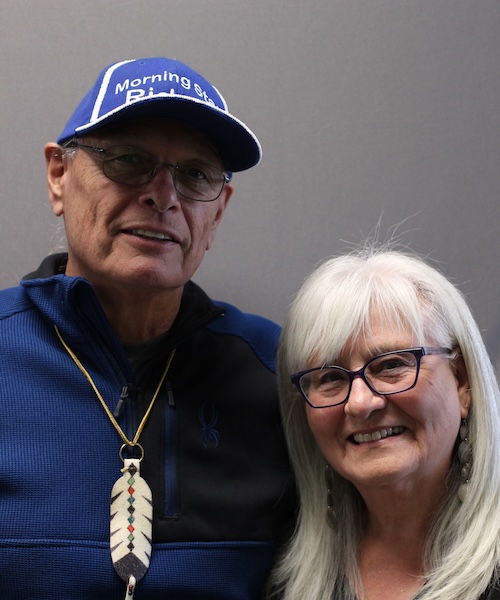
Colleagues and friends Jerilyn DeCoteau (Turtle Mountain Band of Chippewa Indians) and Rick Williams (Oglala Sioux Tribe and part Cheyenne) discuss the terms "indigenous" vis-a-vis "American Indian" and the implications regarding identity and tribal sovereignty when people self-identify as Native but are not formal members of a tribal community.
This story was produced by David Dault at Sandburg Media, LLC.
Rick Williams: My name is Rick Williams. I am a member of the Oglala Sioux Tribe. I'm also part Cheyenne. I greeted my friends and relatives today in a good way. I'm with my interview partner, Jerilyn DeCoteau, longtime colleague and friend of mine.
Jerilyn DeCoteau: So I am a retired attorney, an Indian law attorney. I'm a member of the Turtle Mountain Band of Chippewa Indians, and my tribe is in North Dakota.
Rick Williams: Over the years, the definition of who is an Indian and who isn't an Indian has always been out there, but I think there's some real key important points that we're going to try to discuss today. And it comes down to using the term indigenous. I raised that as an issue because there were people who were describing themselves as an Indigenous, and many people thought they were American Indians when they used that term—Indigenous—and they weren't.
Jerilyn DeCoteau: Indigenous means that you are connected to land from before contact, before European contact. So your roots go all the way back to that period of time. But when you're talking about American Indians, you're talking about members of Indian tribes. And tribes are political bodies. And political bodies have a territory. These things are necessary to the tribal sovereignty. You must have a territory, you must have a people, distinct territory, distinct people, and you must be recognized as such by other neighboring sovereigns in particular. So in the United States, we have Indian tribes that have a relationship with the federal government. So this distinguishes us from the broader category of Indigenous people because we're not a racial group, we're a political body. We're members of a political body. One of the recent things that happened that really made me pay attention to this topic more is the census, the 2020 census, which suddenly there's an 86% increase in the number of people who are identifying as American Indian.
And it's like, how can this be? Our birth rates aren't going up. I think they're going down. So this isn't by birth or it's not by somehow acquiring new membership in tribes, it's by self-identification. So who are all these people, who are saying that they're Native American or American Indian on the census? And I don't know if the problem is with the way the question is being presented, but it's partly because people are choosing to identify. They're self-identifying as American Indian.
Rick Williams: I was shocked to learn that the largest tribe, or the largest recognized Indian tribe, according to the census, were Aztecs. Like 390,000 Aztecs have identified themselves as American Indian. I don't want to say anything bad about Indigenous people from other countries, they have every right to claim that moniker of Indigenous because they are indigenous to their homeland, but they're not indigenous to here. I tell people, don't call me Indigenous. I'm an American Indian. I don't necessarily like that term. It's something that was put on us, but it's a legal term. And that legal standing has tremendous importance to me because I'm an enrolled member of the Oglala Sioux tribe. I have an official ID card that says that I'm in this exclusive club of enrolled American Indians. If you don't have that status and you can't be an enrolled member, you are not protected by having that tribal relationship.
Why is it important? Because our nations at one time were fully sovereign. We had control of our own lives and our own destiny. Well, one of the things that we still have control of is the tribes have the right to determine who is and who isn't a citizen of that nation. And that's what we're protecting today. And for somebody to come along and say, "Well, I'm part Indian." It's facetious. It's irresponsible and it's disrespectful because of our history.
Jerilyn DeCoteau: And those treaties are enshrined in the Constitution of the United States. So it makes you kind of wonder why do people do that? Why do they claim that they're Native American when they're not? Or they can't identify any tribal community or they can't identify any relatives that they have. Indian people are related above all. We are related to each other. We are related to the earth. We are related to every inanimate and animate object on the planet. We know that. But if you can't tell who your relatives are in a tribal community, I don't think your claim to being native can be valid. And sometimes they're not conscious of what they're doing, and I think if they understood what it meant to be a member of a tribe versus just claiming that you're Native American and wearing bead work, they would maybe stop and think.
Rick Williams: And I think that it's more so than any other time it's coming to the surface. People are feeling more guilty because they're becoming more aware. People are saying, "Well, it's a woke culture." Well, we were always awake, but we always knew what was going on. But other people are beginning to see through our eyes and listen to us and understand what we're talking about when we say, "This is who we are. And we protect that identity. We want our children to know that identity."
Jerilyn DeCoteau: Our ways are sacred. Our lives are sacred. Our tribes are sacred. And to have that diluted or that status put at risk because of some carelessness, some careless thought, some unaware thinking, some ignorance…that’s just not acceptable. People need to understand that words do matter, and people have a right to their own identity, but you don't have the right to claim someone else's identity or to make up a tribe. So it's not a minor thing. I mean, we laugh about it, but it's really, it matters. It matters.
Discover similar content through these related topics and regions.