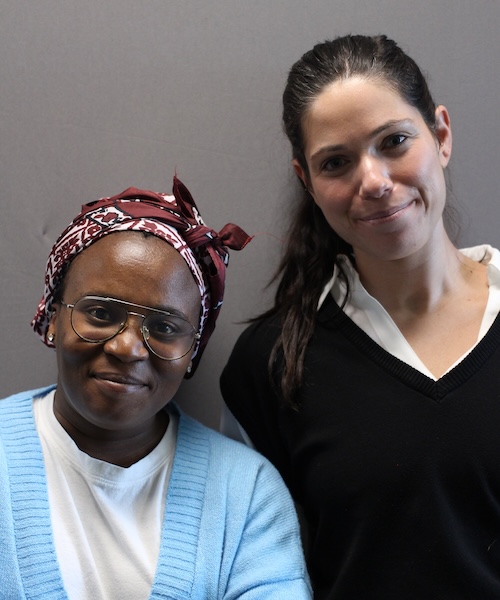
Colleagues and friends Talia Aygun and Matau Setshase discuss building spiritual connections with others, whether via negotiation with one's ancestors that generates an attitude of surrender, or via the ecstatic experience of truly understanding another person.
This story was produced by David Dault at Sandburg Media, LLC.
Matau Setshase: I've kind of been like a spiritual nomad. I was raised by my great-grandmother, Christian, but simultaneously at odd moments when no one was looking, when everything else failed, they would consult traditional healers. People we call sangomas, dingaka...
Talia Aygun: Interesting, yeah.
Matau Setshase: ... to go get answers that Christianity wasn't answering, or not Christianity, that the church wasn't answering. Then we'd have regular thanks-giving rituals and functions for the ancestors.
And then when I went to high school, I got exposed... Well, my last year of middle school, I was exposed to Islam. My school was in a Muslim neighborhood. So then I got exposed to a different culture, their conception of God, their practices. And then another neighborhood nearby was Hindu. And I think I was atheist for like five years. During that time, I was relying on my rationality and nothing else, which, of course, I'll allow, sometimes it was shaken. I think atheists tend to not account for crises of faith.
Then after that five years, and then I ventured into Buddhism, went to many retreats, meditative retreats. Didn't eat, meditated a lot. Also to say I hate meditation now, if anybody's asking me. So I have a very dense background.
Ultimately in the end, all my questions weren't answered, which were what am I doing here? Who am I? What should we do? The answers that I'd been given through various religions would answer me for that moment. And then I get to the next phase of my life, and then the answer would have to come from somewhere else. The last 10 years, the answer came from embracing my ancestors, going for the training, which was harsh, painful.
Talia Aygun: And so I'm curious about how these ancestral connections have addressed some of those things that spill over, those questions that spill over. And does any of it come from a negotiation of things like one of the most unanswerable questions, which is what comes next after life?
Matau Setshase: Right. The thing with, at least, my relationship and my encounters with my ancestors and the way I've been taught and the people of my community is a relationship with the ancestors is a constant negotiation. Not bargaining, but negotiation.
Speak to any South African, they'll tell you they're tired because the ancestors are always asking for this, they're always asking for this. They're always asking for too much. It's almost like you give with the one hand, you take with another.
Then I had to sit with that transactional and kind of a sense of, "Okay, what is this? Every time I need to do something monumental, I have to slaughter a cow? Every time I have to do this... What is this? How does this work?" Because I've had dreams, I've had visions where I've seen them. I've been in other places, and I'm like, "Okay. So then they're in an entire reality world over there. They're not chilling there, hanging out on hammocks, eating grapes and playing fluids and drums and dancing."
Talia Aygun: Yeah, exactly.
Matau Setshase: "It doesn't look like anything that I would imagine paradise is. It's an actual world with things that are being done. Teeming with people, with life. So many people, so many people." I couldn't believe it. And I'm like, "Okay. But then it means in as much as I'm asking, 'Please help me here,' they're probably saying, please help me there." So it kind of has to be, what is it that I have to do here that makes it easier for them to rest a little that side? And I suppose for them, then the situation is the same, which is, "What does our child, what does our descendant need?" So I think it requires a little bit of surrender as well. In as much as I'm a rational person and I want to negotiate and I want to understand, there are things I'm comfortable surrendering at this moment in my life. So that's why I'm like, time is probably something we have to sit with very uncomfortably.
Talia Aygun: Yes, so uncomfortably, so uncomfortably.
Matau Setshase: Do you think maybe we try too hard to be in these religious or connected modes?
Talia Aygun: Yeah.
Matau Setshase: And so because of that, there are moments when it happens just voluntarily, spontaneously, and we miss them?
Talia Aygun: Yeah, totally, totally. And we miss them because we don't have the language. And I also think... And maybe this isn't enough to call it religious, but just sometimes in the ecstatic experience of understanding another person and really feeling that briefly, it's always a glimpse, but just that incredible oneness of some type of interconnection is where... Without some higher understanding, I wouldn't be able to notice how important that moment is or just how kind of rare it is, at least in terms of day-to-day life. And there have been opportunities and experiences where I feel like that type of ecstatic connection has happened. And like I said, it's always a glimpse, and it feels, you can never get back to it, but at the same time you're like, "Wait a second, that's the glue."
Discover similar content through these related topics and regions.