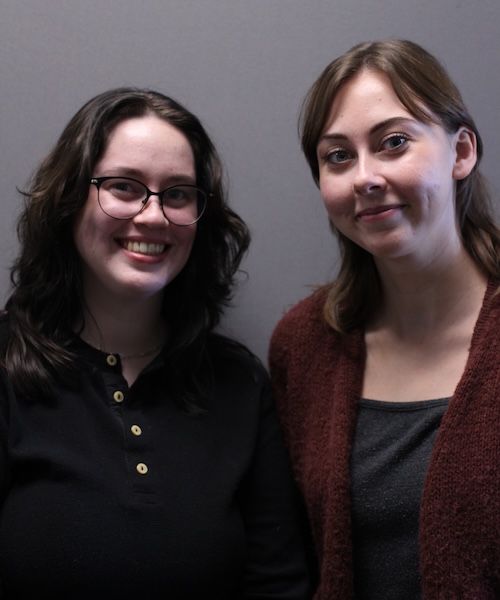
Friends and peers Emma "Scout" Wood and Amanda Mullennix talk about their paths to their religious studies academic program, exploring their academic and personal interests in the moral frameworks built by religious traditions and the ways religious and community belonging can be complicated by queer identity.
This story was produced by David Dault at Sandburg Media, LLC.
Amanda Mullennix: I accidentally placed out of a class my freshman year of college and the only available courses for an incoming freshman for me was either a religious studies course or accounting. And I wasn't about to do accounting.
Emma Wood: I had no idea about this.
Amanda Mullennix: So I ended up in a religious studies course, loved the professor, took four more of his courses, declared myself a minor because I wanted to graduate early so I wasn't willing to do the major requirement.
Emma Wood: Funny.
Amanda Mullennix: And then I really fell in love and I did...my major was anthropology…and so I did an ethnography on religion in Asheville, North Carolina where I went to undergrad. And I was like, "You know what? I really want to stick with religious studies and really explore that more." So that's really ... It was all kind of accidental. Yeah.
Emma Wood: That's really funny because same. I also only did a minor in religious studies and mine was also accidental. I was in the honors college and they made you do these interdisciplinary seminars. And so I took one that was called Sex and the Sacred and it completely changed my entire world. And then I was obsessed with the professor, same as you, and she became my undergrad mentor and I did research with her. So that's really interesting that we both fell into it.
Amanda Mullennix: Yeah. Twin flame.
Emma Wood: Twin flame. Yeah. I feel like I love religious studies because it's so much of everything. This huge intersection, I don't know if this is your opinion also, of sociology, psychology. I don't even know. It comes into gender studies. It pulls from everything. And I think that's why I enjoy it because I'm kind of pathologically curious. I don't know. What do you think?
Amanda Mullennix: No, I get that. I think the field can't be understood on its own. I think if you isolate it, you just get a really reductionist understanding of what religion is.
Emma Wood: You're such a scholar.
Amanda Mullennix: I try my best. But I think you have to take multiple approaches in order to really understand because, especially if we see religion in our country, it affects everything. It affects every...decisions that are made on day-to-day basis, your schedule, your politics, everything you do, I feel like religion can be ingrained into that if you practice and have that faith.
Emma Wood: Yeah. So many people's moral systems also, which is interesting because I don't know that I've ever connected to that…had a moral system that's specifically religiously based.
Amanda Mullennix: Interesting.
Emma Wood: What do you think?
Amanda Mullennix: I mean, both my parents are ministers-
Emma Wood: Right.
Amanda Mullennix: ...so I as entrenched in it. I didn't have a choice.
Emma Wood: That's so interesting.
Amanda Mullennix: Yeah. I don't know. I think a lot of my morals are still...I don't necessarily, I don't go to church anymore. I don't know if I'm a Christian. I'm real confused on that subject, but I still, I think, identify with a lot of the practices I was taught and how to treat other people. And I think that's definitely ingrained into me. But I think also it provided such a sense of community for me as a kid that it's hard to completely separate myself from it.
Emma Wood: Yeah. I've kind of yearned for that most of my life, I think.
Amanda Mullennix: Yeah.
Emma Wood: And I think...my mom was raised Catholic, and so for the first 13 years of my life, I went to Catholic mass, but I just never...I tried. I just never connected authentically. And that's what she would describe to me also is the sense of community and belonging that you can get from that. And I think I've just found that in other places maybe, and maybe we can talk about being queer also.
Amanda Mullennix: Yeah. Yeah. I think also there's this fear, at least for me in a very personal sense, that community is conditional when it's in the church, at least how I grew up. It was, because it's based on, you share these same beliefs. And so then you start to question those and suddenly you feel a bit isolated and insecure. And especially when you start to question your sexuality and gender like I did, it was very much a secret that was not something I felt like I could share in the church. Our church is not..well, I've been a member of many churches, but none of them were outwardly hateful or homophobic or queerphobic or transphobic, but they also weren't outwardly affirming. It felt very behind closed doors or open secret type of thing, which was always uncomfortable.
Emma Wood: Yeah, that's very stifling, I feel like.
Amanda Mullennix: Yeah.
Emma Wood: Interesting.
Amanda Mullennix: Yeah. I don't know.
Emma Wood: Yeah. My mom switched us over to an Episcopal church around the time I was 13, and my sister's 15-ish. And I think a lot of that is in accordance with what you're talking about. She had two queer children and all of a sudden the values that might've been suppressed a little bit in Catholicism were very real in her life. And so I imagine that's probably part of the switch. She's also a very liberal person. So that's interesting. I think the Episcopal church, I mean, maybe from a secular perspective, I can say it's kind of chill.
Amanda Mullennix: Yeah, no.
Emma Wood: I don't know if I'm allowed to make that assessment.
Amanda Mullennix: I mean, it's based on your personal experience.
Emma Wood: It is.
Amanda Mullennix: You're not making a broad claim for everyone's experience.
Emma Wood: Yeah. The ways in which our cultural landscape are such a breeding ground for new religions and new religious movements is so fascinating to me because that's not necessarily the case in other places. And so I think tying that back into this idea of tolerance, yeah, I think it is related to queerness. I mean, for me in my personal drive, my personal interest. What do you think? I want to know your opinion on that more than mine.
Amanda Mullennix: I think also why I caught onto that is because I think that shows up in my own research that I hope to do into queer theology within Christianity. Because I think, I mean, we've seen Christianity can be harmful to queer people and can be the basis for a lot of harm and hate. But I don't think that means…there's clearly queer people who are Christian and who identify with that and aren't ashamed of it. And so I want to explore that theology, both as a queer person who denounced my religion as soon as I was able to go to college and not have to live with my preacher parents anymore. As much as I love them, we have very different religious beliefs. So that's something from a personal angle I've always wanted to explore.
Discover similar content through these related topics and regions.