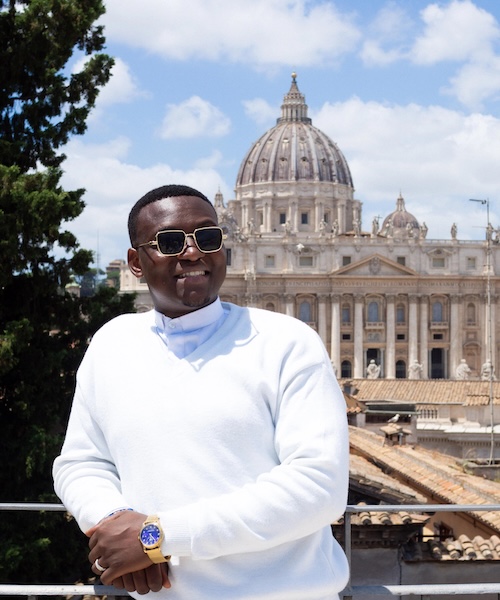
A Conversation with Nkafu Carlson Lekeaka
With: Nkafu Carlson Lekeaka Berkley Center Profile
October 27, 2026
Background: In his address to the first assembly of the International Association of Jesuit Universities (IAJU) in Bilbao, Spain, in 2018, Father Superior Arturo Sosa, S.J., emphasized the importance of “education for world citizenship.” Since 2022, the IAJU Global Citizenship Curriculum Project and the IAJU Global Citizenship Fellows Program have brought together thousands of students from the international network of Jesuit institutions to engage in dialogue and develop leadership skills as global citizens.
Project Manager Jane Fitzpatrick, who supports the IAJU global citizenship programs, connected with members of the Global Citizenship Alumni Ambassadors program during the fall 2026 semester to talk about their experiences with the programs and what it means to be global citizens as students at Jesuit universities across the world.
Biography: Deacon Carlson Nkafu Lekeaka is a graduate student at Hekima University College in Nairobi, Kenya. He is a member of the IAJU Global Citizenship Fellows Program 2025-2026 cohort and serves as an alumni ambassador for the IAJU Global Citizenship Curriculum Project fall 2026 semester.
Please share a little bit about yourself: Where are you from? Where do you go to school, and what are you studying?
My name is Carlson Nkafu, and I am from Cameroon, specifically from the South West Region, one of the country’s two English-speaking regions. I am a deacon of the Catholic Diocese of Buea, Cameroon. I am currently completing a Master of Arts in peace studies and international relations at the Hekima Institute of Peace Studies and International Relations, Hekima University College, a Jesuit institution in Nairobi, Kenya.
What was the name of the class you took that incorporated the global citizenship modules last year? Who was your professor, and how did the global citizenship curriculum support your coursework?
At Hekima, our dean chose to create a separate course devoted entirely to the global citizenship modules, simply called the Global Citizenship Course. We met every Saturday from 9:00 a.m. to 12:00 p.m. East Africa Time. In each session we worked through a module together, drawing on practical examples and on the experiences that each of us brought from our different countries. This tradition has continued at Hekima, and new participants in the global citizenship program still take the course in the same way. Our professor was our dean, Rev. Dr. Elisée Rutagambwa, S.J. He is deeply passionate about promoting global citizenship in our university, and he still teaches the course even after completing his tenure as dean of the institute.
The curriculum strengthened my studies in a very concrete way. Peace studies and international relations deal with the great questions facing our world: conflict, displacement, inequality, and the breakdown of relationships between peoples and nations. These are the same questions that global citizenship asks us to confront. My academic program gave me the theories and tools to analyze these problems. The IAJU Global Citizenship Curriculum Project challenged me to move from analysis to action, to ask what I personally can do, here and now, to respond to them. It reminded me that peace is not only studied in the classroom; it is built through everyday choices and relationships.
What was it like participating in a Global Student Dialogue for that class? What did you take away from that experience?
It was inspiring. In our professor and my fellow students, I saw a real zeal and hunger to find solutions to the problems affecting our world and humanity: war, environmental destruction, and the situation of people living at the margins of society, among others. Being surrounded by people from different backgrounds who shared this commitment gave me great hope.
The most important lesson I took away was that we all share one common home. Pope Francis describes this in his encyclical Laudato Si’ (On Care for Our Common Home), which was one of the key documents we studied in the course. I came to understand that protecting creation is the duty of every one of us, and that caring for the environment and caring for human beings cannot be separated. When the earth suffers, it is the poorest and most vulnerable who suffer first.
How have the global citizenship programs impacted your understanding of Jesuit values or the Jesuit network?
Together, the curriculum project and the fellows program have given me a much broader understanding of Jesuit values, especially cura personalis, care for the whole person. I came to see that the Jesuit mission is concerned with every dimension of the human person, physical as well as spiritual. I also saw how strongly the Jesuit network is committed to inclusion: to making the world a common home for all of us, regardless of race, color, or nationality. Meeting students and educators from Jesuit institutions around the world showed me that this network is not just a set of schools. It is a global community that shares a common mission.
What role do the Jesuit values play in your life as a global citizen?
Jesuit values have helped me grow in empathy: the ability to step into the shoes of every person I meet. Since returning from the IAJU Global Citizenship Fellows Program in Rome, this is what I have been trying to live out every day. I am now better able to see every person as a brother or sister, created with the same dignity, whatever their background. As a deacon and as a student of peace, coming from a region of Cameroon affected by conflict, I know how much healing depends on our ability to listen to and understand one another. These values continue to shape how I serve, how I study, and how I relate to others.
Why did you decide to stay connected to the global citizenship programs by becoming an alumni ambassador?
I decided to become an alumni ambassador because the programs gave me so much that I felt called to give something back. Global citizenship is not just a course that ends with a certificate; it is a way of life that grows when it is shared. As an ambassador, I want to encourage other students, especially in Africa, to take part in the program and discover what it offers. I also want to remain part of this global community, which continues to inspire and challenge me, and to keep learning from people across the Jesuit network.
Based on your experience in the programs, how would you now define global citizenship?
For me, global citizenship means recognizing that I belong not only to my family, my country, or my Church, but to one human family living in one common home. It is the awareness that what happens to people and to the planet anywhere concerns me everywhere. It also means taking responsibility: acting with empathy, justice, and care, especially for the poor, the marginalized, and creation itself. A global citizen does not simply observe the world’s problems. A global citizen chooses to be part of the solution, beginning in their own community.
Do you have any advice or a message for students across the Jesuit university network interested in global citizenship?
My message is simple: do not hesitate, take the step. The global citizenship programs will open your eyes to the world and to the people around you in ways you may not expect. Come with an open heart, be ready to listen, and be willing to learn from people whose experiences are very different from your own. Above all, do not keep what you learn to yourself. Put it into practice in your community, in your studies, and in your daily life. Our world needs young people who believe that another world is possible and who are ready to work for it.
Thank you, Carlson!
Thank you once again for this opportunity, and for all that the IAJU global citizenship programs have meant to me.