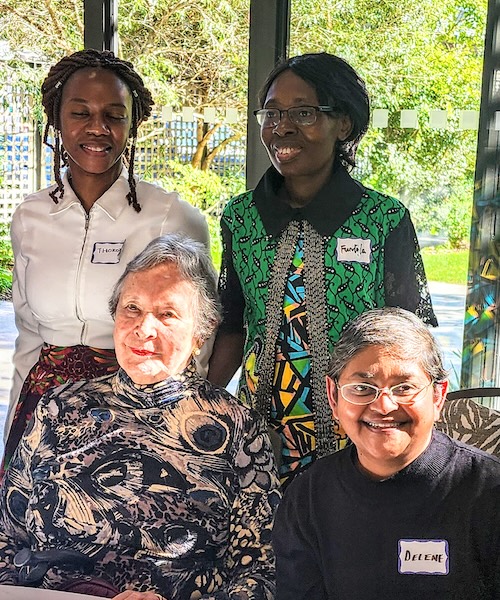
A Discussion with Denise Ackermann, Cape Town,
With: Denise Ackermann Berkley Center Profile
May 20, 2026
Background: Denise Ackermann came to a May 20 event convened by the Georgetown/Lancet Commission on Faith, Health, and Trust in Cape Town, South Africa on May 20, 2026. She met there with several women who are active in the Circle of Concerned African Women Theologians, including Musimbi Kanyoro, who was in South Africa as a Commissioner. Katherine Marshall had a brief conversation with Professor Ackermann, reflected here. Most significant was the reverence of widely differing generations of women theologians who joined her there, honoring her work and mentorship.
The conversation reflects Ackmermann’s concern for present day challenges facing South Africa and her affirmation of the importance of women’s voice, experience, and roles, including but not limited to their roles in theology. Women’s courage and their willingness to use their voice were her central themes.
Denise Ackermann has been one of the most influential South African feminist theologians of the late twentieth and early twenty-first centuries. She has served as a major bridge figure between liberation theology, feminist theology, anti-apartheid activism, and African women’s theology. She has been a mentor, organizer, teacher, and institution-builder, especially within the Circle of Concerned African Women Theologians, where she was a founding member and leader over many years.
Some describe Ackermann as a “feminist theologian of praxis,” who challenged the traditional male dominance of theology and the ways it shaped most teaching and writing before her time. She also broke new ground in linking lived political and social realities and theology. Here work and role were very much set in the context of South Africa--apartheid, gender violence, economic inequality, and ecclesial patriarchy. She argued that women’s lived experiences shaped theology and were relevant. treated as valid theological sources. She challenged male-dominated theological traditions that universalized male perspectives while marginalizing women’s realities. Her work frequently emphasized memory, lament, healing, embodiment, and hope. While her work drew on liberation theology, she was fearless in criticizing the ways in which women were sidelined. Racism, colonialism, and patriarchy were, for her, inextricably linked. She has also taken on more recent issues where women are deeply involved, notably HIV/AIDS and the stigma associated with it, violence against women, including widespread rape, and environmental challenges. Healing, and human flourishing have been dominant themes.
The Circle of Concerned African Women Theologians was founded in 1989. Mercy Amba Oduyoye was among the intellectual leaders with a vision for it. Eight women developed the concept and it was launched by71 women. Leadership has been shared by various women throughout Africa, moving from region to region. Musimbi Kanyorl was the first coordinator of the circle for the first 9 years then other leaders took it on. The Circle’s aim was primarily to create intellectual space for African women theologians. Denise Ackermann was one of the Circle’s most influential South African leaders and interpreters, helping to establish the Circle’s Cape Town chapter in 1992. She helped to embed Circle theology within South African theological institutions.
Denise is widely admired and respected as a mentor to a generation of younger theologians, engaging international feminist theology while retaining a solid grounding in African realities. She has helped give the Circle legitimacy within broader church and academic institutions. She helped normalize feminist theology within South African theological education, connected anti-apartheid ethics with gender justice, and contributed to making African women’s theology an internationally recognized field. Through the Circle, she helped build a transnational community of African women theologians whose influence now extends across theology, ethics, biblical interpretation, public health, development, and human rights discourse.
Ackermann’s works include:
• “Liberation and Practical Theology: A Feminist Perspective on Ministry” (1985)
• “Feminist Liberation Theology: A Contextual Option” (1988)
• “A Voice Was Heard in Ramah”
• "Surprised by the man on the borrowed donkey: Ordinary Blessings" (2014)
Christina Landman’s “Journeying with the Circle of Concerned African Women Theologians” is a historical overview of the Circle in southern Africa. Isabel Apawo Phiri’s “African Women’s Theologies in the New Millennium” explains how African women’s theology developed in relation to liberation theology, feminist theology, and African contextual theology.
Denise Ackermann’s significance as a public intellectual, mentor, and contextual interpreter stands out and merits recognition far beyond her field. Her influence has come through networks, teaching, editorial work, ecumenical engagement, and institution-building within South African feminist theology.
How would you like to start?
I think the challenges today are, in my 91 years of life, worse than they have ever been for the human race. And I think that is also the case of if we look at, the situation here in South Africa.
We recently in Cape Town had a storm that hasn't equaled anything else. If we look at the weather and we look at climate change as a reality, and we look at the people who have power in the world today and their lack of understanding of people's needs and their future, I think we're not in a good shape today.
But my hope is in the courage of women. I have been so blessed to see women fight back against all sorts of odds. And in this country, in South Africa at the moment, we have women who are really speaking out against the corruption that's all been revealed recently, and shaming the leaders who are stealing money and so on.
And it's women who are doing it. Women are not scared. They're speaking out.
Why is that?
I think because we know now that all those years of having shut up and not said anything was wrong. It was for me anyway, because I started to speak up when I was reasonably young. But I think that women have an enormous sense of care. We have children. We care about their future. We care about the beauty of the world which God has given us in so many ways.
I mustn't say that men don't, but we as women are, I think, more sensitively in touch with what is going on. Maybe that's because we're mothers or grandmothers. I have got six grandchildren and I have two Jewish grandchildren, which is fascinating. And I'm just looking at the world that they're going into and it really keeps me praying.
How did you get the idea of focusing on the women theologians? Where did that come from?
I think I was reading the Bible. And when I read, I think it was 1 Corinthians 12 about the gifts that everybody has. And I looked at my church, which had only men who were priests. I thought, "Nonsense. Women can do it... I've got the gift to preach," I thought.
And so I started to realize that women were sidelined in a way that was to the detriment of the Church, to the detriment of the communities of faith.
That's where it started me off. And because I'm more a fighter than anything else and I have a big mouth, I had a lot to say about it. It was wonderful to see that there were times, eventually, when I was heard and that was great. I have no regrets.
Do you have an example of when you were heard?
Yes. I'm an Anglican and in the Anglican Church here, it's all males, as usual. I worked with Desmond Tutu for three years and I think I had a role in convincing him that women should be ordained. So he then issued a, I was going to say a fatwa.! But he issued a statement that said that the bishops in their various dioceses who agreed with him could ordain women, but if the bishop didn't agree, then the woman must just move to another diocese. And I said, "No, no, Desmond, that is awful. It's either right or it's wrong and you know it's right." And in the end I persuaded him and he actually apologized to me. And he then supported women's ordination and that was a great help for us in the Anglican Church.
.
How did the network of women theologians grow? You were very much part of its beginnings.
Well, I suppose through my teaching. The Circle was very instrumental in that. It also was advanced through the work of people like Mercy Oduyoye.
I was just thinking some of those very early American women theologians that I read, and also people in the Netherlands, Riet Bons-Storm, and people like that. They were all early theologians that you probably don't know, in your lifetime. But they were real voices and their theology was good and solid and real. And I was so impressed and so delighted by what I found in their work.
So you started with your understanding of what other women were doing and then helped it to grow. Did you find many in South Africa or was it in other places?
When The Circle started here, I had an interfaith circle. I had a Muslim woman, a Jewish woman, and I had a Hindu woman also. And all of us wanted to be known and recognized and heard in our own different faiths. And because it was interreligious, it had quite a lot of opposition. as you can imagine. You can imagine that my poor Muslim friends didn't have an easy time. But we kept at it and we kept on, because it was right and it was what we believed God wanted. So that's a big incentive not to stop!
And that was during the whole period of the transition to democracy?
Yes. And it was a bit before that. But then during the transition to democracy, which is about 32 years ago, many of us were indeed part of that, too.
Here I am and I'm seeing Musimbi [Kanyoro], after all these years. She was also a leader in building the Circle and giving it a voice. I can't believe it. And all these other women. It's too wonderful. I had not seen Musimbi in a long time. It was amazing when I got this phone call from her, that she is in Cape Town.
Musimbi was very determined that I was going to have you on tape! Thank you so much.It is an inspiration to see you here, surrounded by women theologians marking different countries and generations.