A Region Under Pressure
The Sahel is at the epicenter of multiple intersecting crises, and Burkina Faso has become one of the region's most affected countries, grappling with widespread displacement, persistent insecurity, and mounting humanitarian needs. Repeated violence has disrupted livelihoods, strained social services, and limited access to education and health care. The security crisis has also been accompanied by significant political and institutional challenges; since 2022, Burkina Faso has experienced two military coups, reflecting the depth of public concern over insecurity and governance. As of March 2023, more than 2 million people have been internally displaced, while an estimated 5.9 million people require humanitarian assistance. UNESCO's Education in Emergencies Program documents how the conflict has taken a devastating toll on education: more than 5,300 schools have been forced to close because of insecurity, affecting over 820,000 students and 24,000 teachers.
Despite these hardships, local communities do adapt and persevere. Families rebuild lives after displacement. Religious leaders create spaces for dialogue and reconciliation. Teachers and health workers continue serving communities under difficult circumstances. These efforts illustrate a broader reality: resilience is not merely the ability to endure adversity; it is the determination to create pathways toward a more peaceful future.
Faith Communities as Anchors of Resilience
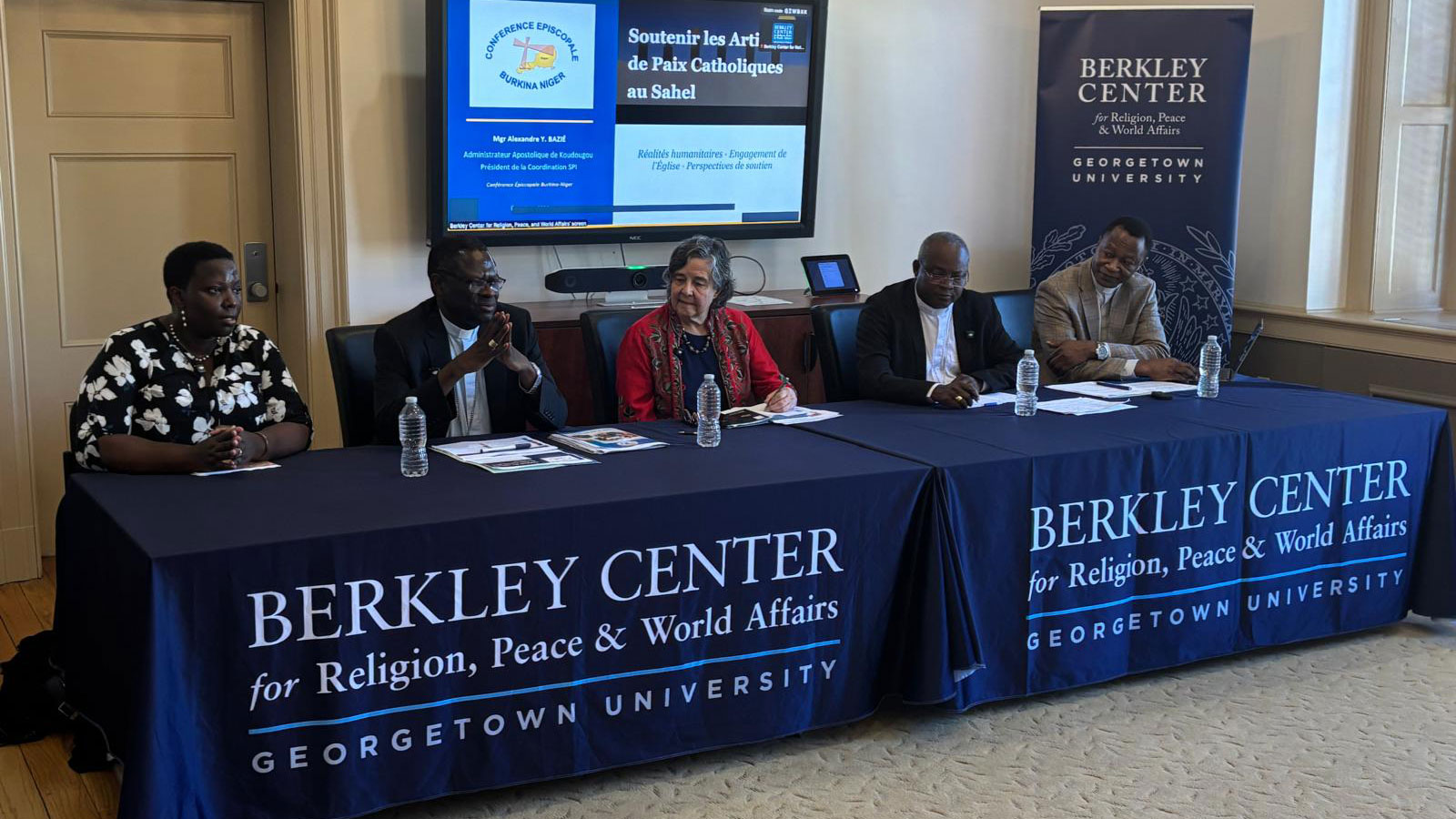
Speaking at Georgetown, Bishop Alexandre Yikyi Bazié, Apostolic Administrator of Koudougou and President of the Sahel Peace Initiative (SPI), emphasized the Catholic Church's longstanding commitment to social cohesion, interreligious dialogue, mediation, and humanitarian assistance.
Alongside Archbishop Laurent Birfuoré Dabiré and Fr. Barthelemy Bazemo, Provincial, Missionaries of Africa, Bishop Bazié highlighted the critical role that faith communities play in supporting populations affected by conflict and displacement. Their message was clear: sustainable peace cannot be imposed from outside. It must be built through trusted local relationships and sustained community engagement.
Across Burkina Faso, religious leaders frequently serve as bridges between communities divided by fear, misinformation, or conflict. Their presence within local communities allows them to facilitate dialogue, address grievances, and promote coexistence among diverse ethnic and religious groups.
These efforts are especially significant in a region where social fragmentation can deepen insecurity. By fostering trust and encouraging collective action, faith leaders help strengthen the social fabric that remains essential for long-term stability.
Resilience Through Interreligious Cooperation
One of the defining characteristics of Burkina Faso's social landscape is its tradition of religious coexistence. Christians, Muslims, and followers of traditional beliefs have historically lived together, often within the same families and communities.
While insecurity has placed immense strain on these relationships, faith leaders continue to champion dialogue and cooperation as powerful tools for peacebuilding. The Georgetown discussion underscored that resilience in the Sahel is not only about responding to immediate humanitarian needs; it is also about preserving the values of solidarity and mutual respect that have long characterized the region.
Religious actors are well positioned to reinforce these values. Through joint initiatives, community outreach, and peace education programs, they contribute to reducing tensions and promoting understanding across religious and ethnic divides.
Investing in the Next Generation
A recurring theme throughout the discussion was the importance of investing in youth. The future of Burkina Faso and the wider Sahel will depend significantly on the opportunities available to a rapidly growing young population.
Participants highlighted the urgent need for expanded access to quality education, skills development, and economic opportunities. Without such investments, many young people risk being left behind, further exacerbating existing vulnerabilities.
In this context, church leaders presented an ambitious vision for a proposed University of Peace in Africa. The initiative seeks to equip future generations with practical skills in fields that are increasingly critical to the continent's development, including artificial intelligence, cybersecurity, smart agriculture, peace mediation, and fact-checking.
The project reflects a broad understanding of resilience: preparing individuals and communities not only to withstand crises but also to shape their own futures. Beyond academic training, the initiative envisions innovation hubs, business incubation programs, FabLabs, seed funding opportunities, and partnerships that can stimulate local economic growth.
Such investments represent more than educational opportunities; they are investments in peace itself.
Local Leadership, Global Partnership
A central message emerging from the Georgetown event was the importance of supporting local peacebuilders. Community leaders, religious institutions, and grassroots organizations often possess deep contextual knowledge and trusted relationships that enable them to respond effectively to local challenges.
At the same time, the scale of the Sahel's crises requires broader partnerships. International actors, including governments, universities, faith-based organizations, and development institutions, have an important role to play in amplifying local efforts, strengthening institutional capacity, and supporting long-term peacebuilding initiatives.
The participation of diplomatic representatives, including Burkina Faso's Ambassador to the United States, His Excellency, Mr. Kassoum Coulibaly, reflected the importance of fostering dialogue among diverse stakeholders committed to the region's future.
Resilience as a Path Forward
The story of Burkina Faso today is often told through statistics on insecurity, displacement, and humanitarian need. These realities are undeniable, but they do not capture the full picture.
Another story is defined by resilience. It is visible in communities that continue to support one another despite hardship, in religious leaders who work tirelessly to sustain dialogue and social cohesion, and in young people who aspire to build a more peaceful and prosperous future.
The Georgetown conversation served as a reminder that resilience is not simply survival. It is the collective capacity to maintain hope, preserve human dignity, and pursue peace even under the most difficult circumstances.
As local peacebuilders continue this work, their efforts deserve greater recognition and support. The future of the Sahel will depend not only on addressing immediate security challenges but also on strengthening the people and institutions that are building peace from the ground up.
Resilience remains one of Burkina Faso’s most valuable resources, and a source of hope.