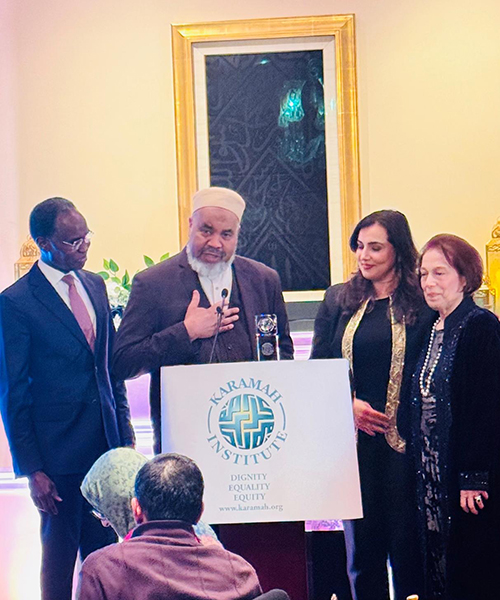
On February 19, during a special Iftar event, marking the breaking of the Ramadan fast, the Karamah Institute launched a brand new and very special award--the distinguished Umm Salamah Award. It was awarded to Imam Mohamed Magid, a well-respected Muslim leader who is active and influential both in the Washington DC area and globally. The award highlighted Imam Magid’s wide array of virtues and his decades long work to bridge divides among people and communities, and to nurture new generations of Muslims and especially women Muslim leaders. The award was created, announced, and given by Dr. Azizah al-Hibri, alongside Mohamed Elsanousi. Individually and collectively, the two scholars and activists exemplify the leadership qualities they highlighted as the award was introduced.
The Karamah Institute prides itself on living core values that center on education, training, and support to the community, with a constant and deliberate focus on women’s roles. It nurtures a deep understanding of Islamic principles, jurisprudence, and worldview. It helps students and participants to navigate the complexity of modern life and culture. The Institute’s demanding notions of leadership center on service to the community. Conflict resolution skills are a focus, as they are so central to making community and family relations healthier and stronger.
Imam Mohamed Magid was honored for a host of activities as a leader, teacher, and mentor. He has served Muslim communities with unwavering commitment, compassion, and vision. The imam comes from a distinguished lineage of Islamic scholarship in his native Sudan, and today is recognized nationally and internationally for his leadership in promoting human rights, interfaith understanding, and community development. He recently was elected to the board of the G20 Interfaith Forum Association (which I also serve).
Imam Mohamed Magid stands with others at a podium with a "Karamah Institute" logo
As the Resident Scholar of the ADAMS Center, Imam Magid plays vital roles, guiding the community through education, spiritual growth, and advocacy. He works to empower both individuals and families across generations, fostering inclusivity and unity. An accomplished author, he focuses on the evolving needs of the Muslim community, always at the fore the timeless values of faith, justice, and compassion.
In naming its new award—the Umm Salamah award—the Karamah Institute looked across Islamic history, to many biographies of outstanding individuals, looking for someone who embodied three key elements: Islamic knowledge, leadership, and conflict resolution skills. Umm Salamah, wife of the Prophet Muhammad, stood out!
A member of the distinguished Quraish tribe and a religious leader and teacher, the nascent Muslim community sought Umm Salamah’s counsel and leadership. She was a source of hadith (reported statements of the Prophet), as well as Islamic knowledge generally, especially fiqh (knowledge of Islamic laws and rules). She put her faith into action. This was evident especially when, twice, she migrated from Makkah. Before her marriage to the Prophet, and upon his advice, she went with other Muslims to Ethiopia to avoid persecution. Later she went to Madinah. In both situations interfaith communities enhanced her understanding of how important religious freedom was in Islam, and the benefits that came from nurturing good interfaith relations. The Prophet himself sought advice from this wise woman leader. In one famous incident, people from the Quraish tribe blocked Muslims who came to Makkah with the Prophet to perform religious rites (the Umrah) at the Ka’bah, which the Muslims claimed as their religious right. The Prophet negotiated a peace treaty that permitted the community to return to Makkah a year later for the Umrah. But the community resisted, sad and rebellious, even as the Prophet called them three different times to perform the rites. The Prophet, rather despondent, sought Umm Salamah’s counsel and she gave him wise advice: to perform the rites himself, quietly, speaking to no one. He followed her advice, and the community followed his lead, thus averting the crisis. Umm Salamah’s effective leadership combined wisdom and a keen instinct, grounded in the example of action.
Imam Magid was cited as an exemplar across each area that Umm Salamah’s leadership demonstrated. The citation stressed that he was uniquely qualified to receive the inaugural award, exemplifying all of Umm Salmah’s invaluable qualities and example.
It is striking that the Karamah Institute, with its mission centered on women’s leadership in Muslim communities, honored a male religious leader with a special award, named for a special female Muslim leader whose example is so deeply part of history and tradition.
Katherine Marshall, a senior fellow at Georgetown University’s Berkley Center for Religion, Peace, and World Affairs, leads the center’s work on religion and global development. She is also a professor of the practice of development, conflict, and religion in the Walsh School of Foreign Service, teaching diverse courses on the ethics of development work and mentoring students at many levels. She helped to create and now serves as the executive director of the World Faiths Development Dialogue, an NGO that works to enhance bridges between different sectors and institutions. In September 2022, she was appointed as a member of the Advisory Committee on Voluntary Foreign Aid at the U.S. Agency for International Development. Marshall has five decades of experience on a variety of development issues in Africa, Latin America, East Asia, and the Middle East, particularly those facing the world’s poorest countries; one way she shares her expertise is through her blog Faith in Action. She was a World Bank officer from 1971 to 2006, and she led the World Bank’s faith and ethics initiative between 2000 and 2006. Marshall is a member of the Working Group on Child Rights and Family Values and the Working Group on Displaced Persons and Hospitality to the Stranger, both part of the Culture of Encounter Project.