In 1995, Haruhisa Handa first encountered a Cambodia emerging from genocide and civil war. The Khmer Rouge had destroyed professions, families, religious life, and public institutions. Widespread conflict had continued into the 1990s, and the resettlement of countless refugees and displaced populations had barely begun. With basic services desperately scarce, providing basic health care, looking after vulnerable children, restarting education systems, demining, and rebuilding institutions were the urgent priorities. Nongovernmental organizations (NGOs) were undertaking work the state could not. The scope for a philanthropist to contribute was vast, while guidance and guardrails were limited.
Today, the environment for a philanthropist or NGO leader has changed in fundamental ways. Three decades after Handa first offered assistance, Cambodia is richer, healthier, and far more connected to other countries. Annual GDP growth averaged 8.2% in 2000–19 and human indicators are far better: infant mortality fell from 95 to 12 per 1,000 births in 2000–21. Yet Cambodia still faces many challenges. The economic base remains narrow, the population’s skills are limited, learning outcomes are poor, and household debt is mounting. Good governance -- a sine qua non for development -- is elusive, with many concerned by trends towards an authoritarian system: the Cambodian People’s Party (CPP) dominates the state, the judiciary is not independent, and independent media and civil society operate under sustained pressure. Civil society organizations have moved from largely free to operate as they chose in the 1990s towards uneasy partnerships with tighter state management.
Scholarship on repression and co-optation of civil society highlights the complex paths that nongovernmental actors face in this and other countries. A broad trend is that service organizations remain welcome while groups challenging political and economic power face stronger constraints. Religious action and paths to recovery form a quieter, far less explored part of this history, with roles focused particularly on the challenges of human development (especially health and education) and reconciliation efforts following bitter conflicts. But many institutions have worked, with religious inspiration, towards healing and sustainable social cohesion.
Haruhisa Handa’s work forms part of both the story of urgent assistance following a devastating crisis and that of navigating changes during the years of recovery. His involvement began in the throes of a crisis demanding emergency relief and subsequently moved towards support and contributions to sustaining dynamic institutional structures. These efforts have navigated the demands of a changing political and social landscape.
Evolution, breadth, and continuity of Handa’s work in Cambodia
Handa’s support in Cambodia reflects an unusual combination of material resources, energy, personal loyalties, and wide-ranging interests. A Japanese religious and business figure, performing artist, and leader of the Shinto-rooted World Mate community, Handa has worked through several foundations he as founded (including notably the Handa Foundation) and in collaboration with Cambodian leaders, international charities, and religious organizations. Handa’s Cambodian portfolio spans health, education, child welfare, disability, agriculture, media, policy dialogue, interfaith work, and rural support. Its defining characteristic is continuity: Handa remained engaged while Cambodia’s needs and politics changed around him.
Health came first. In 1996, the Sihanouk Hospital Center of HOPE opened through a partnership among four groups: World Mate, the American journalist Bernard Krisher, the Christian group HOPE worldwide, and the Cambodian government. The division of labor was productive: World Mate supplied essential finance under Handa’s leadership; Krisher supplied entrepreneurial drive and Cambodian connections; and HOPE supplied clinical management. Cambodian professionals gradually assumed almost all roles. The hospital treated poor patients without charge and became a national training and research site, reporting more than a million consultations over two decades. The numbers are self-reported, but survival, service, and Cambodianization are substantial achievements.
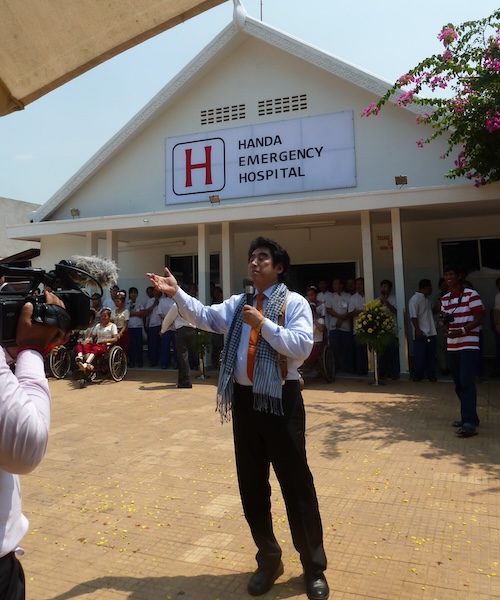
Haruhisa Handa in front of the Handa Emergency Hospital
The Handa Medical Center in Battambang shows the same capacity to adapt. Handa helped sustain a trauma hospital in Cambodia’s mine-affected northwest; in 2012, he established the medical center. As demining reduced the original patient caseload, road injuries, burns, diabetes, hypertension, aging, and other chronic conditions became more important. Mobile clinics, public health research, scholarships, and professional training extended the work beyond a single facility. The Handa Foundation currently reports about 3,000 patients a month, with a mixture of paid and free care. The direction is more important than the tally: from emergency treatment toward Cambodian capability and a wider health system.
Handa’s education work likewise moved from emergency help toward institution-building. World Mate supported the Future Light Orphanage when conflict and poverty left many children without effective care, but withdrew as it became clear that the more compelling need was community care for vulnerable children. Handa backed schools and scholarships, and his long-term partnership with Kao Kim Hourn (now ASEAN Secretary General) helped build the University of Cambodia, founded in 2003 with an international and English-language orientation. The Handa Academy in Battambang combines teaching in topics such as English, computer science, and sport, with outreach on nutrition, health, and agriculture. As care for vulnerable children shifted away from institutions, Handa’s portfolio moved towards schools, higher education, and skills training. This evolution deserves as much attention as the original act of giving. Other examples of Handa-backed interventions in Cambodia include Cambodian Red Cross water and livelihood programs and projects that focus on survivors of Khmer Rouge violence and people with disabilities.
Handa’s Shinto-rooted but deliberately nonsectarian partnerships crossed Buddhist, Christian, Muslim, governmental, and secular lines, while assuring that religious conversion was never the price of humanitarian assistance. Handa-supported projects have deliberately brought diverse, highly motivated people together with a shared commitment to service and care.
Cambodia is not an unusual or solitary example of Handa’s giving. His wider portfolio includes support for human-rights teaching and research at Stanford University; an endowed human-rights chair at Curtin University in Australia, a professorship in Shinto studies at UCLA; numerous patronages of the arts, including at the Julliard School and the Opera Company of Australia; and decades of support for blind and disabled golf. These causes are broad and personal rather than governed by a single technocratic template. The aggregate impact is hard to quantify and compare, but the broad portfolio jibes with qualities that characterize Handa-supported efforts in Cambodia: loyalty, continued support despite challenges, and an appetite for neglected areas and communities
Money, evidence, and the philanthropic bargain
Available financial evidence on Handa’s personal giving in Cambodia confirms substantial commitment, albeit without a reliable consolidated total. Contemporary reporting in 2005 recorded a $1.3 million Khmer Rouge victims’ fund: $300,000 from Handa personally and the rest from World Mate. The Handa Foundation’s latest US return reports about $2.1 million in 2024 program expenses, essentially all for the Battambang medical center and trauma hospital serving more than 35,000 patients.
Handa’s work in Cambodia attests to the ability of private foundations to move quickly, tolerate risk, supply patient capital, and back neglected causes. The OECD’s latest review identifies flexibility, risk-taking, and catalytic support as their comparative advantages. Handa’s willingness to sustain hospitals, scholarships, and partnerships for decades is unusually strong evidence of patient commitment. This bargain can have another side. Private donors can set public agendas without electoral accountability, opaque organizational boundaries and weak evaluation make success hard to test, and personal loyalty can complicate succession. Yet these are risks to manage, not reasons to dismiss the work.
The standard response to the long-term question of sustainability for such interventions—“localize”—is too crude, particularly in situations where governance is weak. Local professionals and communities possess indispensable knowledge, while independent governance protects mission and voice, and government ownership can secure scale and sustainability. These are different virtues that can conflict. Research on localization under authoritarianism warns that transferring authority without safeguards can reinforce state or elite power. The sounder principle is subsidiarity with protection against capture: place decisions as close as practical to affected Cambodians, while keeping the funder responsible for evidence, inclusion, fiduciary integrity, and accountability.
From private creation to durable institutions
The Sihanouk Hospital came into the public health care system in 2022. Despite some tensions surrounding the transfer and a path that was not clearly delineated from the outset, the hospital’s trajectory is a positive contribution to rebuilding national capacity. WHO guidance expressly treats government-led adoption as a route from successful pilots to sustainable scale. HOPE announced in 2021 that its initial goals had been met, Cambodian staff occupied almost all roles, and a management transition was planned. A key question is whether this contested transition protected financing, staff, clinical quality, and affordable access. The hospital’s current website continues to list round-the-clock operations and urgent, surgical, and chronic-disease care: evidence of continuity, though not a full evaluation. The Global Fund’s transition framework supplies the right tests: planned and predictable transfer, adequate domestic finance, and maintenance or expansion of coverage.
Relations with government deserve the same balanced candor. The University of Cambodia identifies Handa as chancellor and a Royal Government adviser with the rank of senior minister. Such relationships open doors and help programs survive. They also can create exposure to patronage, official pressure, and silence on the politically sensitive causes of poverty. Transparent agreements, independent oversight, meaningful participation by patients, students, staff and communities, and explicit safeguards for academic freedom and dissent are what is most important.
Handa’s record matters because he and his partner organizations have accompanied Cambodia from emergency relief through institution-building and, in some places, handover to public service delivery. Its breadth, multifaith openness, adaptability, and three-decade continuity are genuine, all too rare achievements. His insightful and careful engagement with multifaith partnerships has helped in the much-needed process of reconstructing and redefining Cambodia’s social fabric. Its next stage will hopefully preserve the qualities that made them possible—compassion, loyalty, speed and flexibility, and willingness to take risks—while adding the transparency, evidence, and safeguards that personal philanthropy cannot supply by instinct alone.
Katherine Marshall, a senior fellow at Georgetown University’s Berkley Center for Religion, Peace, and World Affairs, leads the center’s work on religion and global development. She is also a professor of the practice of development, conflict, and religion in the Walsh School of Foreign Service, teaching diverse courses on the ethics of development work and mentoring students at many levels. She helped to create and now serves as the executive director of the World Faiths Development Dialogue, an NGO that works to enhance bridges between different sectors and institutions. In September 2022, she was appointed as a member of the Advisory Committee on Voluntary Foreign Aid at the U.S. Agency for International Development. Marshall has five decades of experience on a variety of development issues in Africa, Latin America, East Asia, and the Middle East, particularly those facing the world’s poorest countries; one way she shares her expertise is through her blog Faith in Action. She was a World Bank officer from 1971 to 2006, and she led the World Bank’s faith and ethics initiative between 2000 and 2006. Marshall is a member of the Working Group on Child Rights and Family Values and the Working Group on Displaced Persons and Hospitality to the Stranger, both part of the Culture of Encounter Project.