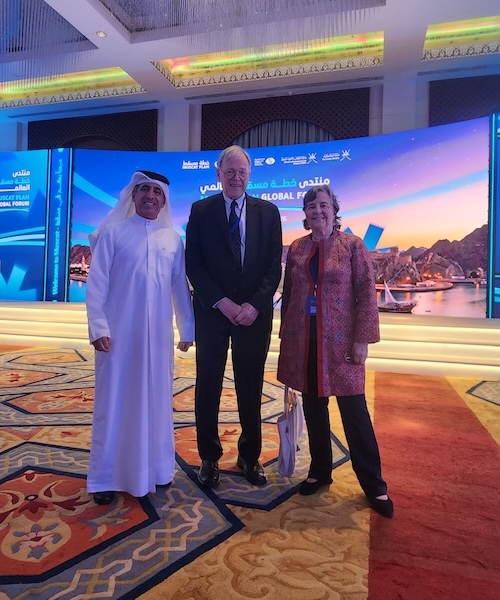
Hate speech and polarization, amplified by social media and increasingly shaped by artificial intelligence, pose difficult challenges in efforts to prevent violence. Threats of genocide and atrocities are still more troublesome. A November 15–16 gathering in Muscat, Oman focused on a group whose contributions are often overlooked: traditional and Indigenous leaders. Building on the Muscat Plan of Action, launched at United Nations headquarters in June, and led by the United Nations Office on Genocide Prevention and Responsibility to Protect, working with the Network of Religious and Traditional Peacemakers, the event’s focus was on how international commitments to preventing violence could translate into local prevention and peacebuilding: moving from words and promises (the Muscat Plan of Action was endorsed by the UN in June) to action, through “capacity, communication, and collaboration”. The impressive, colorful, and diverse group was hosted by the Sultanate of Oman, with touches that included the presence and voice of former f Finnish President Tarja Halonen, deliberate links to a youth training forum, and a group of children urging all to bring about peace. The Forum was timed to culminate on November 16, the International Day for Tolerance (a day that the UN General Assembly proclaimed in 1996).
The effort to engage “traditional and Indigenous leaders” in peace processes sparked a range of questions. First, what traditions are at issue? Discussions about AI (which dominate much discourse these days), often center on concerns about how it relates to fundamental imperatives like human dignity and humanity, and core values that AI seems to challenge or threaten. Those concerns do indeed argue for reflections and action to draw on the traditional wisdom we look to in ancient traditions. Another challenge is that the already grave polarization of the world, with widely differing opportunities and access to power and to development, might be aggravated by the rapid changes that AI propels. The risk is that the peripheries, poor communities, poorly governed spaces, and others may be left still further behind.
Engaging traditional and Indigenous leaders looks to three critical opportunities: drawing on the central sources of wisdom in different cultures to fill gaps in insight and trust, looking to a broad range of leaders that might move us beyond today’s fractured and untrusted political systems, and reaching many in the world’s fragile, conflict-ridden regions where many who suffer deeply live.
The existential challenges facing the world today demand, more than ever, principled, effective leaders in whom we can trust. So what kinds of leaders and leadership are involved? That wisdom is not confined to those who hold conventional political office is a welcome recognition. We find and seek both leadership and wisdom in many forms. We seek it in scriptures. We hear glimpses in prophetic voices of different kinds: great leaders like Mandela, both Franklin and Eleanor Roosevelt, Mother Teresa, for example, but also the courageous and unsung heroes who commit their lives to serving others, like many Catholic sisters and people laboring in humanitarian, peace, and development work. Legends and fairy tales mark us as they convey examples of good and evil. And the rising voices of Indigenous communities remind us of deep connections among species and to “Mother Earth”.
The Muscat gathering thus had at its heart the effort to draw on the wisdom and leadership of leaders coming from a wide range of settings, exercising their leadership in differing ways. There were prominent religious leaders like Metropolitan Emanuel from Constantinople and His Virtue Sheikh-ul-Islam Allahshukur Pashazade from Azerbaijan, Buddhists, Sikhs, and others from traditions that we clearly see as religious. Alongside them were those bearing titles like Sultan, Queen, Chief, Grandmother, and Grandfather, traditional as well as Indigenous leaders, from quite different parts of the world.
The unusual mix reminded me of a moment at the year 2000 Millennium Summit in New York when a group of Indigenous leaders taking the stage at the Waldorf Hotel commented to a large group of assembled religious leaders: “We are what is left when you got through with us”. But the group at Muscat illustrated that the dividing lines among different forms of leadership, formal and informal, traditional and modern, are complex and often blurred. The Muscat plan speaks to different groups of leaders that, in practice, can overlap, both in their access to different forms of authority and respect and in their engagement with spiritual matters. Neither inherited or elected office nor ancient practice guarantees wisdom or fairness. The question is how leaders use their influence: whose voices they hear, whom they protect, and whether they can help communities confront uncomfortable truths. The promises made at Muscat can only be realized through patient local relationships, tested when tensions rise and when defending a vulnerable neighbor carries a cost.
Among the challenges in mobilizing traditional and Indigenous leaders for good (the purpose of the exercise) is indeed their diversity. Some exercise the most conventional types of power, even to decisions about life and death, while others play informal and also contested roles. Among the extraordinary diversity of Indigenous communities, there does seem to be a remarkable common ground, above all in relationships to the natural world. Finding such common ground among the leaders termed traditional seems a bit harder. The importance of family and core human relationships offer a powerful common bond. And we heard time and time again the words “truth” and “trust” as the fundamental need for effective leadership, in past times as well as today.
Nostalgia is evocative in discussions about tradition and leadership but it can also carry risks. We heard about a Bangkok before “development” distorted landscapes and human settlements linked to the natural world. Crime is powerfully linked to the broken families that are a feature of modernity, we were told. And contemporary politics distorts understandings among communities that formerly assured social cohesion, eroding the foundations of ancient approaches that were said to guarantee tolerance. Shared understandings of human rights were mentioned, especially by those representing the United Nations, but much of the discourse looked back to times earlier than 1948. Many accounts expressed a longing for social cohesion, but left questions about whose experiences the remembered past includes—and whose exclusions it overlooks. It was somewhat jarring to hear many references to including women in a group dominated by male leaders. The resonant theme that emerged is that the world is troubled and needs urgently to recall, re-find, and rebuild the anchors of values and practices that can restore peace.
The strongest promise of the Muscat approach lies in local action: mediating disputes, recognizing warning signs, and challenging the words and practices that turn neighbors into enemies. Traditional and Indigenous leaders can bring knowledge, relationships, and credibility that other institutions often lack. Their contributions deserve practical support and a place in decisions. But inherited authority, like every form of leadership, must also earn trust, listen to those excluded, and remain open to change. The task is to draw on the wisdom of the past while building communities in which everyone can belong. That would give substance to the earnest wish expressed so often, to move from words to action.