


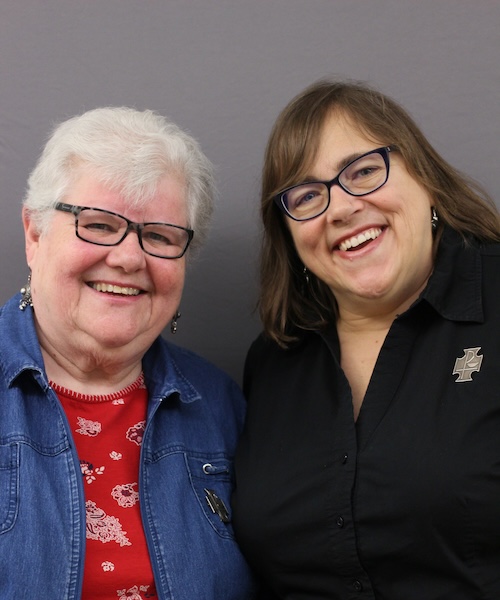
The Heart of Diaconal Ministry: E. Louise Williams and Lisa Polito
First Recorded
May 2, 2019
Topics
Cities
Read Other Conversations About
E. Louise Williams and her friend and colleague Lisa Polito discuss how Louise's upbringing led her to pursue diaconal formation, and together trace how the education of deacons and deaconesses has shifted from a primarily practical exercise toward a greater emphasis on theological education.
This story was produced by David Dault with Kristen Balzer at Sandburg Media, LLC.
Topics
Cities
Read Other Conversations About
Transcript
E. Louise Williams: In the summer when I was a child, we often would go to three different vacation Bible schools. We would go to our church in town, then the little country Lutheran church, and then the little Presbyterian church a couple of miles away where my mother would go teach. And so it wasn't real characteristic of Lutherans to be that cooperative, but I had that kind of ecumenical seed sewn in me very early because I was so involved in church growing up. I dreamed of being a missionary and thought I would be a medical missionary, thought I would become a nurse. And then I realized that wasn't really the kind of education that I wanted. So I didn't know quite what to do with that kind of call I felt to service in the church. And I read an article on deaconesses and I thought, "Aha, this is it." So I've kind of been connected here my whole adult life.
Lisa Polito: So can you tell about some of your time here at the university?
E. Louise Williams: I had a strong background with Bible stories and Luther's Small Catechism, which we had to memorize. But to study the Bible academically just opened a whole new world up to me. And it was a little unsettling at first, but once I got past that, it was just an amazing thing how…to know that God's mercy and grace is not dependent upon the mistakes I've made or the things I've done, but that it's just because God is love. And I've lived off that ever since.
It seemed to me like a lot more of my education and formation as a deaconess was really geared toward becoming somebody who worked in the church, the practical aspects of it. And I think we've kind of flipped to the other side in a lot of ways now because now deaconesses and deacons who graduate from here go into all different kinds of work and ministries.
Lisa Polito: Can you say more about how that evolution occurred? Because I believe that you are a huge part of that evolution where we began talking more about the theology of diaconal ministry.
E. Louise Williams: Well, I came to the staff in 1974 and if you weren't in full-time or at least part-time paid ministry, you couldn't be officially on our roster as deaconesses. And we began talking about how really you're still doing that same work. It's just a matter of who does or doesn't pay your salary. And we started thinking more about what really is the heart of what we're about, and we made the conscious decision that people didn't have to "leave" if they weren't working in church related ministries. And then it became more important to talk about the theology and spirituality and community, those things that are at our heart, but maybe expressed in very many different ways.
Lisa Polito: So then your first call as a deaconess took you a different direction geographically. Do you want to talk about that a little bit?
E. Louise Williams: Yeah. So when I first graduated, we were just assigned. We had no idea where we were going until we got an envelope during a worship service and opened it and there it was: Edmonton, Alberta in western Canada. We were supposed to put a pin on the map where our call was, and the map didn't go that far. But again, I just am so grateful for the people. I was at St. Peter's Lutheran Church and it was the oldest Lutheran church in town and they were just the most wonderful people. And we learned from each other what it meant to be a parish deaconess. But I guess, so already as a young deaconess, I was traveling outside the United States. Eventually I became part of the executive committee of Diakonia and then was able to be president for eight years and virtually travel all over the world.
Lisa Polito: Well, in fact, I still remember voting for you the first time as president, so thank you. And I think this has been a great opportunity for us to have this conversation, especially since it is the one hundredth anniversary of now the Lutheran Diaconal Association.
E. Louise Williams: Thank you. This has been great. Thanks.
Other Conversations About Faith and Calling



0:00/0:00