


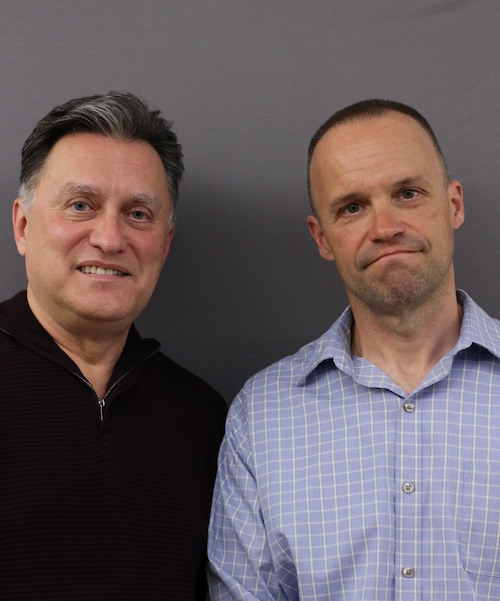
Faith Anchors: Nicholas Denysenko and Michael Gruszyk
First Recorded
May 2, 2019
Cities
Read Other Conversations About
Nicholas Denysenko interviews his church member Michael Gruszyk about how he started coming to the Eastern Orthodox Church as a teenager. Gruszyk describes how the sights, sounds, and smells of the church informed his experience of worship and the importance of prayer and gratitude in his daily life.
This story was produced by David Dault with Kristen Balzer at Sandburg Media, LLC.
Cities
Read Other Conversations About
Transcript
Michael Gruszyk: Sure. I guess my upbringing was different in that my mom was a believer, and specifically in the Russian Orthodox Church. My dad, on the other hand, was a complete non-believer. So it was my mom who really brought me to the church, and I just remember feeling very intrigued about it and very moved. And so I always enjoyed going as a child. My father, on the other hand, would rather that I didn't go. There came a point when my mom was working every Sunday, and we weren't able to go as often as we would like, and I kind of started missing it. So when I finally got my driver's license, I announced, "I'm going to church, and I'm going by myself." And it really meant a lot to me.
Seeing all of the icons of Jesus and Mary and the saints, especially along the plaschanitsa, which separates the altar from the rest of the church, was very cool to me. Then at the same time, there were the smells of the church, which came from the incense. And then there were the sounds of the church, which was cool because everything was chanted or sung 100%. So it really was this overwhelming feeling that all of your sights, smells, sounds, et cetera, everything, all of your emotions were being hit at the same time because of this.
Nicholas Denysenko: Was there any English used in the liturgy at all?
Michael Gruszyk: Yes.
Nicholas Denysenko: Or were you fluent in Russian?
Michael Gruszyk: I was not fluent. My parents did speak Russian to me, so I could understand Belarus White Russian, but I couldn't necessarily speak it back to them. Our services at the time were probably 85% English, and there were certain prayers that were sung in Russian for obviously all of the immigrants that our church was made up of.
Nicholas Denysenko: I have been hearing a lot of echoes of anchors. Anchor in a native church community. Anchor in a faith that gets you through downs and also through ups. Where did these anchors come from?
Michael Gruszyk: My mom was the earliest person who taught me to pray as a child, and she taught me prayers that she actually learned in the Old Country and from the Russian churches there. I learned a few things also from my grandmother, Elizabeth. She was a constant prayer, always praying. And I think that's definitely something that the Orthodox Christianity teaches is this constant praying. My mom didn't necessarily tell me not to pray for what I needed. She was definitely telling me, "It is okay to pray for the things that we need." But to her, having come to this country, it was more that we had to be thankful and thank God for the things that were provided to us more than asking for the next best thing.
So to me, I was always thankful for what I had at the time, and I didn't necessarily then feel the need to ask God, "Well, now this is the next thing that I want." And so that's why I just say, "God, it's your will be done." It's not that someone necessarily taught me to pray this way. It's just that it was based upon that we needed to be more thankful and thankful for God for what he provides on a day-in-day-out basis and then getting us here or getting my family here to this country, which was the most important thing.
Other Conversations About Faith and Identity




0:00/0:00