


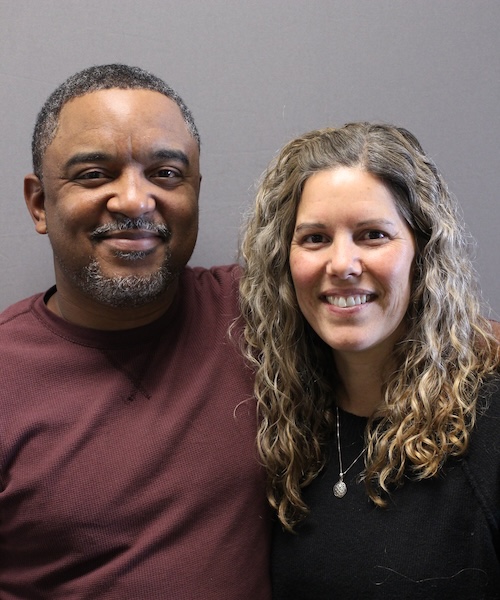
Finding a Sense of Wholeness: Allie Marshall and Henry Schliff
First Recorded
November 13, 2023
Topics
Read Other Conversations About
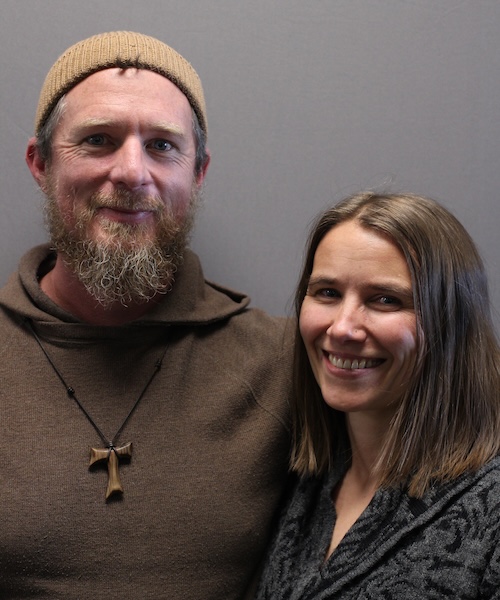
Married couple Allie Marshall and Henry Schliff discuss how the unresolved longing of Henry's childhood eventually led him to find peace in Christianity, while Allie finds wholeness in Buddhist-inspired meditation that reveals her tiny role in an enormous, interconnected universe.
This story was produced by David Dault at Sandburg Media, LLC.
Topics
Read Other Conversations About
Transcript
Allie Marshall: How did you see or experience faith or spirituality growing up?
Henry Schliff: Well, it was both there and not there, I think, because there was an implicit sense of it, which I think at the time I saw mostly coming from my mom. So the spiritual and not religious, I mean, would be the best description, I believe. And yet, I went a very different route and became very religious, in various ways.
But there was a seeker there, particularly my mom, and I think a longing in my dad. I mean, he was a lapsed Catholic. And my mom, I learned later, had been a very devout Methodist. She looked for a lot of different things. She went to Buddhism; she went to yoga philosophy, the Daodejing, Confucianism at one point, I think.
Allie Marshall: How do you see the longing being carried through you?
Henry Schliff: Well, I was looking for something and I couldn't put my finger on it. And the longing, I think, comes from a sense of that there was a lack. And where Buddhism didn't resolve that longing, it remained and it remained.
The next pivotal thing that happened was in Honduras when we went. My mom had died, and my dad and I went on a mission trip, although we were not professing Christians at all. But I ended up on a little hillside there and was reading Autobiography of a Yogi of all books, and it said to seek the face of God. And that's the one line from that book that I remember.
And it connected directly with the early experience and made this kind of continuum, which continued on through St. John of the Cross, and then leading me back to Christ, eventually, or to Christ. Back to Christ is kind of funny, but I guess back to him. It's the only thing that's ever provided any peace in all that longing that I saw both in my parents and in myself.
How has your understanding of faith changed through your life?
Allie Marshall: I think that my interest in Buddhism was very much tied to the quieting of the mind that comes from meditation. My first semi-serious meditation practice was the summer that I lived in Glacier National Park, and so I did all my meditation outside because I was sleeping in a dorm with 30 other people. And it wasn't the larger religious or philosophical underpinnings, although I do still really like the Eightfold Path and some of the attributes that I consider; I don't consider myself a Buddhist. I do think meditation is really helpful.
But I think, in comparison, not good or bad comparison but just as an objective to someone such as yourself who has been constantly seeking, that's where it stopped, in terms of religious paths. And that was in my very early 20s. And I would say that what I found there was a sense of wholeness to something greater that I don't feel any desire or need to name. And the moment that I remember actually feeling that most acutely was, again, that summer in Montana, on a hike where we got high enough for me to realize how little I am in this great world.
And I found that so comforting, to know that I'm just part of this amazing, beautiful, scary, dangerous, wonderful... I think climate change is this awful thing that we face as humanity, and war and hatred are these awful things that we create for each other. But when I remember that I'm part of this little speck, then I'm not alone. And all of those things seem overwhelming, but not in a way that is quite as awful.
And maybe that's how I conceive of God, because it's almost like, when we were thinking about questions for today and we were talking about that question, my flippant answer was, "Well, I don't." And I was like, "Well, if I unpack what I mean, to what..." I don't think about it, because it's not something I feel like I need to. It's not a question. I'm not longing for that question because that part of me is filled when I remember that I'm this tiny little speck on the side of a mountain.
And I know that we have fundamental differences. But at the end of the day, I still wholeheartedly believe that we're all people who want to be loved and appreciated and cared for.
Henry Schliff: And we all have a human heart.
Other Conversations About Boulder, Colorado
0:00/0:00