


Stepping Into the Story: Brian T. Johnson and Dorothy C. Bass
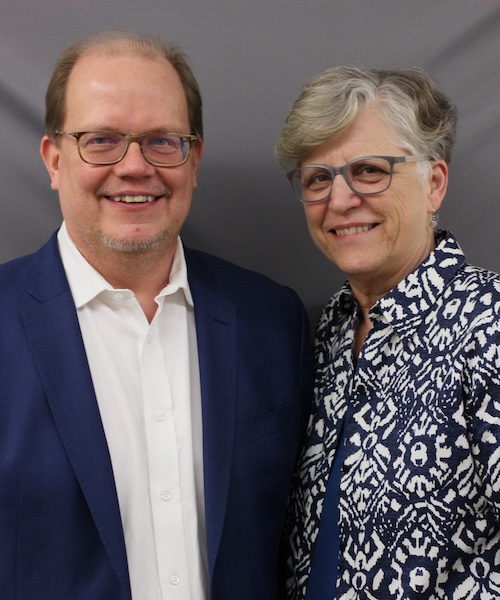
Rev. Brian T. Johnson interviews his friend, Dr. Dorothy C. Bass, about the importance of physicality for her spiritual practice and how understanding the long history of religious practice can help followers critically examine their traditions while preserving what is meaningful and valuable.
This story was produced by David Dault with Kristen Balzer at Sandburg Media, LLC.
Topics
Read Other Conversations About
Transcript
Dorothy C. Bass: I knew the theories of worship and baptism and all this, but it really blew me away to see colors and to have people moving around the worship space, including the worshipers, and to have communion every week and to just participate with our bodies. And that helped me towards a transformation where the life of faith was not so much a head thing, but a body thing, a thing that comes out through your hands and you're flushing and all kinds of body things. The idea of actually stepping into the story of what God is doing in the world with your body and with colors and with stories, that's more vivid to me in a tradition like the Lutheran tradition.
Brian T. Johnson: That is just a lovely image, this idea of stepping into the story because it's about real people and real places and real time. One of my first introductions to you was in a library because I pulled off a book by Dorothy Bass and it had to do with practicing faith. Can you say a little bit about that?
Dorothy C. Bass: Yes. And I should say, I don't think that I naturally exude this stuff. I think it has grown in me over the years, but it's not like some natural gift.
Brian T. Johnson: No.
Dorothy C. Bass: No. I think one reason I love liturgical participatory worship so much is that I really need other people to help me along in the life of faith. I am not so good at just keeping it all straight together by myself, but it's really important to me to share that with other people and to be encouraged and actually to encourage them. I'm a person who likes to sing with other people and eat with other people and greet them in their hands and hugs and all that. So I think that one reason my academic work began with being a student of history is that I really feel like I'm joining something that's long, that I don't have to make up the answers.
At the same time, there's a lot of wickedness and brokenness and failure in that historic thing that we have inherited into which we step. So figuring out how to critique while you're embracing, how to confess the wrong while you become open to that which is good and right, and to be part of a community that's doing that together. And the tradition and the liturgy itself includes things that help us to be self-critical and that help us to move beyond the failures of what we have received and what we do. We have the prophets, we have the confession of sin, and we have a whole host of ways of checking things out with each other that we need to keep doing. I need other people to share this with. I really do. And I'm grateful that I've been given a call in a sense to be at work to help other people figure this out.
In the nineties when we started this, the mainline churches were declining. There was a lot of sense of loss and crisis in the churches. And yet there was this manifest spiritual hunger. And what we tried to do, we tried to give people a door into Christian faith that did not start with great, big, hard, abstract ideas. As you join this community of practice, we're going to get to those questions. But to invite people into a way of life, come on in and help us practice hospitality to the poor. Come join the work that God is doing in the world and see how it fits. And then we can have conversations. A lot of the people who heard this invitation were already churchgoers who had forgotten what it really could mean to take on the way of life that opens up to what God is doing in the world.
And to do that within the frame of an ongoing argument about what all this means, that God came to be with us in this way is very exciting. And it goes back a long time and it's going to continue. And yes, it's going somewhere. It's really hard to be hopeful these days, but I think that knowing that we live into a promise that's not concrete in a certain way, but that our own failures are not the last thing to be said about us or about the world and that life is stronger than death, I think is helpful. We really need that at this moment as we do the hard, gritty, critical work of living in twenty-first century America.
Other Conversations About Valparaiso, Indiana
0:00/0:00