


Faith Can Be Fluid: Maria Autrey and Jean Molesky-Poz
First Recorded
November 1, 2022
Topics
Read Other Conversations About
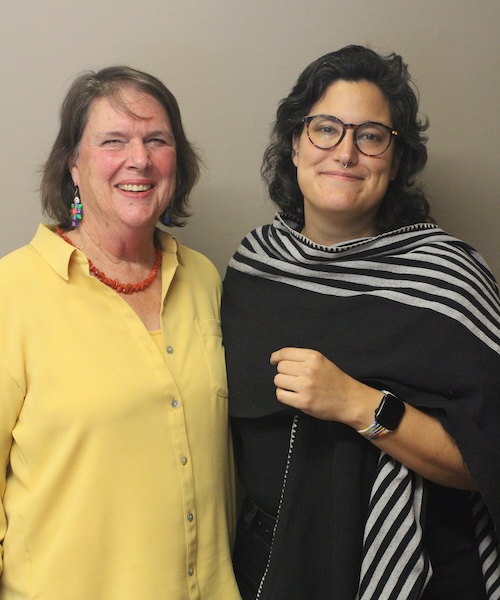
New acquaintances Maria Autrey and Jean Molesky-Poz reflect on the ways Indigenous spirituality emphasizes mutuality and how expressing that spirituality in combination with queer identity disrupts Catholic conceptions of linear time.
This story was produced by David Dault at Sandburg Media, LLC.
Topics
Read Other Conversations About
Transcript
Maria Autrey: For me, what I've experienced is this idea of belonging to each other, of being in community with our fellow humans, but also with the earth, with the plants, with the mountains, with the wind, with the four directions, with the universe. And it's just this mutuality that I think it shows up in so many things, in how we live our spirituality, in our language.
Jean Molesky-Poz: I think in the West we talk about the worldview and it's very anthropological. In other words, the humans are very much the center. But when you look at Maya worldview, or cosmovision, it has to do with all of created reality. It has to do with the cosmos. And so their sense of being immersed, as you said, in this community of every living creature is to connect to the center in which we trust. And so the center is both within their hearts and into the center of the universe. According to the Maya creation story, humans were created to be givers of praise and thanks to the gods. And second, to be providers and nurturers for one another.
Maria Autrey: I remember my mom sharing how, when two cultures came together with the evangelization of the Catholic Church, of how in many senses, some communities grabbed what made sense and merged it with their own traditions and with their own gods and with their own thinkings. And that was the first time I saw that approach to, "Oh, the ways we live our faith can be fluid. They don't have to be one single thing." I remember going to San Juan Chamula, and just like, it was a Catholic Church. There was a priest, but there were also, I don't know the correct word, but there were also sacred men and women doing their thing. There were some people praying to a saint, some others offering Coca-Colas to an idol. Everything under the same roof, which I found beautiful. It can overcome even the most violent of colonialism. And it's still here and it's still some places thriving even, if not surviving.
Jean Molesky-Poz: So I want to ask you how your experience with indigenous rituals or spirituality has informed your own experience as a Catholic woman.
Maria Autrey: Wow, that is a very good question. I think for me is this idea of finding the fluidity and the connectedness. I think I keep going back to the community of religion, and something that we are building and we're believing and we're doing together with others. That is sometimes hard to find in Western or structured spaces. A lot of things in the Catholic Church have set a timing of the human life. So you have the sacraments that are very time-rooted, when you're born, when you become of age, when you get married, when you are older, when you're dying. It's very time-rooted in our lifetime. And it's marking how we grow. And being both queer and being in indigenous spaces, this understanding of time gets disrupted. So as a queer person, we have a lot of childhoods. We sometimes end up having a second adolescence in our 30s or 40s because we couldn't have that space as our full selves when we were kids.
And I think right now we're seeing a lot of that as well with communities regaining their indigenous roots, that they're learning, out of time, a lot of things. And I think just this conscious understanding has really informed how I relate to my Catholic faith and uncoupling that set of a linear time and journey that we have as people through the sacraments to saying, "Well, maybe it can happen with another set of time, within other benchmarks, with other ways of being." But they have also been instrumental in a lot of social justice, equity, bringing down governments, unjust governments, unjust systems. And I think that's where I find my faith.
Other Conversations About Santa Clara, California
0:00/0:00