


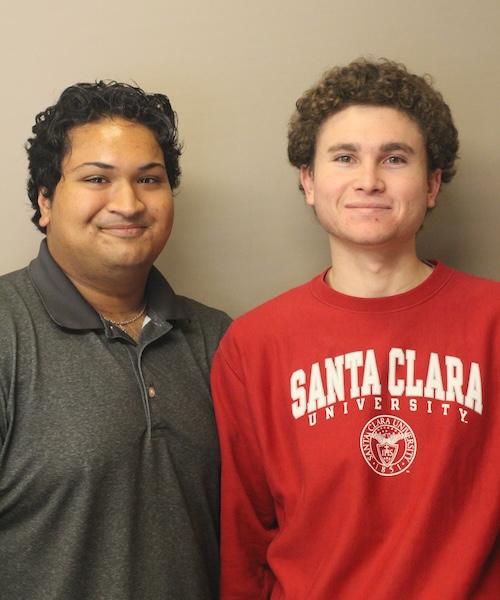
Faith Is Not Trendy: Daniel d'Abreu Noronha and Alejandro Eros
First Recorded
November 1, 2022
Topics
Read Other Conversations About
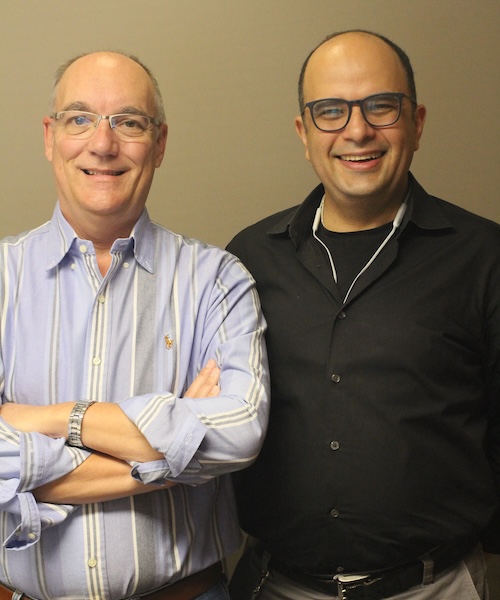
Friends Daniel d'Abreu Noronha and Alejandro "Sasha" Eros share the practices that connect them to their Catholic faith and how they wrestle with faith and doubt when confronted with religious skepticism and past atrocities committed by the Catholic Church.
This story was produced by David Dault at Sandburg Media, LLC.
Topics
Read Other Conversations About
Transcript
Daniel d'Abreu Noronha: As I got into high school, I started getting very involved with my parish and specifically music ministry at my parish and youth ministry. I started to tie faith more deeply into it, and I started to learn other instruments too, like guitar and bass and drums, and I was able to apply that in a way that was more spiritual where... I guess through some of the mentors that I met, especially one of my music mentors, who was my music director in high school and at the parish that I attended, and he shaped a lot of my relationship with music and my religion, and then that's why I wanted to go to a Catholic university where I could continue to practice that music and we can build ministry in that way.
Alejandro "Sasha" Eros: Yeah. I don't think you'd get that at a secular school.
Daniel d'Abreu Noronha: I went to a public high school. Not that it was explicitly anti, but definitely being Catholic in a public school, you get challenged a lot in terms of, "Why do you go to church? Why do you believe? Why do you believe that?", and I never really had a right answer, because even today I do struggle with what does it mean for me to be Catholic and go around saying that. Maybe I wouldn't be so much a Catholic if I wasn't so into music or if I couldn't resonate with prayer in that musical way, but down to the core for me, the reason why I stay with Catholicism is because it's my way of having a community. I don't have to resonate with every single teaching. I just have to know that the community that's there is doing good in the world, and that's what I resonate with the most. The biggest thing for me is I'm Catholic. I will say that culturally, I'm Catholic. I will go to mass as a musician, and I will say I don't know. That's the biggest thing.
Alejandro "Sasha" Eros: I don't know if you experienced this. I'd be curious, but it's almost embarrassing sometimes to tell people who are not Catholic that I'm Catholic, because it's like, "Oh, you believe in God? That's so dumb." We've moved past that, and then also like, "Oh, you're in the Catholic church. Haven't you heard about all of the atrocities that the church has committed?"
Daniel d'Abreu Noronha: I think it depends on the setting. Definitely in high school, I wouldn't walk around saying I'm Catholic. If somebody asked me, I'd be like, "Yeah, absolutely," but definitely it is looked at with distaste to be a part of the Catholic church because of the atrocities that have happened in the past, because of what you see in the news and hear in the news, because of how priests are viewed in modern day right now, and I know a lot of priests and I consider a lot of them my friends, and for somebody to say like, "Oh, do you know this priest? Has he done anything to you?", and I'm like, "Well, absolutely not," but I understand where you're coming from because you don't know, but it is very real that things are going on. So that's part of the struggle.
I think it takes a lot of energy to be part of the church and in a world where it's really easy to disassociate, because a lot of people can find comfort and happiness in other things. What do you think, Sacha?
Alejandro "Sasha" Eros: Yeah. Faith is hard work, and it's not trendy. It gives you happiness, but it's more of an enduring long-lasting happiness rather than a rewarding sort of dopamine kick. So it's delay of gratification, and then there's also increased awareness of religious trauma, I think. Especially because of social media, people will post about their religious experiences. I think more often, people will post that they have a negative experience than they have a positive experience.
Daniel d'Abreu Noronha: Yeah. I think another kind of turnoff to religion is that we don't have all the answers, and even if you go talk to a priest who's supposed to be an expert, they don't have all the answers either for the most part, and something that's frustrated me as well is I've gotten a response, which is, "Oh, well, my child, that's the mystery of our faith."
Alejandro "Sasha" Eros: Yeah. It's very frustrating that we can't know everything.
Daniel d'Abreu Noronha: I can say very personally, I don't understand majority of our religion, but I can still be a part of it and feel comfortable with it in some ways despite that. At the end of the day, I don't really care about the details so much. What I do care about is, do I feel like I'm learning how to be a better person? Do I feel like I'm being inspired to go out, promote change in my community? Do I feel like I'm bringing peace to other people through it? And if I am, that's why I'm there, but at the end of the day, it's just, "Are we good people?", is what I'm getting at.
Alejandro "Sasha" Eros: Yeah. You sound like an agnostic Catholic, almost.
Daniel d'Abreu Noronha: Well, I try to be, but...
Alejandro "Sasha" Eros: I kind of consider myself almost an agnostic Catholic.
Daniel d'Abreu Noronha: Interesting.
Alejandro "Sasha" Eros: Not that I have lack of belief, but that I accept that I'm probably wrong about most things.
Daniel d'Abreu Noronha: Well, that's the view that I want to take as well, which is... I don't know what's going on. That's what I'm going to kind of go at. So if we can just approach it in a positive light, then that's the way to go.
Alejandro "Sasha" Eros: Yeah.
Other Conversations About Santa Clara, California
0:00/0:00