


Faith as a Guiding Light: Tesenga Smith and Tony Smith
First Recorded
October 31, 2022
Topics
Read Other Conversations About
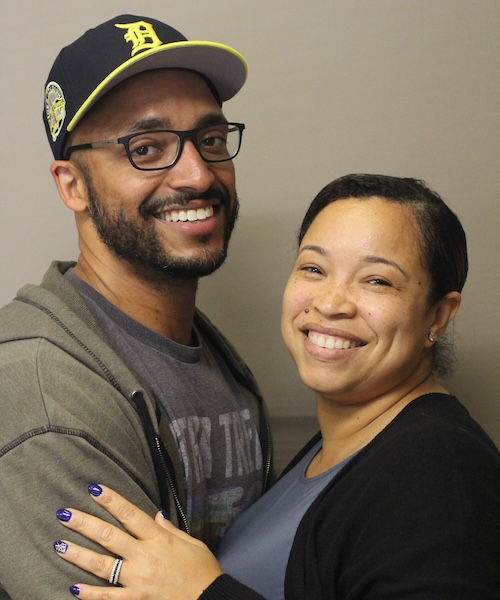
In a conversation with his wife, Tesenga "Shá" Smith, Tony Smith contrasts his father's Seventh-day Adventist church with his mother's African Methodist Episcopal congregation, recalling how their profoundly different ways of expressing faith impacted his childhood.
This story was produced by David Dault at Sandburg Media, LLC.
Topics
Read Other Conversations About
Transcript
Tony Smith: So we grew up African Methodist Episcopal, so AME. Early on, my father went to the church with us, but later he went through some stuff. He was in a really low point in his life, and he reconnected to his faith that he grew up with. It was through his faith, through his connection to his faith that he grew up with, that he was able to come back from the brink, and that was at this Seventh-day Adventist. It was initially a white church, like a super white church. We were the first Black family, and there were a few Filipino families. But the experience beyond the demographic of it, the way that they worship, it couldn't have been more starkly contrasted.
So in my mother's church, it's an AME church, it's very lively. They put a lot of emphasis on the praise part of praise and worship. They have the instruments, there's the music, and people are really into it, and the sermons and the preachers are very expressive, even animated at times. It's just a different type of experience. A lot more energy, a lot more life, you might want to say.
Tesenga Smith: Yeah, I would say a lot more exhortation. Then I would say the Seventh-day Adventist was to me more of a teaching ministry.
Tony Smith: Yeah. As a kid though, the way I looked at it then, Mom's church was loud. Dad's church was quiet. Mom's church was Black. Dad's church was white, and his church, they had... So it was a Seventh-day Adventist church. They had certain rules or things that they followed. For example, they followed the dietary prescription of Exodus. I think it was Exodus where it's like you don't need meat of, what is it, animals that don't chew cud or have a cloven hoof. But basically it excludes pork.
Tesenga Smith: And seafood.
Tony Smith: And seafood. Yeah. They followed the Sabbath and keep it holy. The Sabbath being Saturday, we couldn't watch TV because they didn't do that.
Tesenga Smith: So it was Friday sundown to Saturday?
Tony Smith: Yes. Yeah, exactly. So when my father reconnected with his church, my mother kept going strong with hers, and so there was a split. There was a rift. So my mother wanted us to keep going to church with her, and my father said, "No, they should be coming to church with me." So we went to church on Saturdays. That was how we did things for a number of years. I think ultimately my mother won out because Dad finally just relented until we got a little older, and we just went to my mom's church. They said, "As long as you go to one of them, you'll be fine." As we got little older there were activities and things that we wanted to do on Saturdays. Play sports, watch TV. So we're not going to choose that one.
But I'll say though, there's certain pieces of that... I mean, I still carry that with me, that experience, like you said, as a teaching ministry, and to focus more on a different way of expressing their faith. It was more within, quieter. It wasn't as outward. Me and my two older brothers, we're naturally shy about expressing our faith and being very outward. So that actually was a better match for my dad's church. So when we were at my mother's church, we often didn't participate as fully as my mother would've liked, and that was a point of consternation. So she'd be like, "Well, y'all are standing up." I just didn't feel comfortable doing that.
So long story short, we ended up settling into this state. I guess our stable state long term was just go to Mom's church, but we still carried the spirit of my father's Seventh-day Adventist Church. So growing up in Mother's church, they were super active in the community with stuff. They had fish fries or feeding people, but they also had resource centers for homes for women who were coming from abusive situations, battered women. They had events where you're getting clothes and food and backpacks for homeless. But it was a larger church. It wasn't megachurch level, but it was a bigger church. It wasn't megachurch level. It was a step below that. But they were really active in the community. But at the same time, some of the seeds were sown in my challenges with religion in general, just because you would see how well off the pastors were doing.
But this isn't a church that situated in an area... I mean, this is on the west side of Detroit, but it's still, they were living pretty high on the hog relative to the average parishioner. So it was difficult for me to reconcile that with a lavish lifestyle with some of the stuff that I was hearing about in Sunday school. But I will say though, even though I have questions, I wouldn't call it crisis of faith, but I've definitely changed my perspectives on who God is and what He does or doesn't do. I still think faith is important. It's important to have that as a guiding light through this human experience.
Other Conversations About Santa Clara, California
0:00/0:00